Lifestyle Design
What Is a Lifestyle Business? A Plain Answer
By Beyond Growth · 14 November 2026

What is a lifestyle business? A business run mainly to support a life and an income you chose, not to grow as large as possible or to be sold. You decide how much is enough, and growth is optional. A venture-backed startup is the opposite deal: outside money in, fast growth required. Most American businesses have no employees at all, but being small does not make a business a lifestyle business: the purpose does.
Search for "lifestyle business" and you will find two moods. One is a laptop on a beach. The other is a shrug: a business that is not ambitious enough to be a real one. Both miss the plain meaning, which is more useful than either. This page gives the definition, the contrast with a startup, how common the one-person business is, and an honest answer to whether a business built around your own life can also do some good for other people's. It sits inside our wider coverage of lifestyle design.
What is a lifestyle business?
A lifestyle business is a business whose job is to pay for a particular way of living. The owner starts with the life (hours, place, the monthly number it costs) and the business is sized to fit it. When it brings in enough, it has done its job. There is no obligation to double it next year, hire a team or sell up.
That is the whole definition, and it has three consequences. The owner usually pays for the beginning out of savings or early customers, because nobody invests on the promise of "enough". Success is measured in income you keep and time you control. And the business can be any size, because the test is the purpose, not the headcount: a one-person workshop and a twelve-person studio can both be lifestyle businesses if their owners are running them to support a life rather than to chase a sale.
In May 2010 Klint Finley published an essay on this site asking whether lifestyle design could be turned towards social problems, and proposing a tentative definition of lifestyle design as building "lifestyle businesses". This is a fresh essay on the same question, written sixteen years later and in our own words.
How is a lifestyle business different from a startup?
The difference is who paid, and what they expect back. A venture-backed startup takes money from investors who are betting on a large outcome, usually a sale or a stock-market listing, and the company is run with that goal in mind. So growth is required, and the owner's own preferences about hours and place come second. A lifestyle business answers to the owner and the customers.
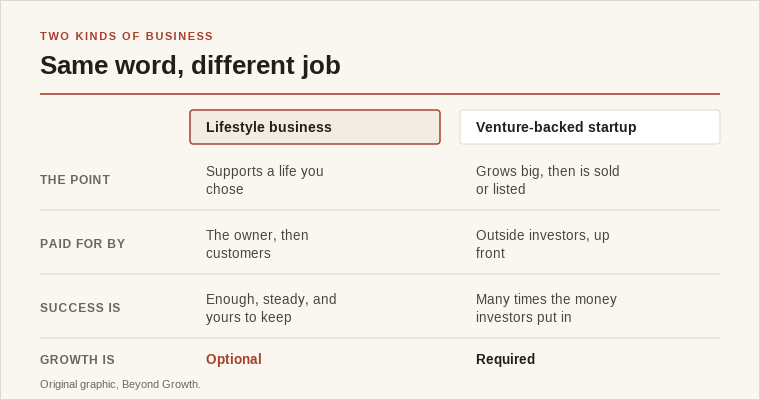
Neither is better. They are different bets, and mixing them up is where people get hurt. A founder who takes investors' money while privately wanting a calm four-day week has signed up for the wrong game. A founder who runs a steady business and feels like a failure because it is not a "unicorn" has measured themselves against a game they never entered.
What does "scalable" have to do with it?
You will often see lifestyle businesses described as "scalable", and the word is doing two jobs. Nassim Nicholas Taleb, in his 2007 book The Black Swan, separates "scalable" from "non-scalable" work. Our plain-terms version of the idea: some work pays you for your hours, so your income is capped by how many hours you can physically work. Other work pays you for what you have made, so the same effort can reach a handful of buyers or a vast number of them. Hourly work is the first kind; a book that anyone can buy is the second.
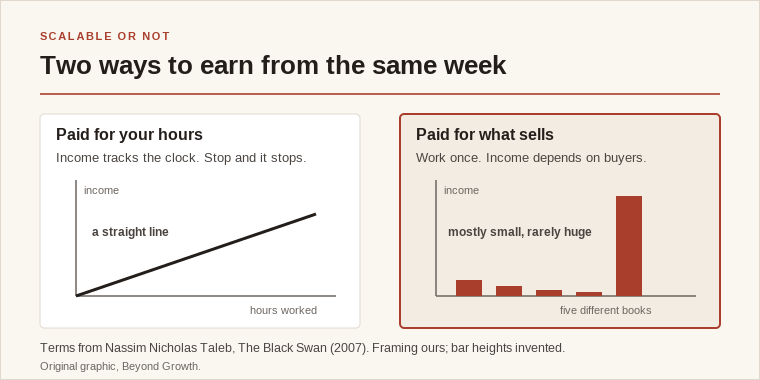
Here is why this matters for a lifestyle business. The "paid for what sells" kind sounds like the dream: work once, earn while you sleep. But the picture on the right is the honest one. Most of the bars are short, and a few are very tall. Our own reading of the picture is that income from work like this is uneven, so it is a risky thing to bet your rent on. Plenty of good lifestyle businesses are the plain kind: a trade, a practice, a specialist service, where you are paid for your hours at a rate high enough to make them enough. The right question is not "is it scalable?" but "does it reliably pay for the life I described?"
How common is the one-person business?
Very. The US Census Bureau counts "nonemployers": businesses with no paid employees, subject to federal income tax and with receipts of $1,000 or more ($1 or more in construction). In its 2022 data there were 29.8 million of them, against 8.3 million employer businesses. The Bureau adds that most nonemployers are "self-employed individuals operating small unincorporated businesses, which may be the owner's principal source of income".
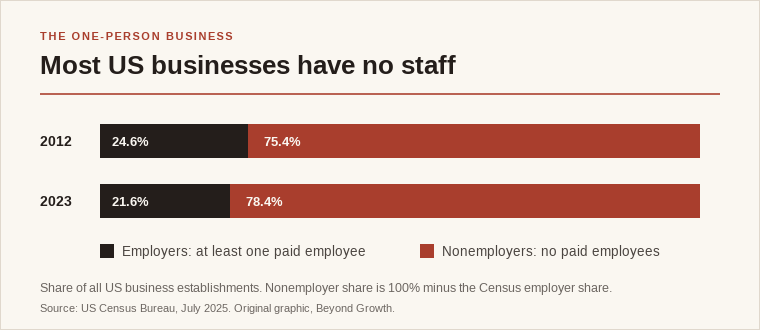
The Census analysis of the 2023 data shows the trend: employers' share of all US businesses fell from 24.6% to 21.6% between 2012 and 2023, and the number of nonemployers grew by an average of 2.7% a year against 1.1% for employers. The Bureau published its 2024 figures in September 2026; we have quoted 2022 and 2023 because those are the numbers we could read in full from the Bureau's own write-ups.
One caution, because this is where lifestyle-business articles tend to overreach. "Nonemployer" is a tax category, not a lifestyle. It covers a plumber who wants to grow, a driver, and someone with a weekend stall, and it says nothing about whether the owner chose the arrangement or wanted it. What the figure does tell you is that running a business with nobody on the payroll is not an eccentric path: it is the ordinary shape of American business, and it has been getting more common.
What are the common myths?
| Myth | Fact |
|---|---|
| A lifestyle business is a business that is not serious. | It is serious about a different goal: enough income, on your terms. |
| It has to be online and run from a beach. | The test is purpose, not location. A workshop is as good an example as software. |
| "Scalable" work is always better. | Its income can be very uneven. Hourly work at a good rate is a sound base. |
| One person means a lifestyle business. | One person is a tax category. The owner's purpose makes it one. |
| It cannot do any good beyond paying the owner. | It can, through how it treats people. A formal social purpose is a separate, deliberate choice. |
Can a lifestyle business do social good?
Yes, but be precise about how, because the claim is easy to inflate.
The first way is ordinary and mostly invisible: how the business behaves. It prices honestly, pays suppliers on time, refunds without a fight, and does not squeeze its owner into burnout. A business built around a sustainable life tends to have the time to behave this way, which is a real advantage over a company under pressure to hit a growth target. We do not have evidence to say lifestyle businesses are more ethical than other businesses, and we will not pretend otherwise. The point is only that the structure does not get in the way.
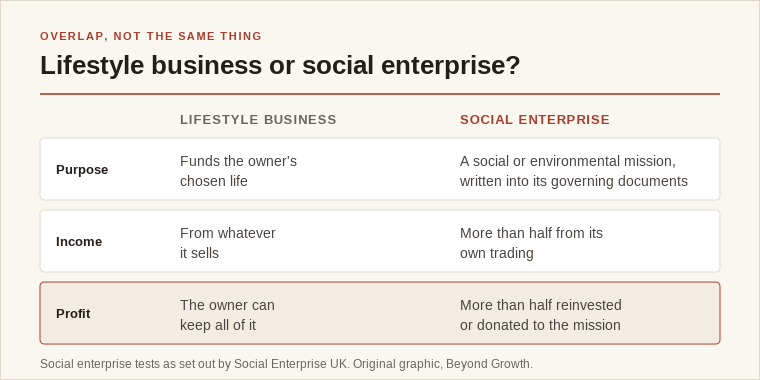
The second way is to build the purpose in. The term for this is social enterprise, and it has tests. Social Enterprise UK says that to be identified as a social enterprise a business must have a social or environmental mission set out in its governing documents, "generate more than 50% of their income through trade" (it usually allows two years to get there), see "more than 50% of the organisation's profits" reinvested or donated to the mission, and be owned or controlled in the interest of that mission rather than by one individual. That last test is the sharpest contrast with a lifestyle business, which is usually the founder's to control. In the UK there is also a legal form: a community interest company must satisfy the Regulator that a reasonable person might consider its activities are carried on for the benefit of the community.
Those tests show the trade-off. A social enterprise gives up much of the owner's freedom to take every pound of profit, which is part of the point of a lifestyle business. So the two overlap rather than coincide. Some owners will run a plain lifestyle business and give time or money generously out of their own pocket. Others will choose a social-enterprise structure and accept a lower take. Both are fair choices. The mistake is to claim the label without the structure, or to assume that wanting a good life is itself a contribution to the world.
How do you decide whether you want one?
Ask three questions. What does a good year cost you, in a real number rather than a dream? Would you rather own all of a business that is enough, or part of one that might be very large? And what would you want to be true of how the business treats other people, written down before you are busy? If you can answer those, you know more about your own lifestyle business than most definitions will tell you.
For the rest of our thinking on this, start with the lifestyle design hub, read the lifestyle design unmanifesto for the six plain rules, and see why every lifestyle designer looks the same for what the genre gets wrong.