Lifestyle Design
17 Steps to Instant Success as a Lifestyle Designer
By Beyond Growth · 13 July 2026
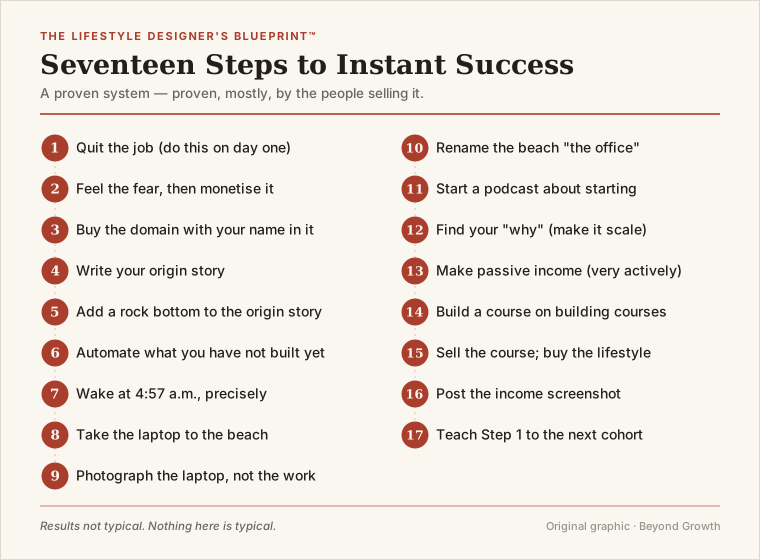
Every few years the personal-development industry produces a new kind of person: the lifestyle designer. He does not have a job. He has a system. He works four hours a week, from a hammock, and spends the remaining hours teaching other people how to work four hours a week from a hammock. It looks effortless, which is the entire product.
What follows is the complete method, reverse-engineered from roughly a thousand launch emails. Follow all seventeen steps in order and success is not merely possible — it is, we are repeatedly assured, instant.
Step 1. Quit the job (do this on day one)
Before anything else, quit. The system cannot begin while you still have income, health insurance, or a reason to get out of bed that someone else is paying for. Burning the boats is essential; it also makes a far stronger origin story, which you will need shortly. If you have dependents, do not describe them as dependents. Describe them, later, as your why.
Step 2. Feel the fear, then monetise it
You will feel afraid. This is not a warning sign. It is inventory. Every anxiety you have — about money, about mornings, about whether any of this is real — is a market. Name the fear, record a short video about overcoming it, and sell the video to people who have the same fear and have not overcome it either. You are all in this together, financially.
Step 3. Buy the domain with your name in it
yourname.com is the foundation of the empire, chiefly because it costs nine dollars and feels like progress. Put the words official and coaching somewhere on it. The business does not exist yet, but the website will imply that it is thriving, and implication is roughly ninety per cent of the work.
Step 4. Write your origin story
Nobody buys a course. They buy a transformation, and a transformation needs a before. Draft the story of who you used to be: tired, trapped, commuting, spiritually beige. Keep it vague enough to feel like the reader's own life and specific enough to seem true. You are not lying. You are positioning.
Step 5. Add a rock bottom to the origin story
A good origin story needs a night on the floor. If you have not yet hit rock bottom, lower the floor. The moment of despair is load-bearing: it is what makes four hours a week feel earned rather than merely inherited, lucky, or, most likely, not actually happening.
Step 6. Automate what you have not built yet
The dream is passive income, so speak only in the language of automation — funnels, pipelines, systems that "run while you sleep." Do not mention that building the automation is a full-time job performed very much awake, often at the expense of sleep. The customer is buying the sleeping. They are not buying the building.
Step 7. Wake at 4:57 a.m., precisely
Not 5:00. 4:57. The oddly specific number signals discipline and hints at a protocol you will fully explain in Module 3. What you actually do between 4:57 and dawn is unimportant, and honestly none of it will be work. That you woke up then — and posted about it — is the deliverable.
Step 8. Take the laptop to the beach
Location independence must be visible or it does not count. Relocate the laptop to sand. Ignore the glare, the heat, the grit in the ports, and the well-documented fact that no serious work has ever been completed within earshot of surf. The beach is not a workplace. It is set dressing.
Step 9. Photograph the laptop, not the work
Frame the shot carefully: open laptop, single coconut, unbroken horizon. Crucially, angle the screen away from the lens, because there is nothing on it. You are not selling the work. You are selling the view of the work, which is considerably more valuable and requires no work at all.
Step 10. Rename the beach "the office"
Language is leverage. The beach is now "the office." Wednesday is now "a Tuesday, technically — who's counting." The nine-to-five that funded all of this until eleven days ago is now "the matrix." Rename enough things and the absence of a functioning business begins to feel, convincingly, like a lifestyle.
Step 11. Start a podcast about starting
Interview other lifestyle designers about how they became lifestyle designers. This generates content, credibility, and the warm sensation of belonging to an industry — all without any of you having built a single thing a stranger would pay for. Cross-promote generously. The audience, for now, is mostly each other.
Step 12. Find your "why" (make it scale)
Every guru has a why. Yours should be emotional enough to move a room and abstract enough to survive being attached to whatever you decide to sell next quarter. "Freedom" works. "Impact" works. Avoid any why so specific that it commits you to actually doing one particular thing for anyone in particular.
Step 13. Make passive income (very actively)
Passive income is produced by answering support emails at midnight, patching the funnel that broke on launch, refunding the furious, and relaunching the thing that did not sell the first time. It is the most active labour you will ever perform. Continue calling it passive. The word, remember, is the product.
Step 14. Build a course on building courses
Here is the master move — the one the entire system quietly bends toward. Once you have made a little money, or convincingly implied that you have, package the making of that money into a course. The course teaches people how to make courses. You have now located the only reliable revenue in the genre: selling shovels to the people who bought your map.
Step 15. Sell the course; buy the lifestyle
Use the course revenue to fund the beach, the 4:57 mornings, and the photographs — all of which become the marketing for the course. The lifestyle sells the course; the course funds the lifestyle. Nothing is produced or consumed outside this loop, and that is not a defect. That is the machine, running exactly as designed.
Step 16. Post the income screenshot
Screenshot a good month. Blur nothing that flatters you. Do not mention the three bad months, the refund requests, or the small technicality that the "income" is other people's tuition for learning to do precisely this. A screenshot is testimony, and testimony has never once been required to come with a balance sheet.
Step 17. Teach Step 1 to the next cohort
Finally, find someone tired, trapped, and commuting — spiritually beige — and tell them to quit their job. Sell them the seventeen steps. In time, they will sell the seventeen steps to someone else. The system is now self-sustaining, fully location-independent, and — this is the real genius of it — powered entirely by the shared belief that it works.
Alright. Dropping the act.
The joke only lands because the shape is real: a genre that sells the appearance of a business — the mornings, the beach, the freedom — far more dependably than it builds one, and whose single most reliable product tends to be a course about selling courses. Tim Ferriss wrote a genuinely useful book about questioning why we work the way we do; the archetype that grew up in its wake too often kept the aesthetics and quietly deleted the part where you make something a real person actually needs.
There is nothing wrong with wanting freedom, or slow mornings, or work that can travel. There is a great deal wrong with a business whose only customer is the next person hoping to run the same business. If you want the unglamorous version — the one where you find out what genuinely produces a result and then go and do it — that is the whole of our method.