Personal Development
Get a Growth Mindset (Or: What the Research Actually Shows)
By Beyond Growth · 14 July 2026
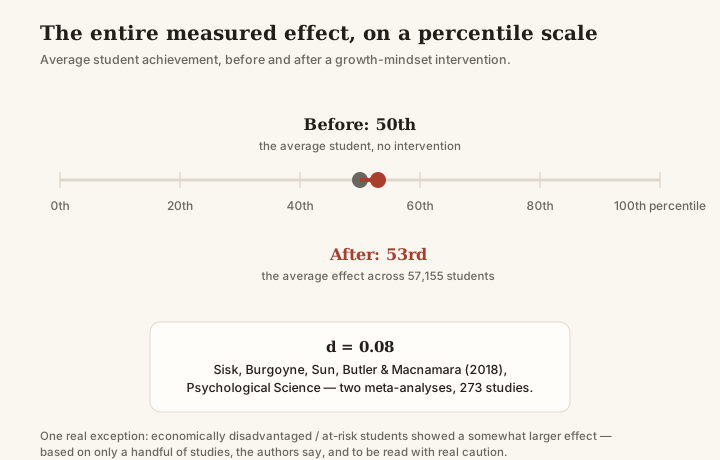
Does "growth mindset" actually work? The underlying idea — that believing your abilities can develop through effort changes how you respond to setbacks — is real, peer-reviewed psychology, not a hoax. But the largest studies ever run on it, covering hundreds of thousands of students, found the average effect of a growth-mindset intervention on academic achievement is tiny: d = 0.08, equivalent to nudging the average student from the 50th to the 53rd percentile. A modest, conditional finding — stronger for some disadvantaged and at-risk students, close to invisible for everyone else — got sold to schools and companies as a near-universal fix. Even Carol Dweck, the psychologist who discovered it, has publicly said the popular version schools actually use is a "false" one.
Growth mindset is one of the few ideas in this whole genre that didn't start as a scam, a stage act, or a wellness fad. It started as careful, peer-reviewed psychology. Carol Dweck, a Stanford researcher, spent decades studying how children respond to failure, and found a genuinely interesting pattern: kids who believed intelligence was fixed tended to fall apart after setbacks, while kids who believed ability could be developed tended to persist. Her 2006 book Mindset: The New Psychology of Success turned that finding into a framework — fixed mindset versus growth mindset — and sold well over a million copies. From there it went everywhere: teacher training days, corporate offsites, parenting columns, classroom posters reading "Not Yet" instead of "Fail."
That is the story growth mindset tells about itself: rigorous science, popularised responsibly. The harder question is what happened when researchers actually tried to measure the size of the effect at scale, across the hundreds of thousands of students who've now sat through a growth-mindset lesson.
| What the popular pitch implies | What the largest studies actually found |
|---|---|
| Growth mindset meaningfully raises achievement | Across 57,155 students, the average intervention effect was d = 0.08 — moving a student from the 50th to the 53rd percentile |
| This is settled, well-replicated science | Over a third of intervention studies never even checked whether the program changed anyone's mindset |
| It works because it changes how students think | Achievement sometimes rose in studies where mindset didn't change, and didn't rise when it did |
| The classroom version schools use reflects the research | Dweck herself has publicly criticised the common classroom version as a "false growth mindset" |
| A short lesson can transform any student | The one large, nationally representative trial found real gains concentrated mainly among lower-achieving students, not across the board |
What the biggest study of growth mindset actually measured
In 2018, Victoria Sisk, Alexander Burgoyne, Jingze Sun, Jennifer Butler and Brooke Macnamara published two meta-analyses in Psychological Science — the largest look at growth mindset ever assembled. The first, covering 365,915 participants, measured how strongly a student's mindset actually correlates with their achievement: the relationship, they found, is weak, and stronger in children than adults. The second, covering 57,155 participants across dozens of intervention studies, measured what happens when researchers actively try to shift students toward a growth mindset and then track their grades, test scores, or GPA afterward.
The average effect size across that second analysis was d = 0.08 — psychology's shorthand for "barely detectable at the individual level." Translated into something visual: it's roughly the difference between sitting at the 50th percentile of your class and sitting at the 53rd. As lead author Alexander Burgoyne put it plainly, "there was little to no effect of mindset interventions on academic achievement for typical students."
There was one real exception worth taking seriously: economically disadvantaged students and those already at high risk of academic failure showed a somewhat larger benefit. The authors' own caution matters here too — only a handful of studies fed that specific finding, so it should be read as a promising lead, not a settled result.
The finding that should worry growth-mindset advocates more than skeptics
Buried inside the same meta-analysis is a detail that gets far less airtime than the headline effect size, and it's the more damning one. More than a third of the intervention studies never verified whether the program had actually changed anyone's mindset at all — they just ran the workshop, then checked grades. Worse: in the studies that did check, achievement sometimes went up in programs that failed to shift mindset, and didn't go up in programs that succeeded at shifting it.
That is not what you'd expect if believing in malleable ability were the active ingredient. It's exactly what you'd expect if something else — a novel activity, extra adult attention, a day out of the normal curriculum, the Hawthorne effect of simply being studied — were doing some or all of the real work, and "growth mindset" were the label being attached to it afterward.
The one large study that found something real
None of this means the concept is worthless, and the fairest complete picture includes the strongest study on the other side of the ledger. In 2019, David Yeager and a large team published the National Study of Learning Mindsets in Nature — a nationally representative trial of 12,490 US ninth-graders across 65 schools, individually randomised to a short online growth-mindset exercise or a control. This is about as rigorous as education research gets, and it found a real effect: GPA improved, months later, for students who received the intervention — but concentrated mainly among lower-achieving students, and shaped heavily by whether the school's broader peer culture already supported a growth mindset. Students who were already getting high grades saw no bump in GPA at all, though they became somewhat more likely to choose harder math classes going forward.
Put the two bodies of evidence together and a coherent, unglamorous picture emerges: growth mindset has a real, modest, unevenly distributed effect, concentrated among students who are struggling or at risk — not a universal lever that lifts every student's performance the moment they hear the pitch.
Even the person who discovered it says the classroom version is wrong
Perhaps the most credible critic of how growth mindset is actually used is Carol Dweck herself. As the idea spread into schools worldwide, she watched it get flattened into a slogan: praise effort, not outcome, full stop. In interviews and in print, she has pushed back hard enough to coin her own term for it — "false growth mindset" — for the version where a teacher applauds a student's effort on a test they failed, without ever helping that student find a better strategy, seek help, or honestly reckon with what isn't working. Dweck's own description of the actual, careful version of her research includes exactly the things the popular poster-and-slogan version leaves out: strategy, honest feedback, and help-seeking, not just trying harder at the same failing approach.
That is a strange position for an idea to be in: the researcher who discovered the effect spending part of her public career correcting the industry that grew up around it.
What to actually take from this
Growth mindset doesn't belong in the same category as earthing or an unverified wristband — the underlying research is real, peer-reviewed, and has produced at least one large, rigorous, positive replication. But "real effect" and "effect the size that's been sold to you" are two different claims, and the gap between them here is enormous: a genuine, conditional, three-percentile nudge for some students got marketed to entire school systems and corporations as a near-universal performance unlock. If you're deciding whether a growth-mindset workshop, book, or classroom program is worth your time, the honest answer from the largest data available is: maybe, a little, for some people, under some conditions — and if the program never checks whether it actually changed anyone's mindset, it's not measuring the thing it claims to be selling you.
Frequently asked questions
Does having a "growth mindset" actually improve academic achievement?
Only slightly, on average. The largest meta-analysis to date — Sisk, Burgoyne, Sun, Butler and Macnamara (2018), covering 365,915 participants for the correlation and 57,155 for interventions — found a weak overall correlation between mindset and achievement, and an average intervention effect size of just d = 0.08, equivalent to moving the average student from the 50th to the 53rd percentile.
What did the largest growth mindset studies actually find?
Mixed, population-specific results. The 2018 meta-analyses found small-to-null effects for typical students, with a somewhat larger (but caveated, low-study-count) benefit for economically disadvantaged or academically at-risk students. Separately, the 2019 National Study of Learning Mindsets, published in Nature, found a real but modest and unevenly distributed effect among US ninth-graders, concentrated in lower-achieving students and shaped by school-level peer norms.
Has Carol Dweck's original research been criticized?
Yes. Over a third of the intervention studies in the 2018 meta-analysis never verified whether the program actually changed students' mindset at all — and, oddly, achievement sometimes rose in studies where the mindset intervention failed to shift mindset, and didn't rise when it succeeded, suggesting something other than the mindset itself was doing the work.
Does Carol Dweck herself agree with how growth mindset is used in schools?
Not entirely. Dweck has publicly criticized what she calls "false growth mindset" — the popular, watered-down version that reduces her research to "praise the effort, not the outcome" and skips the actual strategies, honest feedback, and help-seeking her work says matter.
Is growth mindset completely debunked, like some self-help ideas?
No — that would overstate the case in the opposite direction. The underlying research is real, peer-reviewed, and shows a genuine, if small and conditional, effect for some students. The criticism is that a modest, population-specific finding was sold to schools and companies at a scale and certainty the evidence never supported.
Sources: To What Extent and Under Which Circumstances Are Growth Mind-Sets Important to Academic Achievement? Two Meta-Analyses, Sisk, Burgoyne, Sun, Butler & Macnamara, Psychological Science (2018); Study finds popular 'growth mindset' educational interventions aren't very effective, ScienceDaily, for effect-size figures and the Burgoyne quote; A national experiment reveals where a growth mindset improves achievement, Yeager et al., Nature (2019); Carol Dweck Explains The 'False' Growth Mindset That Worries Her, KQED Mindshift.