Personal Development
Meaninglessness, Nihilism, and the Landmark Forum
By Beyond Growth · 14 July 2026
Does the Landmark Forum actually teach that life is meaningless? Yes — it's a scripted step, not a spontaneous insight. On the second or third day of the three-day course, a trainer leads the room to the stated conclusion that "life is empty and meaningless," and that meaning is something people invent rather than discover. It borrows the vocabulary of real existentialist philosophy while skipping the argument, and it has a documented cost: a federal court found that a woman who went through the same three-day process in 1989 suffered a psychotic break and was hospitalised for two weeks. The "nothing" is real. So is what it's used to sell next.
There is a moment near the end of the Landmark Forum's three days that almost every graduate describes the same way, because it is designed to be described the same way. A trainer, standing in front of a room of 75 to 250 people who have just spent two days taking apart the stories they tell about their lives, says some version of a single sentence: life is empty and meaningless, and that's it being empty and meaningless.
People cry. People laugh. Several first-hand accounts describe the room as electric, cracked open, momentarily undone. Then the trainer explains what it means: since life has no built-in meaning, meaning is something you make up — which means you're free to make up something better than the story you've been stuck with. From nothing, anything is possible. That's the pivot the whole course is built to deliver you to.
It's a genuinely striking piece of theatre. It is also, when you look at where it comes from, what it's built on, and what it has cost at least one real person, considerably less mysterious — and less safe — than the room is told.
| What the room is told | What's actually going on |
|---|---|
| This is a personal insight you arrive at yourself | It's a scheduled step in a fixed, scripted three-day curriculum every cohort is walked through in the same order |
| Realising life is meaningless is a philosophical breakthrough | It restates a century-old existentialist and absurdist position, without the argument, in a paid seminar |
| The exercise is safe because it's "just a distinction," not therapy | It is delivered to a large, unscreened room with no mental-health professional present |
| Feeling "cleansed" or "transformed" afterward proves it worked | The only major funded study found a short-term shift in self-reported control and no lasting change either way |
| The company's techniques have never seriously hurt anyone | A federal court record says otherwise — a participant's psychotic break, 14 days hospitalised, a $501,970 default judgment |
Where the exercise actually comes from
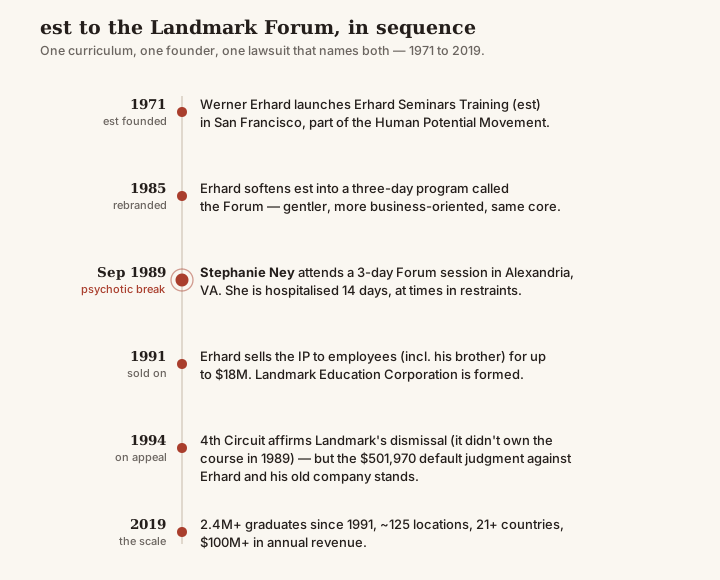
The Landmark Forum did not appear from nowhere in 1991. It is the third name for a program Werner Erhard built in 1971 as Erhard Seminars Training — est — out of San Francisco's Human Potential Movement, on the promise that people are "empowered when they take personal responsibility for all events in their lives, both good and bad." In 1985 Erhard softened and rebranded est into a gentler, more business-friendly three-day course called the Forum. In 1991 he sold the intellectual property to a group of employees, including his own brother Harry Rosenberg, for an initial fee plus payments that could reach roughly $18 million — and that employee-owned company became Landmark Education, later Landmark Worldwide. The techniques, the structure, and the script travelled through every name change largely intact.
By 2019, more than 2.4 million people had gone through a Landmark program since 1991, across roughly 125 locations in 21-plus countries, on more than $100 million a year in revenue. That is a genuinely large number of people who have sat in that room and heard that sentence.
The three days, compressed
The course itself runs three consecutive long sessions — about 39 hours in total — usually to a room of 75 to 250 people. The first day and a half work through a specific distinction: that there is a difference between the facts of what happened to you and the meaning you assigned to it afterwards, and that the meaning is something you made up, not something the event carried in itself. Participants are pushed to see their own long-standing complaints and self-images — what the course's internal jargon calls a "racket" — as a story they've been running on autopilot, not a fact about who they are.
That demolition work is the setup. Once enough participants have stood up and had a personal story taken apart in front of the room, the leader delivers the payoff: if meaning is something you invented, then underneath all your invented stories there is, quite literally, nothing — no built-in significance, no cosmic instructions. "Life is empty and meaningless," in the fuller version some leaders use, "and it's empty and meaningless that it's empty and meaningless." One attendee, writing about his own third day, recorded the line almost verbatim and described his own reaction as being reduced, in the moment, to a feeling of nothingness he called "terrifying, beautiful, and holy."
That is not a slip of the tongue or an unscripted aside. It is the advertised architecture of the course: get everyone to nothing, together, on schedule, so that the next thing you offer them — a "new possibility," created from that nothing — lands as a revelation rather than a pitch.
This isn't a discovery. It's a script with a lineage it doesn't cite
None of the underlying idea is new, and the Forum doesn't pretend otherwise so much as skip past it. Nietzsche spent decades on the death of inherited meaning. Sartre and Camus built entire philosophical careers arguing, rigorously and in public, that existence precedes essence and that a life without built-in purpose is not automatically a tragedy. Those are real, load-bearing arguments, tested for a century against serious counter-argument.
The Forum borrows the vocabulary — meaninglessness, nothingness, invented meaning — and delivers the conclusion directly, on a fixed schedule, to a room that has just spent 30-odd hours having its emotional defences worked over. You are not asked to follow an argument from premise to conclusion. You are walked, as a group, to a feeling, and the feeling is presented as the proof. That is a meaningfully different thing from philosophy, and the difference matters, because a felt conclusion arrived at under pressure in a room of 200 strangers behaves very differently in your head than a position you reasoned your own way into over years.
When it goes wrong: the court record
The clearest evidence that this is not a harmless rhetorical trick is that a federal appeals court has already ruled on a case where it wasn't harmless.
In September 1989, a Maryland artist named Stephanie Ney attended a three-day session of what was then called simply "the Forum," run by Werner Erhard and Associates in Alexandria, Virginia — two years before Erhard sold the business and the same course was renamed Landmark. According to the appellate record in Ney v. Landmark Education Corporation and Werner Erhard (4th Cir. 1994), by the end of the three days Ney "began a process of psychological decompensation" and "had a psychotic break with reality." She was hospitalised at the Psychiatric Institute of Montgomery County for 14 days, medicated, and — the court's own language — "at times strapped to a bed in four-point restraints to prevent her from harming herself."
Ney sued for $2 million. The Fourth Circuit affirmed that Landmark Education Corporation itself was correctly dismissed from the case, on a narrow but real technicality: in September 1989, Landmark did not yet exist as the owner of the course — Erhard and his prior company did. A jury separately found the individual trainer, Ron Zeller, not personally liable for her distress. But Werner Erhard himself was never served and never answered the suit, and a default judgment of $501,970 was entered against him and Werner Erhard and Associates. The court expressed no view on whether that judgment was correct on the merits — only that Erhard had forfeited the chance to contest it.
Read narrowly, that is a case about one specific trainer, one specific session, and a corporate ownership technicality. Read plainly, it is a federal court record stating that the same three-day process — same structure, same architect, same script — produced a documented psychotic break in at least one participant, and that the company built on that script paid, through its founder, more than half a million dollars over it.
The company paid for its own research
Landmark and its predecessors have pointed to research to back the course's effects. The most substantial study is real, but it comes with a conflict of interest stated on its own cover: a 1985 study of 135 participants, funded with $88,000 from Werner Erhard and Associates itself, published as Fisher, Silver, Chinsky, Goff and Klar's Evaluating a Large Group Awareness Training in the Journal of Consulting and Clinical Psychology (1989–1990). Its actual finding was modest — a short-term increase in participants' sense of personal control over their lives, and no measurable lasting change, positive or negative, in self-perception.
That is a long way from "verified transformation." Sociologist and new-religious-movement researcher Stephen A. Kent, who has studied Landmark since the 1990s, put it directly in 2014: the company's pitch is that people need "a new set of values" that Landmark can supply, and "I don't know of any academic research that verifies that kind of perspective." The company-funded study on the record does not verify it either — it measured a brief mood and confidence shift, not the deeper personal transformation the marketing describes.
The pivot: what "nothing" gets sold into
The "nothing" is never left empty for long. The moment a room has been brought to it, the course pivots to "possibility" — the idea that free of your old, invented story, you can now declare a new way of being and take on ambitious goals. That pivot is also where the business model sits. Landmark does not run conventional advertising; instead, as the company's own history of press coverage records, it "repeatedly pressures participants during their courses to recruit relatives, friends, and acquaintances" — described across various outlets as "evangelical" in style, having "a Ponzi taste," and amounting to a "hard, hard sell." The Skeptic's Dictionary reported that in an observed session roughly one in five participants brought a guest they had personally recruited mid-course.
That newly declared "possibility" is also the on-ramp to Landmark's paid Advanced Course and further seminars — priced, as reported at one point, from around $700 to $1,700 on top of the roughly $495 entry fee for the Forum itself. None of this makes the underlying philosophical question fake. It does mean the emotional low point of the course and the sales pitch that follows it are not two separate things. They are staged back to back, on purpose.
What to actually take from this
None of this means meaning is real, or that meaning is fake — that argument was worth having centuries before a company put a price on it, and it will keep being worth having afterwards. The point is narrower and more practical: a felt realisation, engineered on schedule inside a room of 200 strangers with no clinical screening, is not the same event as a philosophical position you have tested against argument over years, and it should not carry the same authority in your life just because it arrived with more emotional force. When a technique that reliably produces intense feeling is followed, every single time, by an invitation to buy something, the feeling and the invitation are not a coincidence. They are the product.
Frequently asked questions
Does the Landmark Forum really teach that life has no meaning?
Yes, in almost those words. Participants are walked through a scripted process, typically on the second and third day of the three-day course, that ends with the stated realisation that life is "empty and meaningless" and that people are "meaning-making machines." Multiple first-hand accounts quote Forum leaders using close variants of that exact phrase.
Is Landmark's "life is meaningless" idea the same as real existentialist philosophy?
It borrows the vocabulary of existentialism and absurdism but not the argument. Nietzsche, Sartre and Camus spent careers building and defending the case for a universe without inherent meaning. The Landmark Forum compresses the conclusion into a guided, scheduled exercise inside a paid three-day course, with no requirement to engage the actual philosophical arguments at all.
Has the Landmark Forum's techniques ever caused serious harm?
Yes, on the public court record. In Ney v. Landmark Education Corp. and Werner Erhard (4th Cir. 1994), a federal appeals court upheld findings that participant Stephanie Ney suffered a psychotic break during a 1989 session of the same three-day course, was hospitalised for 14 days, and won a default judgment of $501,970 against Erhard and his company.
Is there real psychological research backing the Landmark Forum?
The one major published study — funded with $88,000 from Erhard's own company and covering 135 participants in 1985 — found a short-term increase in participants' sense of personal control, and no lasting change, positive or negative, in self-perception. Sociologist Stephen A. Kent has said he knows of no independent academic research verifying Landmark's broader claims about transformation.
Is the Landmark Forum a cult?
Scholars disagree, and Landmark has sued people who used the word. Several sociologists classify it as a "new religious movement"; others note it lacks a single central leader and doesn't isolate members from family, which are usual cult markers. Cult-researcher Rick Alan Ross doesn't call it a cult but does call it harmful, citing the stress and pressure put on largely unscreened participants.
Sources: Ney v. Landmark Education Corporation and Werner Erhard, 16 F.3d 410 (4th Cir. 1994), via Justia, and the case summary on Wikisource; Landmark Worldwide (Wikipedia) for company history, curriculum structure, scale figures and press characterisations; Landmark Forum entry, The Skeptic's Dictionary, Robert Todd Carroll; Creating from Nothing — Reflections on the Landmark Forum, Doug Toft, for first-hand account and quoted trainer language; Evaluating a Large Group Awareness Training (Wikipedia) for the 1985 Fisher et al. study.