Positive Thinking
The 4-Minute Mile and the Myths of Positive Thinking
By Beyond Growth · 13 July 2026
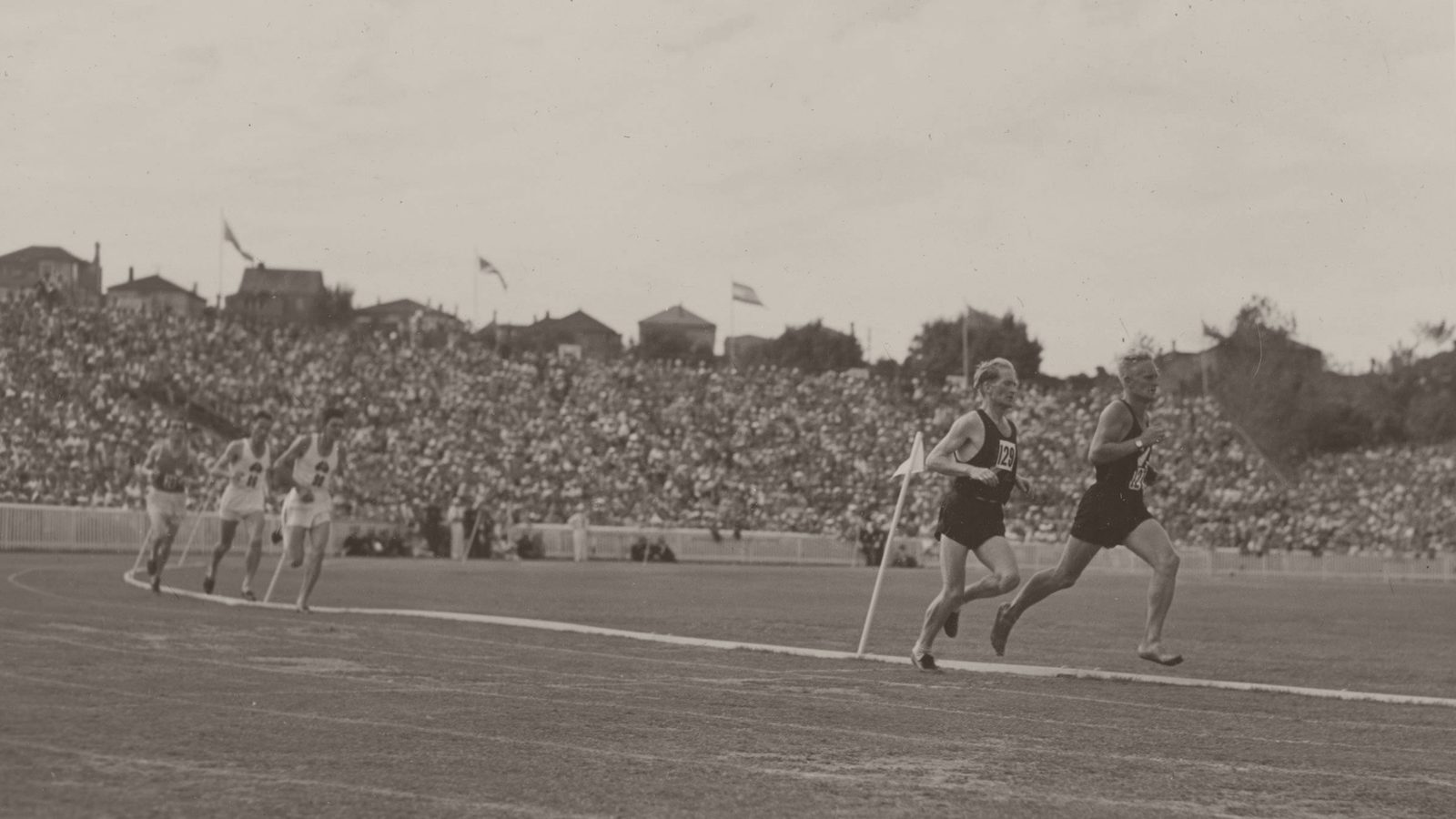
Did Roger Bannister break a psychological barrier? No. The mile record had been falling for forty years and already stood at 4:01.4 — nine years before 1954. There was no medical consensus that four minutes was impossible; that was a press milestone, and Bannister said so himself. And the runners who followed weren't unblocked by belief — they were carried by better training, deeper post-war fields, and the same steady progress that had been lowering the record since 1913.
There is one story the self-help industry tells more than any other. You have heard it, probably more than once, usually from a stage with a headset microphone on it.
For decades, the story goes, everyone knew a human being could not run a mile in under four minutes. Doctors said the heart would burst. Scientists said the body would fail. It was a physical law, a wall. Then on a windy evening in Oxford in 1954, a young man named Roger Bannister simply decided the wall was not real, and ran through it. And here is the punchline, the part the speaker leans into: within weeks, others did it too. The barrier was never in the legs. It was in the mind.
Tony Robbins tells it this way on page 84 of Awaken the Giant Within: that Bannister succeeded "not merely by physical practice but by constantly rehearsing the event in his mind," and that within a single year "37 other runners" broke the barrier too. Hold on to that second number. We will come back to it, because it is wrong, and how it is wrong tells you everything.
It is a beautiful story. It is also, in almost every load-bearing detail, wrong.
The four-minute mile is worth taking apart carefully, not because the runners don't deserve the credit — they do — but because this single anecdote is the keystone of an entire worldview that gets sold back to you at $2,000 a ticket. If the story is false, the worldview built on it is standing on sand. So let's look at what actually happened.
| What the story says | What actually happened |
|---|---|
| Four minutes was a known physical limit | It was a round number in Imperial units, just past a line runners were already near |
| Doctors believed it was impossible or fatal | No medical consensus; a press milestone Bannister himself dismissed |
| The record had stood, unbroken, forever | It had fallen from 4:14.4 (1913) to 4:01.4 (1945) — a steady 40-year decline |
| It stood for nine years because of a mental barrier | It stood because WWII and athletics bans removed the best milers |
| Bannister beat it through belief and mental rehearsal | He beat it with pacemakers, interval training and a physiologist's plan |
| 37 runners followed within a year, freed by belief | One did (Landy). The rest came over years, on better training |
What actually happened on 6 May 1954
Roger Bannister ran 3 minutes 59.4 seconds at the Iffley Road track in Oxford, in a match between the Amateur Athletic Association and Oxford University. He was 25. He was also a medical student who would go on to become a distinguished neurologist, and — this matters — he approached running as a physiological problem to be solved, not a barrier to be wished away.
He did not run alone, and he did not run on faith. Two friends paced him: Chris Brasher took the first two laps at a deliberately calculated speed, and Chris Chataway took the third, so that Bannister only had to find his own pace on the final lap. This was engineered. The whole point of the pacing was to hold an even, optimal split — because Bannister and his coaches understood that a mile is won or lost on pace distribution, a fact you learn from physiology and stopwatch data, not from positive thinking. The wind was strong enough that day that Bannister nearly called the attempt off. He went ahead because the conditions eased, not because he had achieved a mystical state of certainty.
This is the first crack in the parable. The man at the centre of it was the least mystical person on the track. He was a scientist running a well-designed experiment with two collaborators and a stopwatch.
The record was already standing at the door
Here is the fact the motivational version always omits: the mile record had been falling, steadily and publicly, for forty years.
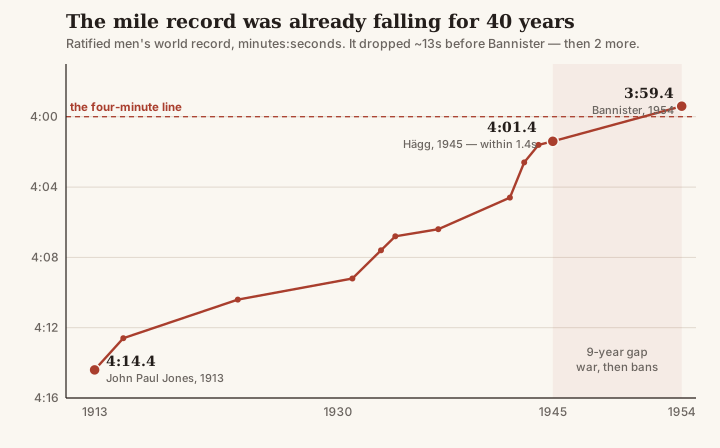
The first official record was 4:14.4, set by John Paul Jones in 1913. Jules Ladoumègue took it under 4:10 in 1931. By 1942 the Swedish runner Gunder Hägg had it under 4:05, and over the next three years he and his rival Arne Andersson traded it back and forth — 4:04.6, 4:02.6, 4:01.6 — until Hägg ran 4:01.4 in Malmö in 1945.
Sit with that number. 4:01.4. By 1945, nearly a decade before Bannister, a human had run the mile to within one and a half seconds of four minutes. The "impossible" wall was, in reality, a line drawn 1.4 seconds beyond where people were already comfortably running. Nobody would design a barrier there. Four minutes was never a law of physiology; it was a round number in Imperial units — four laps, four minutes, sixty seconds a lap — that happened to sit a hair past the trend line and made an irresistible headline.
So why did Hägg's 4:01.4 stand for nine years, if the record had been dropping so reliably? Not because of a psychological barrier. Because of the Second World War. The record was set in neutral Sweden precisely because the rest of Europe's young men were not on running tracks between 1939 and 1945 — they were at war, and many did not come home. A generation of milers was removed from the sport at exactly the moment the record needed pushing. Hägg and Andersson were themselves later banned for professionalism, taking the two best milers alive out of competition. The nine-year "stall" is a story about history and geopolitics, not about the limits of the human mind.
Did doctors really believe a four-minute mile would kill you?
The dramatic core of the parable is the claim that qualified people — doctors, scientists, physiologists — believed a sub-four mile was physically impossible or fatal. Danger sells. A record that is merely difficult makes a dull story; a record that could stop your heart makes a legend.
But the claim does not survive contact with the primary source. Bannister addressed it directly in his 1955 memoir, The First Four Minutes, and treated the "barrier" as a media invention rather than a settled scientific belief. That is not our inference — it is the account of the one man in the best position to know, published under his own name a year after the run. What the record actually shows is not a medical consensus but a journalistic convention: sportswriters needed the round number to mean something, so they dressed it in the language of physical law.
This matters more than it looks, because the entire "limiting belief" reading depends on the wall having been real in expert minds first. If the doctors never actually said it — and the person who would have defied them says they didn't — then Bannister did not overturn a belief held by science. He beat a number invented by newspapers. The same press that built the wall then got to write the story of the man who knocked it down. Both halves sold papers.
Why did the record fall so fast after Bannister?
Now we come back to Tony Robbins' number. The strongest-sounding evidence for the mind-over-matter reading is the aftermath: John Landy broke Bannister's record just 46 days later with 3:57.9, and — in the telling — dozens more poured through the opened gate. Robbins says 37 within a year. Surely that proves the barrier was mental.
It is the best part of the argument, and it is also where the story is caught red-handed. In the year after Bannister, exactly one other man ran a sub-four mile: Landy. Not 37. The "37 in a year" figure is simply false — it took roughly six years to reach two dozen men, and around eight to reach 37. The number was inflated because a cascade makes a better sermon than a trickle. When the storyteller needs the floodgates to open, they open them.
And Landy did not suddenly discover self-belief on hearing Bannister's time. He had already run 4:02 on several occasions before May 1954 — he was, by any measure, the fittest miler in the world and visibly closing on four minutes on his own trajectory. He was going to break it in 1954 whether or not Bannister got there first; Bannister simply reached an even-paced, well-supported attempt a few weeks earlier. Two men at the front of a slowly advancing field arrived at the same line within two months of each other. That is not a psychological cascade. That is what the top of a trend line looks like when two great athletes are both standing on it.
The slower build that followed — two dozen men over six years, more than two hundred by 1979 — tracks something far less magical than belief: interval training spread and matured, coaching professionalised, cinder tracks eventually gave way to faster synthetic surfaces, shoes got lighter, nutrition improved, and post-war competition deepened so milers had more fast fields to be dragged along by. Each of those shaves fractions of a second off, and fractions of a second are the whole game at this level. A record that keeps falling for twenty-five years is not a barrier that was psychological all along. It is a barrier being lowered, continuously, by better methods.
Why the myth survives — and what it's selling
If the real story is this well-documented, why does the fairy-tale version dominate every stage and airport bookshop?
Because the two stories sell completely different things, and only one of them is easy to sell.
The honest story of the four-minute mile is a story about material causes. It says records fall because of decades of incremental physiological progress, specific training methods you have to actually do, pacing you have to calculate, collaborators, coaches, competition, and the slow accumulation of knowledge — most of it unglamorous and taking years.
The self-help version deletes all of that. In the parable there is no forty-year record progression, no Hägg, no war, no interval training, no pacemakers, no stopwatch, no Landy-already-at-4:02. There is only a wall and a will. And that is precisely why it is the version that gets told — because "there is no wall, only your belief" is a product, and "do specific hard work under favourable conditions for many years" is not. The myth survives because it is frictionless. It hands you the outcome while quietly removing every material precondition that made the outcome possible.
There is a genuine cruelty in this. Tell a room of people that Bannister broke a belief, and the ones who then fail to break their own barriers — the ones held back by real, material limits of talent, money, time, health, or circumstance — are left with only one explanation for their failure: they did not believe hard enough. The myth doesn't just misdescribe history. It relocates the cause of every shortfall into the individual's mind, which is a convenient place to put it if you are the one selling belief.
The tell: watch for the deleted preconditions
Once you have seen how the four-minute mile is assembled, you can spot the same construction almost anywhere, because motivational anecdotes are nearly all built the same way. The move is a deletion. Take a real achievement, strip out the material preconditions that made it possible — the years, the training, the money, the collaborators, the luck, the favourable timing — and what remains is a clean before-and-after in which the only visible variable is the person's state of mind. The achievement now appears to have been caused by belief, for the simple reason that belief is the only cause left in the frame.
So the diagnostic is easy, and it is the one thing worth taking from this whole piece: when you are handed an inspiring story, ask what has been removed. Where are the pacemakers? Where is the forty-year record progression, the war that emptied the field, the coach, the stopwatch, the rival who was already running 4:02? A story that cannot answer those questions is not telling you how the thing happened. It is telling you how it feels to have already decided the thing was about willpower.
This is not cynicism, and it is not a claim that mindset is worthless — your attitude plainly affects how consistently you show up and how you survive a bad day. It is a claim about causal weight. The mind is one input among many, and it is rarely the binding constraint. The stories invert this precisely because the inversion is what sells: they promise that the single input entirely under your control, available at zero cost, is also the decisive one. That is a lovely promise. It is why the story gets told. And it is why, almost every time, the preconditions have gone quietly missing from the telling.
What the four-minute mile actually teaches
None of this diminishes Roger Bannister. Running 3:59.4 into a headwind on a cinder track in 1954 is one of the great athletic feats of the century, and it took extraordinary talent and years of disciplined work. The point is not that the achievement was small. The point is that it was real — real in the way real things are, made of training and physiology and pacing and history, not made of belief.
And the honest version is, in the end, the more useful one. If you take from the four-minute mile the lesson that barriers are mostly mental, you will spend your energy trying to feel more certain, and grow quietly ashamed when certainty doesn't move the number. If you take from it the lesson that barriers are mostly material — that the way you beat a hard target is to find the specific conditions and methods that move it, and then do the unglamorous work of applying them — you will spend your energy on the things that actually work. You will look, as Bannister did, for the pace, the plan, and the people who can help you hold it.
That is the real inheritance of 6 May 1954. Not "believe and the wall disappears." Something harder and far more honest: find out what actually makes the thing possible, and go and do that.
Frequently asked questions
Did breaking the four-minute mile prove mind over matter?
No. The mile record had been falling steadily since 1913 and already stood at 4:01.4 by 1945 — nine years before Bannister ran 3:59.4. His run continued a long material trend driven by training, competition and physiology, not a sudden change in what runners believed was possible.
Did doctors really say running a four-minute mile would kill you?
There was no medical consensus that it was impossible or fatal. Bannister, himself a medical student, called the "barrier" a press invention in his 1955 memoir. The danger framing was largely a sportswriters' story, not a scientific one.
How many runners broke four minutes in the year after Bannister?
One — John Landy, 46 days later. The popular claim, repeated by Tony Robbins in Awaken the Giant Within, that 37 runners broke it within a year is false. The numbers built over several years, driven by better training and deeper post-war fields.
Was the four-minute mile close to being broken before 1954?
Yes. Gunder Hägg ran 4:01.4 in 1945 — within 1.4 seconds of four minutes — and it stood for nine years mainly because the Second World War and athletics bans removed the best milers from competition, not because of a mental barrier.
Does the four-minute mile prove the power of positive thinking?
No. It is the self-help industry's favourite example, but the evidence points to material causes — decades of incremental records, scientific training, pacemakers and post-war competition — not belief.
Sources: Roger Bannister and the four-minute mile (Wikipedia); mile world record progression (Wikipedia); Recalling Hägg's 4:01.4 world record (World Athletics); "The Roger Bannister Effect: The Myth of the Psychological Breakthrough" (Science of Running); Tony Robbins' 4-Minute Mile — Meaningful Metaphor or Unfounded Fiction? (Business Coaching Journal); Roger Bannister, The First Four Minutes (1955).