Technology Of The Self
Does grounding (earthing) actually work? What the evidence really shows
By Beyond Growth · 13 July 2026
Does grounding work? Not in the way it's sold. One small part of the claim is real — standing barefoot on the ground measurably lowers the tiny voltage your body picks up from nearby wiring. Everything built on top of that — that "antioxidant electrons" from the earth neutralise free radicals, cure inflammation and fix your sleep — rests on small, mostly unblinded pilot studies, many of them authored by people who own shares in the company selling grounding products. The honest verdict isn't "definitely fake." It's weaker and more useful than that: the evidence is thin, low-quality and conflicted, and the mechanism has never been shown to work.
You have probably seen the pitch, even if you didn't know its name. Take off your shoes, press your bare feet into the grass or the sand, and something quietly medicinal is supposed to happen. The earth, the story goes, holds a limitless supply of free electrons. Modern life — rubber soles, raised floors, cars, beds off the ground — has cut us off from them. Reconnect, and those electrons flow up into you, mop up the "free radicals" behind chronic inflammation, and leave you calmer, less achy, and sleeping like you did as a child. If you can't get outside, you can buy a grounding sheet, mat or patch that wires you to the earth through the earth pin of a wall socket, and get the same effect indoors.
It is one of wellness culture's most mocked ideas — grounding gets called the silliest health scam going about as often as it gets sold. And it is genuinely easy to mock. But mockery is cheap, and it also isn't quite fair, because a sliver of the claim is true, and the people who try it often really do feel better. So this piece does something more useful than dunk. It takes the claim apart carefully — steelmans it first, then asks the only questions that matter for anything health-related: what does the actual evidence show, how good is that evidence, and who paid for it?
The short version is that grounding is not a cartoon fraud. It is something more common and more instructive: a real, trivial physical effect, wrapped in an unproven mechanism, propped up by a stack of small studies run largely by the sellers, and sold as a cure. Here is how each of those layers holds up.
| What grounding is sold as | What the evidence actually shows |
|---|---|
| Skin contact floods your body with healing "free electrons" | Electron transfer into living tissue in this way is unestablished; the claim's own physiology runs backwards |
| It neutralises free radicals and cures inflammation | No large controlled trial shows this; free radicals are neutralised by antioxidant molecules, not loose electrons |
| "Proven by dozens of studies" | Nearly all are small (roughly 8–40 people), unblinded pilot studies in low-impact journals |
| Independent, peer-reviewed science | Lead authors are paid contractors for, and shareholders in, the company that sells the products |
| It measurably lowers your body's voltage, so it must be doing you good | Lowering body voltage is real and trivial — and is not evidence of any health benefit |
| An ancient, rediscovered way of healing | The modern practice was devised in the 1990s by a retired cable-television businessman who sells the mats |
First, the fair hearing: what grounding gets right
Skepticism that refuses to grant the other side its strongest points isn't skepticism, it's just contempt with footnotes. So let's give grounding its best case.
The physics of body voltage is real. When you stand in a normal room, your body acts as a small antenna and picks up a low-level alternating voltage from the mains wiring and appliances around you — a few volts, harmless, but measurable. Touch something connected to the earth and that induced voltage drops sharply toward zero. This is ordinary electrostatics, it's not in dispute, and even grounding's proponents can show it on a voltmeter. When someone demonstrates that a grounding mat "reduces your body voltage," they are telling the truth. That measurement is the solid ground the whole edifice is built on.
People often do feel better. Plenty of grounding users report deeper sleep, less pain, more calm. There's no reason to call them liars. Lying on grass in the sun, slowing down, breathing, being outdoors and off your phone for twenty minutes — these things genuinely affect how you feel. A pleasant, relaxing ritual that you believe is healing you is close to a textbook setup for a real subjective improvement.
And the underlying worry isn't crazy. Chronic inflammation really is implicated in a long list of modern diseases, and the idea that industrial life has separated us from something our bodies evolved with is a reasonable thing to wonder about. Grounding takes a legitimate question and offers a simple, physical-sounding answer.
Hold on to all three of these, because they explain why grounding persists. The problem is not that any of them is false. The problem is what happens when you try to connect them into the chain the sellers need — from your body voltage drops to therefore your disease is cured.
Does grounding (earthing) actually work?
No — not for the health claims, which are the entire selling point. And the cleanest way to see why is to lay the mechanism out as the chain of separate claims it actually is, and check each link.
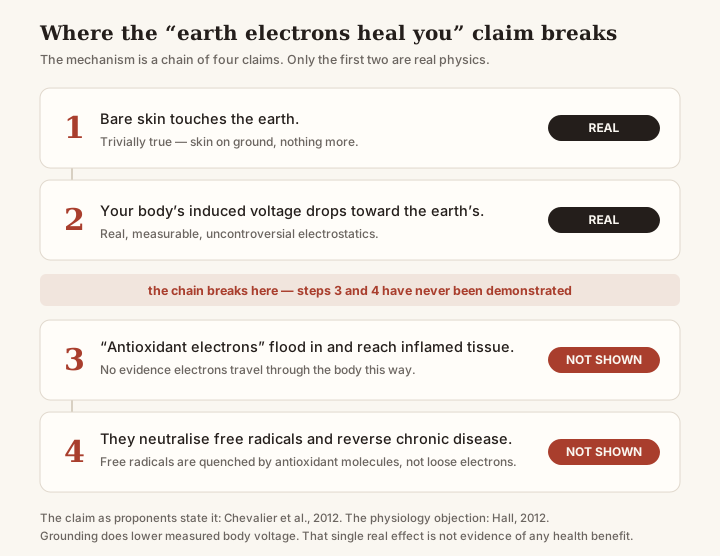
Steps one and two are true and trivial. Your bare skin touches the ground; your body's induced voltage falls. Fine. Nobody disputes this, and nobody should be impressed by it either, because it is just what a conductor touching a bigger conductor does.
The therapy lives entirely in steps three and four — and that is exactly where the evidence runs out. Step three asks you to believe that a meaningful flow of "antioxidant electrons" travels up from the soil, through your skin, and reaches the specific inflamed tissues deep in your body. Step four asks you to believe those electrons then chemically neutralise the free radicals driving your disease. Neither of these has been shown to happen. They are asserted, illustrated with diagrams, and repeated — but the demonstration that would turn them from a hypothesis into a fact does not exist.
It's worth being precise about how the mechanism is stated, because the proponents' own words are clearer than any paraphrase. The foundational 2012 review — the paper the whole field leans on — puts it like this: grounding "allows negatively charged antioxidant electrons from the Earth to enter the body and neutralize positively charged free radicals at sites of inflammation," and that "the influx of free electrons absorbed into the body through direct contact with the Earth likely neutralize ROS." Read it slowly and notice the load-bearing word: likely. This is not a report of a measured pathway. It is a proposed one.
Where the free-electron story falls apart
Two problems sink the mechanism, and they're worth separating because they fail in different ways.
The first is physiological, and it is the more damaging of the two, because it means the story is wrong even on its own terms. Retired physician Harriet Hall, reviewing the claims for Skeptic, put her finger on it: "Do free radicals cause inflammation? No, it's probably more accurate to say inflammation causes free radicals. And to neutralize free radicals you need antioxidant molecules, not free electrons." That's the whole game in two sentences. The body doesn't quench reactive oxygen species with a bath of loose electrons; it uses actual antioxidant molecules — vitamin C, vitamin E, glutathione, enzymes — that safely receive and carry the charge. "Free electrons from the earth cure inflammation" isn't a bold new frontier of the science; it's a sentence that misdescribes the chemistry it's borrowing.
The second problem is the electrical premise itself. The story needs you to be dramatically disconnected from the earth in normal life, so that grounding can be a dramatic reconnection. But you aren't sealed off. As neurologist Steven Novella, reviewing the field for Science-Based Medicine, points out: "Even with rubber soles, we are far from electrically isolated. We easily share electrons with everything we touch." Electrons are not a scarce nutrient your body is starved of and the earth is generously donating. You are swimming in them and exchanging them constantly. The "reconnection" the story sells as a health event is, electrically, a non-event. Novella's blunter summary: "Just from the perspective of basic physics, earthing makes no sense."
So the mechanism is unproven at step three and, at step four, describes the chemistry backwards. That is not a promising theory awaiting confirmation. It is a story that already conflicts with what we know.
Does grounding reduce inflammation? What the studies really show
Here defenders will object, reasonably: forget the mechanism — plenty of therapies worked before anyone knew why. Aspirin relieved pain for decades before we understood prostaglandins. If the studies show grounding reduces inflammation, the missing mechanism is a footnote, not a refutation. Fair. So do the studies show it?
They show much less than the headlines claim. The inflammation case rests largely on two review papers, both led by the same small group of researchers. The 2012 review in the Journal of Environmental and Public Health and the 2015 review in the Journal of Inflammation Research are the most-cited sources, and they are honest about one thing in their own text: they are summaries of pilot studies. The 2015 paper describes its evidence base as work in which "most of these pilot studies involved relatively few subjects." A pilot study is not a verdict; it is a suggestion that a proper study might be worth running. Fifteen years on, the proper studies still haven't been run.
Novella describes the pattern precisely: "Studies generally have small numbers of participants, focus on subjective outcomes (the usual suspects of pain, 'well-being', and stress), and are poorly controlled." He also notes where this literature lives — "Most of the research is published in 'alternative medicine' journals, predatory journals, or other low impact journals" — which lets a claim accumulate citations and the appearance of scientific backing without ever passing through the harder filter of a major medical journal and a large, well-designed trial. Publication is real. It is just not the same thing as proof, and the gap between the two is where a lot of wellness claims live comfortably for years.
The deeper tell is one that shows up across pseudo-medicine: the better-controlled the study, the smaller the effect tends to get. When the outcome is subjective and the participant knows whether they're being "treated," you are measuring expectation as much as physiology. A therapy that only performs in loosely controlled, unblinded conditions, and fades whenever the controls tighten, is behaving the way a placebo behaves — not the way a real anti-inflammatory drug behaves.
Can grounding improve your sleep?
Sleep is grounding's most persuasive claim, partly because it's where the personal testimonials are most vivid and partly because it traces back to the practice's origin story. The single most-cited sleep study is Ghaly and Teplitz's 2004 paper in the Journal of Alternative and Complementary Medicine, which reported that grounding people during sleep lowered their night-time cortisol and improved their reports of sleep, pain and stress.
It sounds impressive until you look at the shape of it. Twelve people. Each person was compared against their own earlier baseline — there was no separate control group sleeping on a fake mat. And nobody was blinded: every participant knew they were being grounded, and so did the researchers. With twelve unblinded subjects and self-reported outcomes, you cannot separate "grounding worked" from "people who signed up for a sleep-improvement study, were given a special mat, and were asked whether they slept better, said yes." That's not a criticism of the participants. It's the reason blinding and control groups exist: to stop exactly this kind of hopeful noise from being read as a signal.
Better sleep from grounding may well be real for some people. But "I lay down somewhere calm, believing it would heal me, and slept better" has an obvious, boring explanation that has nothing to do with electrons from the earth — and until a study rules that explanation out, it remains the most likely one.
Follow the money: who actually funds the research
For an ordinary consumer product this next point would be a minor caveat. For a health claim it is close to decisive, because in medicine we have learned, expensively and repeatedly, that who pays for a study predicts its result.
Grounding's core research is not independent. The same 2012 and 2015 reviews that anchor the field carry disclosures worth reading in full. In the 2015 paper, the authors state that G. Chevalier and J. L. Oschman are "independent contractors for EarthFx Inc., the company sponsoring earthing research, and own a small percentage of shares in the company," with a third author also contracting for the same firm. The 2012 review carries a materially identical disclosure. In plain terms: several of the scientists producing the evidence that grounding works are paid by, and hold equity in, the company that profits when you believe it. To their credit, they disclosed it. But disclosure doesn't neutralise the conflict; it just lets you see it.
The origin of the practice fits the same shape. Grounding as a commercial wellness product was not handed down from ancient medicine — it was devised in the 1990s by Clint Ober, a retired cable-television executive who noticed that shielding cables from stray signals reminded him of "grounding," wondered whether the same might steady the human body, built a grounded sleeping mat, and went on to co-author the movement's founding book and sell the products. That isn't a scandal on its own — plenty of useful things were invented by outsiders with something to sell. But it does mean the entire package, from the hypothesis to the studies testing it to the mats you buy, traces back through people with a direct financial stake in the answer being yes. When that's the structure, the burden of proof isn't lower. It's higher.
So is grounding a scam? A fair verdict
"Scam" implies knowing deception, and that's more certainty than the evidence supports and more than this piece will claim. Many grounding proponents plainly believe it. Ober seems to have genuinely felt better and genuinely wanted to share it. Sincerity is not the issue.
The issue is that a health claim has to clear a specific bar — good evidence, a plausible mechanism, and research that isn't controlled by the sellers — and grounding clears none of the three. The mechanism is unproven and, on the free-radical chemistry, wrong. The evidence is a stack of small, unblinded pilot studies in minor journals, and independent scientists who have gone through the whole literature find it doesn't hold up. And the research that does exist is substantially produced by people who sell the product. You don't need to prove bad faith to reach a clear verdict. You just need to notice that the thing being sold as established science is nothing of the kind.
So the accurate label isn't "silliest scam ever" and it isn't "promising breakthrough." It's this: an unproven wellness claim, resting on weak and conflicted evidence, that has been marketed with the confidence of a settled fact. That's a more boring verdict than either the believers or the mockers want. It's also the true one.
What's actually true here — and what to do with it
None of this means you have to stay off the grass. This is the part the debunking usually forgets, and it matters, because the useful move isn't to sneer at people who like standing barefoot outside.
Walking barefoot on grass or sand is genuinely pleasant, and it may do small, real things for you: varied ground wakes up the muscles and sensory nerves in feet that spend their lives in shoes, and any excuse to be outside, unhurried and off a screen is good for most people's mood and stress. Enjoy all of it. Just notice that none of those benefits require the electron story to be true, and none of them require you to buy anything. The lawn was always free.
The line to hold is the one between a nice thing to do and a treatment for disease. Feel free to ground yourself in the first sense as much as you like. Be very careful about the second — especially if it's edging you toward spending real money on mats and sheets, or, far more seriously, toward treating grounding as a substitute for actual medical care for a real condition. That's the point where a harmless ritual turns into a harmful one.
And the diagnostic here is the same one that works on most of the wellness industry, because grounding is built like most of its neighbours. Take a small, true physical fact — your body voltage drops when you touch the earth — and quietly stretch it, one unproven link at a time, into a sweeping health claim, while the studies that would test the stretch stay small, soft and funded by the sellers. The tell is never in the first link, which is usually real. It's in the links after it, the ones you were hoping were true, that nobody has actually shown. Ask, every time, exactly where the demonstrated part stops and the sold part begins. With grounding, it stops early — right after your feet touch the grass.
Frequently asked questions
Does grounding (earthing) actually work?
There is no good evidence that it delivers the health benefits claimed. Grounding measurably lowers the small electrical voltage your body picks up from surrounding wiring — that part is real — but the leap from that to curing inflammation, disease or poor sleep is unproven. The studies behind those claims are small, mostly unblinded, and largely run by people who sell grounding products.
Is there real science behind grounding?
There are published studies, but nearly all are small pilot experiments — typically 8 to 40 people — with weak controls, and many appear in low-impact or alternative-medicine journals. After more than fifteen years, no large, well-controlled randomised trial has confirmed the health claims. Published is not the same as proven.
Does grounding reduce inflammation?
This is the headline claim, and it is not established. The main papers are proponent-authored reviews of small pilot studies, and the proposed mechanism — "antioxidant electrons" from the earth neutralising free radicals — runs against basic physiology, since free radicals are neutralised by antioxidant molecules, not loose electrons.
Can grounding improve your sleep?
Some people report sleeping better, and that experience can be real — but the studies can't separate it from relaxation, expectation or placebo. The most-cited sleep study followed just twelve people, each compared only against their own earlier baseline, with no control group and no blinding.
Is walking barefoot on grass good for you?
Walking barefoot outdoors is pleasant and may help balance and foot strength — but those are ordinary benefits of moving and being outside, not evidence for the "earth electrons" theory. You don't need a grounding mat or the electron story to enjoy a lawn.
Sources: Chevalier, Sinatra, Oschman, Sokal & Sokal, "Earthing: Health Implications of Reconnecting the Human Body to the Earth's Surface Electrons", Journal of Environmental and Public Health, 2012 (mechanism claim and conflict-of-interest disclosure); Oschman, Chevalier & Brown, "The effects of grounding (earthing) on inflammation, the immune response, wound healing…", Journal of Inflammation Research, 2015 (pilot-study caveat and conflict-of-interest disclosure); Ghaly & Teplitz, "The Biologic Effects of Grounding the Human Body During Sleep…", Journal of Alternative and Complementary Medicine, 2004 (the twelve-subject cortisol/sleep study); Steven Novella, MD, "Earthing Update", Science-Based Medicine, 2023 (physics and evidence-quality critique); Harriet Hall, MD, "Barefoot in Sedona", Skeptic, 2012 (the free-radical physiology objection); "About Clint Ober", Earthing.com (the practice's cable-television origin).