Conscious Marketing
Linchpin by Seth Godin: A Critical Review
By Beyond Growth · 14 November 2026

Seth Godin's Linchpin: Are You Indispensable? makes a generous offer: become the person your employer cannot do without. It is a book people love, and it deserves a fair reading. This review sits in our conscious marketing section because the book is partly about work and partly about a way of selling ideas about work. We check its main claims against research, and we try to be clear where the evidence stops. We work from the publisher's description, Godin's own blog posts and the research, not from a page-by-page reading of the book.
Does Linchpin's advice hold up? In part. The call to take initiative and finish things is sensible. The promise that this makes you indispensable, and therefore safe, is not supported by anything the book offers, and the research we checked points the other way: value depends heavily on setting. The enthusiasm for "emotional labour" is also one-sided. The research on it shows real costs when you fake the feeling, with benefits only in some forms.
What does Linchpin actually claim?
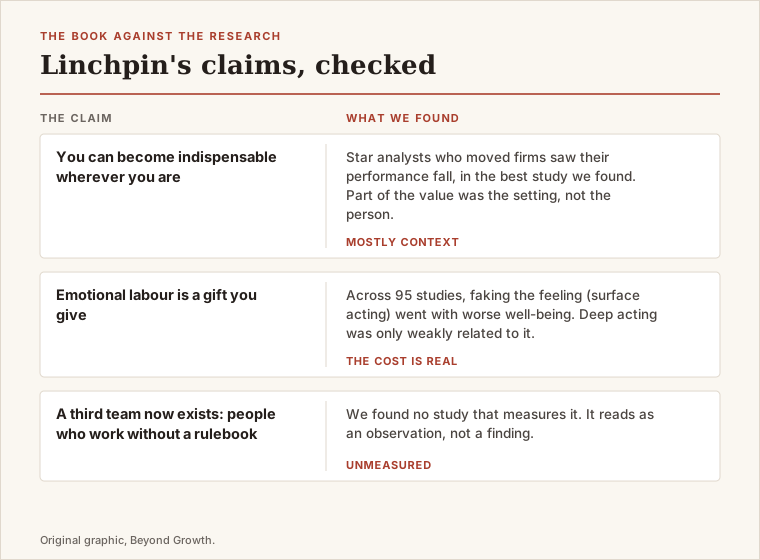
The publisher's description is the cleanest primary statement. The book was published by Portfolio, with ebook and audio editions listed by Penguin Random House at 26 January 2010 (Penguin Random House listing). The description says there used to be two teams in every workplace, management and labour: "Now there's a third team, the linchpins." Those people, it says, "figure out what to do when there's no rule book", and anyone can "become indispensable, by overcoming the resistance that holds people back".
Its examples are ordinary workers: a buyer who scours flea markets to fill a retail chain's stores, a designer who got a dream job without a résumé, a man at a New York coffee shop. The pitch is that initiative, generosity and finishing work are a route to being irreplaceable.
Godin has defended the idea since. In a June 2010 blog post he answered the question "Surely not everyone can be a linchpin?" with "your ability to create and contribute isn't determined at birth. It's a choice" (Seth's Blog, 3 June 2010). In the same post he acknowledged that "the cards are unfairly stacked against too many people" and that there are "too many barriers and not enough support". In the same post he wrote about bringing "emotional labor to the table", and his 2019 post on two kinds of nine-to-five worker describes the linchpin as someone who "brings so much emotional energy, thoughtfulness, risk-taking and passion to the job" (Seth's Blog, 6 September 2019).
Three claims are testable enough to check: that effort makes you indispensable, that indispensable means safe, and that emotional labour is a gift.
Does being indispensable make you safe?
The word "indispensable" assumes the value is yours and travels with you. The best study we found on that assumption looked at star security analysts. Those who switched employers "experienced an immediate decline in performance that persisted for at least five years", most sharply when they moved to firms with lesser capabilities or moved without team members. Stars who moved between equally capable firms dropped for about two years. Those who moved to better firms, or with team members, showed no significant decline (Groysberg, Lee and Nanda, Management Science, 2008; abstract via Crossref).
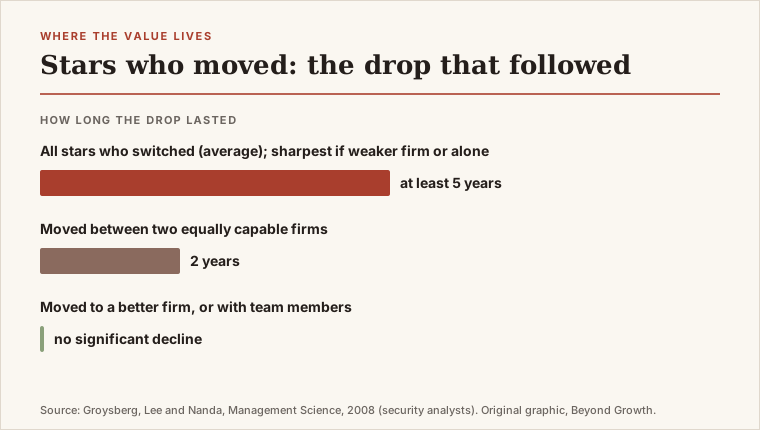
That is one profession, and it is a study of people already at the top, so it cannot be stretched to everyone. But it cuts against the central image. If the best performers' results fall when the setting changes, then being a linchpin is partly a property of the wheel it sits in, not only of the pin.
On security more broadly, the US Bureau of Labor Statistics reported that the median time wage and salary workers had been with their current employer was 3.9 years in January 2024, "down from 4.1 years in January 2022 and the lowest since January 2002" (BLS, October 2024).
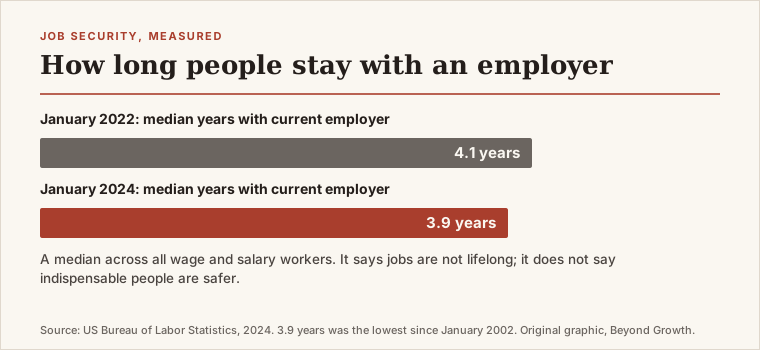
We should be careful what this shows. It is a median across all workers. It says people are not staying in jobs for life, which is the world the book is written for. It says nothing about whether indispensable workers last longer, and we found no study that measures that. The book's promise of safety is therefore untested, not disproved.
Is emotional labour a gift?
Godin uses "emotional labour" to mean the effort of caring, risking and bringing yourself to work. The term has an older, more specific origin. In The Managed Heart, Arlie Hochschild described how people manage their feelings for a wage, through "surface acting", managing outward expression, and "deep acting", or "emotion work" that induces or suppresses the feeling itself (University of California Press). The page says emotional labor has seldom been recognised or understood, which is her starting point: it is work, and it has a price.
A meta-analysis of 95 independent studies, with 494 correlations, found "substantial relationships" between surface acting (and the related gap between felt and required emotion) and impaired well-being (correlations between .39 and .48) and poorer job attitudes. Deep acting "displayed weak relationships with indicators of impaired well-being and job attitudes but positive relationships with emotional performance and customer satisfaction" (Hülsheger and Schewe, Journal of Occupational Health Psychology, 2011, via PubMed).
So there is something in Godin's favour. Working to actually feel the emotion the job calls for (deep acting) seems to go with better outcomes for customers and no strong penalty for you. But the same literature warns about the other form: putting on a feeling you do not have, day after day, is linked with worse well-being. A book that tells you to bring more emotion to work without separating those two is leaving out the half of the research that matters most to the person doing the work.
Is it really "a choice"?
"It's a choice" is a clean line and a risky one. It turns every shortfall into a decision. If you are not indispensable, you did not choose to be. That echoes the structure we find in other self-help promises: the method is available to all, so any failure is personal.
The research above suggests the setting does a lot of the work: which firm, which team, whether your employer rewards initiative or punishes it. To be fair to Godin, the 2010 post that says "It's a choice" also says "the cards are unfairly stacked against too many people", and his 2019 post ends: "If you're lucky enough to have the choice, it's worth seeing that you have the choice." That concedes the point: some people have the choice and some do not.
Myth or fact: what holds up?
| Linchpin's message | What we could check |
|---|---|
| Effort and initiative make you indispensable. | No study offered. Star performers' results fell when the setting changed. |
| Indispensable means secure. | Untested. Median job tenure is 3.9 years, with no link to indispensability measured. |
| Emotional labour is a gift. | Deep acting has benefits for customers and little cost; surface acting is linked to worse well-being. |
| It is a choice. | Context shapes results, so it is partly a choice and partly a position. |
What can you take from it?
Take the push to finish things and to solve problems no one assigned. That is good professional advice with or without the label. Then add three cautions from the evidence: look at whether your value would travel, because skills and relationships you can take with you protect you more than a role that exists only inside one team; notice whether you are faking the feeling or working to actually feel it, since the research links only faking it with worse well-being; and do not treat security as something effort alone can buy. Those three are our reading of the studies above, not findings, and they are worth testing against your own job.
For the wider argument about what "design your own working life" advice leaves out, see our Lifestyle Design Unmanifesto. More in conscious marketing.