Lifestyle Design
Why Every Lifestyle Designer Looks the Same
By Beyond Growth · 14 November 2026
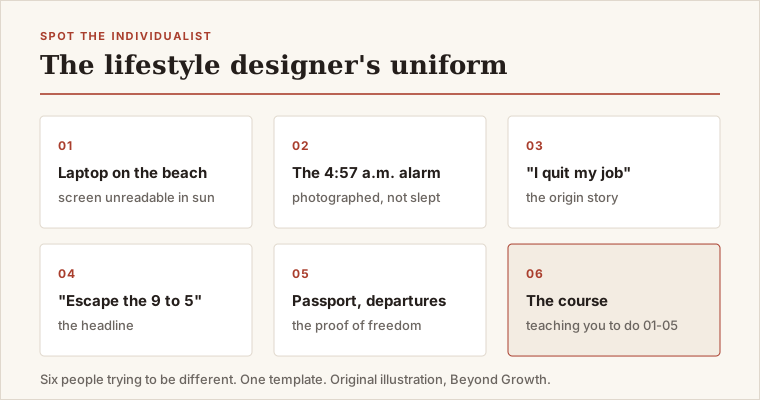
Why does every lifestyle designer look the same? Because a crowd of people all trying to escape the same thing tends to escape in the same direction. A 2014 mathematical model, nicknamed "the hipster effect", showed that anti-conformists who notice trends late end up making the same choices together. Lifestyle design sells individuality, but the version most people buy is a uniform: the beach laptop, the early alarm, the quit-my-job story and the course that teaches you the rest.
Lifestyle design is sold as an escape from the herd. The office worker is the sheep: same commute, same desk, same two weeks off. The lifestyle designer has broken out. And yet scroll through a few hundred lifestyle-design profiles and something odd happens. They start to blur. The laptop is always on a beach. The alarm is always before 5. The story always starts with a resignation letter. The course always teaches you to do the same.
It is easy to laugh at that, and we have: our 17-step field guide is the long version of the joke. But there is a more interesting question underneath it. Why would a movement built on being different produce people this alike?

What is the hipster effect?
In 2014 the researcher Jonathan Touboul published a paper with one of the better titles in the literature: "The hipster effect: When anticonformists all look the same" (Touboul, arXiv, 2014).
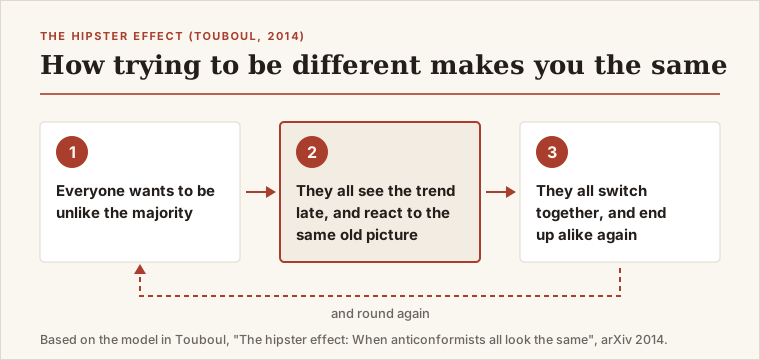
The model is simple. Picture a population of two kinds of people: "mainstreams", who go along with the majority, and "hipsters", who go against it. Each person can be in one of two states (think: beard or no beard) and switches depending on what everyone else was doing. The key detail is the delay. Nobody sees what the crowd is doing right now; they see what it was doing a little while ago.
The result is the part that gave the paper its name: "when hipsters are too slow in detecting the trends, they will consistently make the same choice, and realizing this too late, they will switch, all together to another state where they remain alike."
In other words, if everyone is reacting to the same out-of-date picture of what is popular, everyone trying to be different ends up making the same move at the same time. Touboul notes the maths applies well beyond fashion, to nerve cells and investment strategies, wherever there are delays in who knows what.
It is a model, not a survey of lifestyle designers, and we should not stretch it further than it goes. But it describes the shape of the problem precisely.
How does lifestyle design become a uniform?
Map the model onto lifestyle design and the fit is uncomfortable.

The "trend" everyone is reacting against is the same: the office job. Everyone sees it through the same few books and the same few successful examples, which, like the delayed signal in the model, show what worked for a handful of people years ago. So thousands of people, each trying to be different from the office, move in the same direction at once. They quit in the same way, describe it in the same words, photograph it in the same places and, when they need an income, sell the same thing: a course on how to do what they did.
| What the movement says | What it tends to produce |
|---|---|
| Escape the herd | A new herd, facing a different way |
| Design your own life | Copy a small number of designed lives |
| Reject the 9 to 5 | Adopt the 4:57 a.m. alarm |
| Be your own boss | Sell the same course to the next cohort |
None of this makes any one person a fraud. It makes them typical. The irony is that the office worker who negotiates a four-day week to coach their kid's football team is doing something more individual than the person in the beach photo, because their version fits their own life rather than a template.
How do you design a life that is actually yours?
If the trap is reacting to the same delayed signal as everyone else, the way out is to stop reacting to the signal at all.
- Start from your own week, not someone else's highlights. The question is not "how do I get what they have?" but "what would a good Tuesday look like for me?" The answers are usually smaller, odder and more specific than the brochure.
- Notice when the goal came from a photo. If you cannot say why you want to work from a beach, beyond the fact that it looks good, the wish may not be yours.
- Judge the advice by people who used it, not people selling it. A crowd of course sellers is not evidence; it is the hipster effect with a payment link.
- Expect your version to look boring from outside. A life that genuinely fits one person rarely photographs like an advert.
The original idea behind lifestyle design, arranging your work around the life you actually want, was individual by nature. No two people want the same life. The branded version turned it into a uniform. Taking the idea back means letting your version look nothing like theirs.