Guru Criticism
Tony Robbins and the Cult of Aggressive Positivity: Does the Method Hold Up?
By Beyond Growth · 13 July 2026

Is Tony Robbins' method as powerful as the room is told? In parts, and with big caveats. The genuinely useful core — that you can shift your state, and that your decisions matter — is real but modest, and older than him. The problems are in the strong claims layered on top: that belief overrides circumstance, that a firewalk proves it (it's physics, and people have been burned), and that the "neuro" science underneath (NLP) is settled (it isn't). This is part one of a series taking the method apart, fairly.
Picture the room. Ten thousand people, four days, a stadium PA, and a man with boundless energy telling you that the only thing between you and the life you want is a decision you have been refusing to make. By the first night you are barefoot in a car park, staring at a forty-foot bed of glowing coals, and a coach is teaching you a chant. You walk. You don't get burned. You come off the other side shaking, elated, certain that something in you has changed.
That is the Tony Robbins experience, and it would be dishonest to open a critique of it by pretending nobody gets anything from it. Millions of people have paid to be in that room, and a great many walk out genuinely fired up, having made a decision they had been dodging for years — to leave the job, end the relationship, start the business, call the estranged parent. Robbins is a formidable performer with real stamina, real charisma, and a genuine talent for getting a distracted, defended person to feel something and act on it. If self-help has a heavyweight champion, it is him. So let's be fair to the case before we test it.
The trouble starts when you ask a simple question: once you strip away the stagecraft, what is the actual claim, and does the evidence support it? Because the Robbins method does make claims — specific, checkable ones — about why the firewalk works, about the science underneath the techniques, and about the relationship between your inner state and your outer results. This piece takes those claims one at a time. Not to sneer at the people in the room, who are mostly earnest and hopeful, but because a worldview sold at four figures a ticket ought to be able to survive being looked at closely.
I should say plainly what kind of piece this is. Everything here framed as fact is sourced to Robbins' own books, to news reporting, or to published research, and linked. Everything framed as judgement — where I think the method oversells, where the evidence runs thin — is exactly that: reasoned opinion, offered as such. This is criticism of ideas and a business model, not an accusation of wrongdoing.
What does Tony Robbins actually teach?
Underneath the fire and the volume, the core of the method is surprisingly simple, and it has a name he uses often: state management. The idea is that how you feel at any moment — your "state" — is not something that happens to you but something you can deliberately change, in seconds, by changing three things: your physiology (posture, breathing, movement, facial expression), your focus (what you choose to pay attention to), and your language (the words and questions you run in your head). Change the state, the argument goes, and you change what you're capable of doing next.
On top of state sits a second layer: decisions and beliefs. Robbins' most-quoted line, from Awaken the Giant Within (1991), is that "it is in your moments of decision that your destiny is shaped." Around it he builds the notion of "limiting beliefs" — stories you tell yourself about what is possible that quietly cap your results — and a technique he calls Neuro-Associative Conditioning for rewiring the emotional associations that drive behaviour. The whole system is designed to move you from feeling stuck to taking action, fast.
Here is the fair part, and I want to give it full weight. A lot of this is defensible, as far as it goes. That your posture and breathing affect your mood is not woo — it's ordinary embodied psychology. That taking action tends to precede motivation rather than wait for it is the well-supported premise behind behavioural activation, a standard treatment for depression. That the questions you habitually ask yourself shape what you notice is plainly true. If Robbins only said "change your body and your focus to change how you feel in the moment, then go do the hard thing," there would be very little to argue with. It would be unremarkable, even — good, plain advice that your grandmother might have given, delivered with a headset mic.
The problem is that the method does not stop there. It inflates. "Your state affects your mood in the moment" becomes "your state is the decisive variable in your results." "Beliefs can hold you back" becomes "emotion and belief can override circumstance." And that last step — from a real, modest input to the cause — is where a piece of sensible psychology turns into something closer to magic. The rest of this essay is about that step, because it's the one being sold.
| What the pitch promises | What the evidence shows |
|---|---|
| The firewalk proves your mind can override your body | Firewalking is ordinary physics; embers conduct heat poorly and contact is brief |
| Belief and state are the decisive cause of your outcomes | State is one modest input; circumstance, resources and luck do heavy lifting |
| The techniques rest on "neuro" science | The parent tradition, NLP, is widely classed as a pseudoscience |
| Everyone can walk the coals safely with the right state | People have been treated for burns at these very events (2012, 2016) |
| A breakthrough in the room is a change in your life | The room reliably produces feeling; durable change is a separate, harder question |
| If it didn't work, you didn't want it enough | Some barriers are real and material, not a failure of desire |
Does the firewalk prove what the room is told it proves?
The firewalk is the method's master demonstration — the moment the abstract claim ("your state changes what's possible") is made to feel physically real. You were afraid; you managed your state; you walked on fire and lived. Surely that proves the mind can override the body.
It doesn't, and the reason is not controversial. Firewalking is explained by ordinary physics, and has been for decades. As the plain-language summary of the science puts it, embers "have a poor thermal conductivity," so only the parts of the coal touching your foot give up heat, and they cool fast; walkers "do not spend very much time on the embers, and they keep moving," so contact time is short; and the whole thing is neither supernatural nor paranormal. Physics professor David Willey, who has firewalked many times to demonstrate exactly this, is quoted making the point directly. A layer of ash, a light, quick step, and coals that are a poor conductor: that's the trick. Boy Scouts and physics classes do it. It requires courage, not a special mental state.
Why does this matter beyond pedantry? Because the firewalk is doing rhetorical work. It takes a fear you really feel and an outcome you really achieve, and it invites you to conclude that your belief bridged the gap — when what actually bridged the gap was thermodynamics you were never told about. You are handed a physics demonstration and sold a metaphysics. The feeling of transformation is genuine; the causal story attached to it is not.
And the demonstration is not risk-free, which is the tell that it was never about mind over matter. In June 2016, at a Robbins event in Dallas, dozens of attendees were treated after walking across the coals, with five taken to hospital. Four years earlier, in 2012, at least 21 people were treated for burns at an event in San Jose, some with second- and third-degree burns. In fairness, Robbins' organisation has noted that the firewalk has run for decades with trained staff on hand and that injuries are rare relative to the numbers who walk. That's a reasonable point about base rates. But it cuts against the mythology, not for it: if the coals can burn you when the conditions aren't right — the temperature, the length of the bed, how fast people move — then whether you get burned was always about physics and procedure, not about the quality of your belief. The state you're in doesn't change the thermal conductivity of carbon.
Is the science underneath the method actually science?
Robbins came up through neuro-linguistic programming — NLP, the 1970s technique tradition of Richard Bandler and John Grinder. His early bestseller Unlimited Power (1986) is essentially an NLP manual for a mass audience: modelling excellence, "anchoring" states, mirroring, reframing, submodalities. The "neuro" in his branding, and much of the machinery of his method, traces straight back to it.
So it matters a great deal that NLP does not have the scientific standing its name implies. It is, in the plain summary of the evidence, "a pseudoscientific approach," and "no scientific evidence supports the claims made by NLP advocates." This is not one blogger's grudge. A critical review by researchers at the University of Reading found the research base thin and largely unsupportive of NLP's core claims, and surveys of psychologists have repeatedly placed NLP among discredited techniques for mental-health treatment. The word "neuro" does a lot of quiet lifting: it borrows the authority of neuroscience for a set of practices neuroscience never validated.
Now, the fair caveat again. "Not scientifically supported" is not the same as "does nothing." Some NLP-adjacent moves — building rapport by matching someone's pace, reframing a problem, rehearsing a hard conversation — are perfectly ordinary rhetorical and coaching tools that can help, and would help under any label. The criticism is narrower and, I think, fairer for being narrow: the branding claims a mechanism (that these are precise, science-based techniques for reprogramming the brain) that the evidence does not deliver. You are being sold rapport and encouragement dressed as neuroscience. When a method's foundational science is contested and its signature demonstration is a physics trick, you are entitled to ask what, exactly, the premium price is buying.
What does aggressive positivity cost the person who buys it?
There is a reason we filed this under a slightly loaded phrase — the cult of aggressive positivity. Not "cult" in the sense of an accusation about the organisation; I make no such claim. I mean the style: the high-volume, high-certainty insistence that your state and your beliefs are the main thing standing between you and any outcome you want, and that anything less than total commitment is an excuse. It's exhilarating in the room. It also has a cost, and the cost is usually paid quietly, later, by the person who believed it hardest.
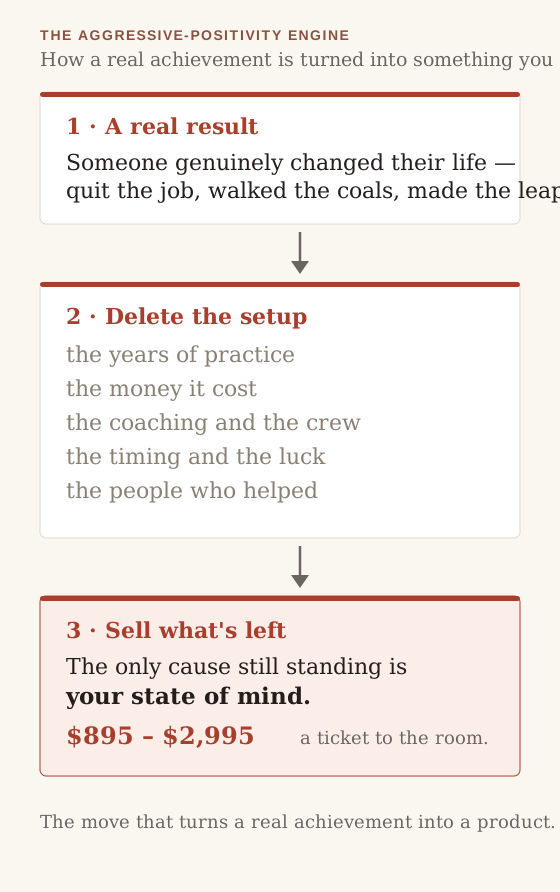
The cost is this. If the decisive variable really is your inner state, then success and failure both become verdicts on you. Win, and it's proof the method works. Fail — because the business needed capital you didn't have, because your health gave out, because the market turned, because you were caring for a sick parent, because of any of the thousand material things that actually govern outcomes — and there is only one explanation left standing: you didn't manage your state well enough, didn't decide hard enough, didn't want it enough. The philosophy that promised to empower you hands you, at the exact moment you're most vulnerable, a reason to blame yourself for forces that were never in your control.
This is the same structural move we take apart in detail in the flagship piece on the four-minute mile: take a real achievement, quietly delete the material preconditions that made it possible — the years, the money, the training, the luck, the people who helped — and present what's left, a clean before-and-after in which the only visible variable is the person's state of mind. It's no accident that Robbins reaches for that exact story. On page 84 of Awaken the Giant Within, he tells it, writing that Roger Bannister broke four minutes "not merely by physical practice but by constantly rehearsing the event in his mind," and claiming that "within one year… 37 other runners also broke it". That second number is simply false — in the year after Bannister, exactly one other man ran a sub-four mile — and the way it's false is instructive: the cascade has to be inflated because a flood of believers makes a better sermon than the real, slow, material story of better training and deeper fields. When the storyteller needs the floodgates to open, they open them.
That, in my view, is the deepest problem with aggressive positivity. It isn't that mindset is worthless — your attitude plainly affects how consistently you show up and how you survive a bad day. It's that the method systematically overstates mindset's causal weight, because overstating it is what makes it sellable. "The one input entirely under your control, available at zero cost, is also the decisive one" is a wonderful promise. It is also, most of the time, not true, and the people it fails are taught to read that failure as a personal defect.
How does Tony Robbins make his money?
Follow the incentives and the aggressive framing makes more sense. Estimates commonly put Robbins' net worth at around $600 million, built over four decades from books, licensing, a large portfolio of businesses, and — above all — live events. This is a serious enterprise, run well. Understanding its shape is not an accusation; it's just useful for anyone deciding what to pay.
The events are structured as a ladder. Unleash the Power Within, the four-day firewalk event, has been offered at roughly $895 for general admission, about $1,495 for VIP, and around $2,995 for the top "Diamond" public tier. Above the public events sits a further climb of higher-touch, higher-priced programmes — deeper multi-day intensives and, at the summit, an invitation-only "Platinum Partnership" widely reported to run into five and six figures a year. None of that is inherently wrong; premium coaching is a legitimate business, and plenty of buyers feel they got value. But it's worth seeing the design clearly. A method whose central promise is that total commitment is the difference between winning and losing is also, conveniently, a method that always has a next, more-committed, more-expensive tier for you to buy. The philosophy and the funnel point the same direction. When the answer to a disappointing result is "go deeper," there is always somewhere deeper to go, and it is rarely free.
For completeness, and with care: Robbins has also faced allegations about his conduct. In 2019, BuzzFeed News published an investigation reporting claims by some former staff and attendees; Robbins categorically denied the allegations and disputed the reporting as inaccurate and agenda-driven. Those claims are contested, were strongly denied, and are beyond the scope of this piece, which is about the method and the model. I note the reporting exists only so the record is complete, and draw no conclusion from it.
So is any of it worth anything?
Here is where a fair critic has to resist the easy ending. It would be neat to say the whole thing is empty. It isn't.
If you take from a Robbins event the habit of managing your physiology and focus when you feel stuck, the willingness to act before you feel ready, and the courage to finally make a decision you'd been avoiding — you have taken something real and useful, and you didn't need the metaphysics to get it. Plenty of people do exactly that, and their lives are genuinely better for it. Credit where it's due.
What I'd urge you to leave in the room is the strong version of the story: that your state is the decisive cause of your outcomes, that the firewalk proved your mind can beat your body, that the science is settled, and — most of all — that when things don't work out, the fault must lie in how hard you believed. That last idea is the expensive one. Not because of the ticket price, but because of what it does to a person who bought the promise in good faith, worked hard, and still hit a wall made of real, material things.
The honest version is less thrilling and more useful. Your mind is one input among many. It's the one you control, which is exactly why it's worth working on — but it is rarely the binding constraint, and pretending otherwise sets people up to blame themselves for gravity. Find out what actually makes the thing you want possible — the resources, the skills, the conditions, the help — and go and assemble those, in the state that helps you do the work. That's not as good a sermon. It has the advantage of being true.
This is part one, on the method and its costs. In later parts we'll look harder at specific claims, specific programmes, and the wider machinery of the aggressive-positivity industry Robbins did more than anyone to build.
Frequently asked questions
What does Tony Robbins actually teach?
At its core, Robbins teaches "state management": the idea that you can change how you feel, and therefore what you do, by changing your physiology, focus and language in the moment. Around it sit decision-making, "limiting beliefs", and the claim that emotion and belief can override circumstance. Some of this is genuinely useful; the strong version — that your inner state is the decisive cause of outcomes — is where the evidence thins out.
What is Tony Robbins' net worth and how does he make his money?
Estimates commonly put his net worth at around $600 million. The money comes mainly from live events, books, licensing and a portfolio of businesses. His flagship event, Unleash the Power Within, has been sold at roughly $895 for general admission up to about $2,995 for the top public tier, with a further ladder of higher-priced coaching and mastermind programmes above that.
Does walking on hot coals prove mind over matter?
No. Physicists explain firewalking through ordinary thermodynamics — embers conduct heat poorly, and walkers keep moving so contact time is short. It is a demonstration of physics, not of belief. At Robbins events in 2012 and 2016, news outlets reported dozens of attendees treated for burns, which is what physics predicts when the variables aren't controlled.
Is neuro-linguistic programming (NLP) scientifically proven?
No. NLP — the technique tradition Robbins came out of — is widely classified as a pseudoscience. Reviews of the research find little to no reliable evidence for its core claims. That doesn't make every exercise worthless, but it does mean the "neuro" branding oversells what is really rhetoric and rapport.
What is 'aggressive positivity' and what are its costs?
It's the high-energy insistence that your state and beliefs are the main thing standing between you and any goal. In my view its hidden cost is that when the method doesn't work — because of money, health, luck or circumstance — it leaves the person with only one explanation for the shortfall: they didn't believe or want it enough. It relocates every failure into the individual's mind.
Sources: Tony Robbins and Neuro-linguistic programming (Wikipedia); the physics of firewalking (Wikipedia); Passmore & Rowson, "Neuro-linguistic programming: a critical review" (University of Reading); "Tony Robbins 'fire walk' over hot coals injures dozens" (CNN, 2016) and "5 Hospitalized After Tony Robbins Urges Them to Walk Over Hot Coals" (Time, 2016); "21 treated for burns at Tony Robbins firewalk event" (CBS News, 2012); "Unleash the Power Within review" (Moneywise) for event pricing; "Tony Robbins' 4-Minute Mile — Meaningful Metaphor or Unfounded Fiction?" (Business Coaching Journal) for the Awaken the Giant Within quotation. Tony Robbins, Awaken the Giant Within (1991) and Unlimited Power (1986).