Lifestyle Design
What Is a Lifestyle Designer? An Honest Answer
By Beyond Growth · Updated 14 November 2026
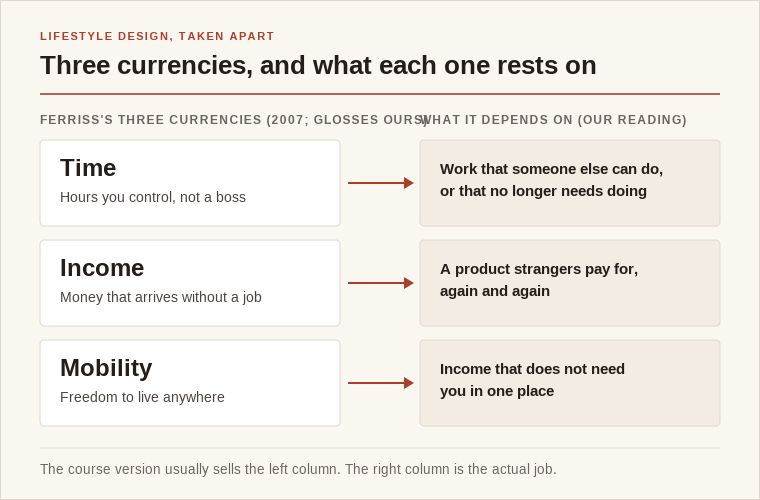
What is a lifestyle designer? Someone who decides the life they want first (their time, their location, how much they need) and then shapes their work to fit it, instead of the other way round. Tim Ferriss named the idea in 2007. Since then "lifestyle designer" has also become a job title for people who sell courses and coaching about living that way. The idea is sound. The industry built on it mostly sells the freedom and skips the business that has to pay for it.
Most careers work like this: you pick a job, the job decides your hours, your city and your income, and you fit a life into whatever is left. Lifestyle design flips the order. You start with the life (how you want to spend a Tuesday, where you want to live, how much money that actually takes) and you work backwards to the work that could pay for it.
Put that way it sounds almost too obvious to need a name. It got one anyway, and then it got a whole industry.
| What the lifestyle-design pitch suggests | What it usually takes |
|---|---|
| Decide what you want and the business will follow | The business comes first; the lifestyle is what it pays for |
| Four hours a week is the goal | Low hours come late, after years of building something that runs without you |
| Anyone can do it from a laptop | Only work that can be delivered remotely can be done remotely |
| The course gives you the system | The course gives you a framework; nobody can sell you customers |
| The person teaching it is proof it works | Check whether they earn from anything other than teaching it |

What does "lifestyle designer" mean?
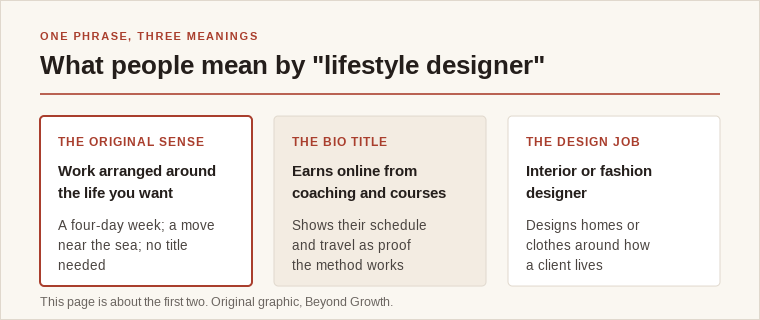
In the original sense, a lifestyle designer is anyone who arranges their working life around a deliberate picture of how they want to live. A teacher who takes a lower-paid post to live near the sea is doing it. So is a software developer who negotiates a four-day week, or a freelancer who works from a different city each winter. None of them need to call themselves anything.
In the current sense, "lifestyle designer" is something people put in their social media bio. It usually means someone who earns a living online, often from coaching, courses or content, and who presents their own schedule and travel as evidence that the method works. That second meaning is where most of the confusion, and most of the criticism, comes from.
There is a third meaning that has nothing to do with either: some interior stylists and fashion designers use "lifestyle designer" as a job title for designing homes or clothes around how a client lives. If that is what you were looking for, you want a design studio rather than this page.
Where did the term "lifestyle design" come from?
Tim Ferriss is usually credited with the phrase. In a talk at SXSW in 2007, the year his first book The 4-Hour Workweek was published, he described his book as the result of "conducting experiments around the world on what I call lifestyle design, which I view as an alternative to long-haul career planning" (transcript on Ferriss's own blog).
In the same talk he set out what the lifestyle was made of: "the three currencies, time, income, and mobility". And he described the experiment that started it: travelling through 20 to 25 countries, "doing everything that I had postponed, everything I had wanted to do but put off waiting for retirement".
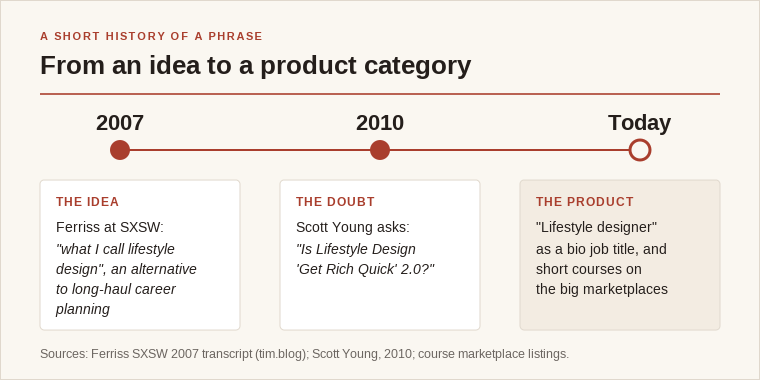
That last line is the real idea, and it is a good one. Do not defer your whole life to a retirement that may never arrive in the shape you imagined. The phrase caught on fast. By 2010 the writer Scott Young could open an essay with "Since Tim Ferriss coined the term, 'lifestyle design' has become a phenomenon", and in the same piece ask a question that has aged well: "Is Lifestyle Design 'Get Rich Quick' 2.0?" (Scott Young, 2010).
How do people actually become lifestyle designers?
There is no qualification, no licence and no professional body. Strip away the branding and the path has three steps.
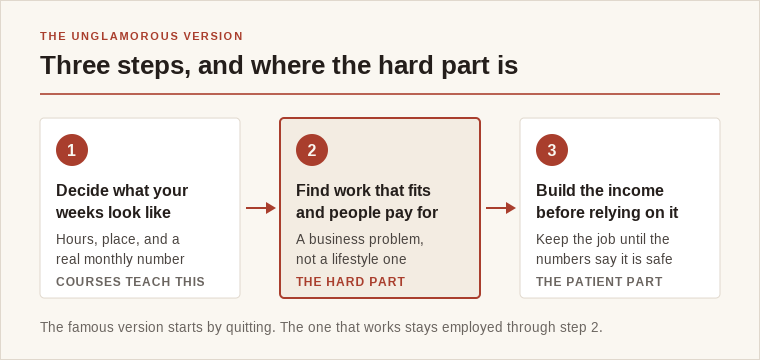
- Decide what you want your weeks to look like. Not "freedom" in general: actual hours, an actual place, an actual monthly number. This is the part the courses are good at, and it is genuinely worth doing.
- Find work that fits that shape. That means work that can be done remotely, flexibly, or by other people, and that someone will pay for. This is the hard part and it is not a lifestyle problem. It is a business problem or a career problem.
- Build the income before you rely on it. The famous version quits the job first. The version that works usually keeps the job, builds the alternative on the side, and moves over when the numbers say it is safe.
Look closely at most real examples and step two took years. The freedom on display is the result of a working business, not the method for building one.
What do lifestyle design courses actually teach?
Search for a lifestyle design course and you will find short, self-paced classes on the big marketplaces, such as Lifestyle Design: A 5 Step Method to Design Your Ideal Lifestyle on Skillshare (listing), which is also sold on Udemy as Lifestyle Design - Find Your Recipe for Extraordinary Living (listing). The same course turning up under two titles on two platforms says something about how the market works.
The cheap ones mostly teach step one: values exercises, goal setting, a template for your ideal week. That can help, and it costs little. The expensive ones tend to promise step two, and that is where to be careful. A course can teach you how other people found customers. It cannot find yours.
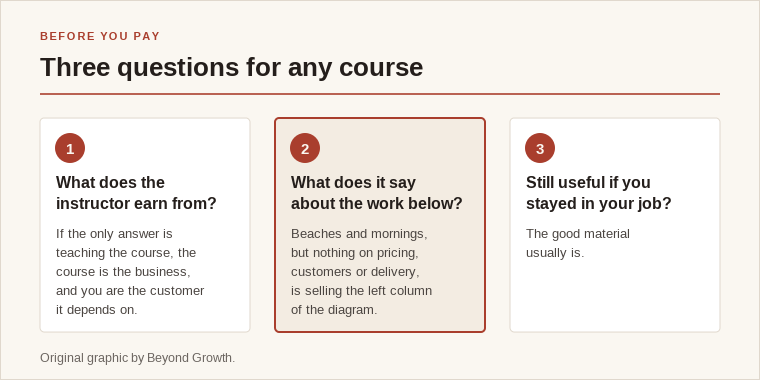
Three questions are worth asking before you pay for any of them:
- What does the instructor earn from? If the only answer is teaching the course, the course is the business, and you are the customer it depends on.
- What does it say about the work underneath? A course that talks about beaches and mornings but not about pricing, customers or delivery is selling the left column of the diagram above.
- Would the lesson still be useful if you stayed in your job? The good material usually is.
If what you want is a structured way to think about your working life, the best-known alternative comes from outside the self-help industry. Designing Your Life by Bill Burnett and Dave Evans, Stanford educators, applies design thinking to career and life decisions (designingyour.life). It promises less, which is part of why it is more useful.
Is lifestyle design a scam?
The idea is not. Asking why you work the way you do, and refusing to postpone everything you care about until you are 65, is reasonable advice, and Ferriss deserves credit for popularising it.
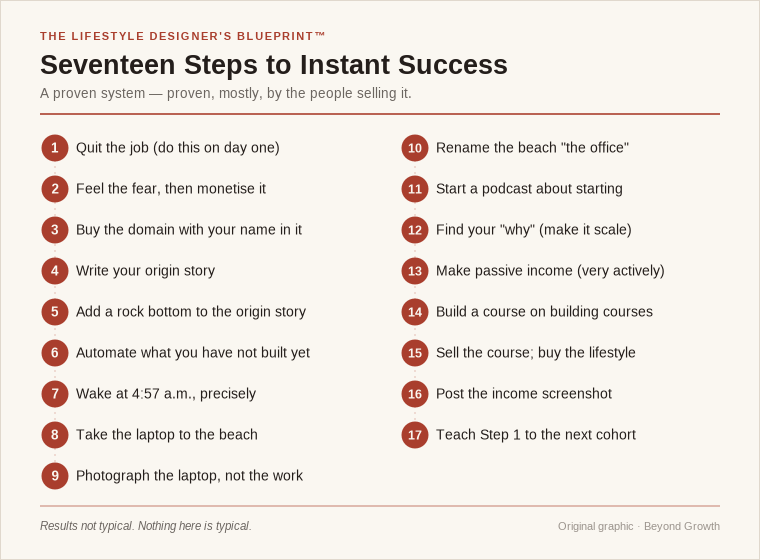
What deserves suspicion is the shape the industry took. When the most dependable way to fund a lifestyle-design life is selling lifestyle design to others, the people at the front of the queue are paid by the people behind them. The beach photo is marketing, not evidence. Our satirical 17-step field guide to the lifestyle-design guru takes this to its logical end: a course about selling courses.
A useful test for any pitch: does it describe the business, or only the freedom? Real businesses can say who pays, for what, and why they come back. A pitch that skips that and goes straight to the hammock is selling a feeling.
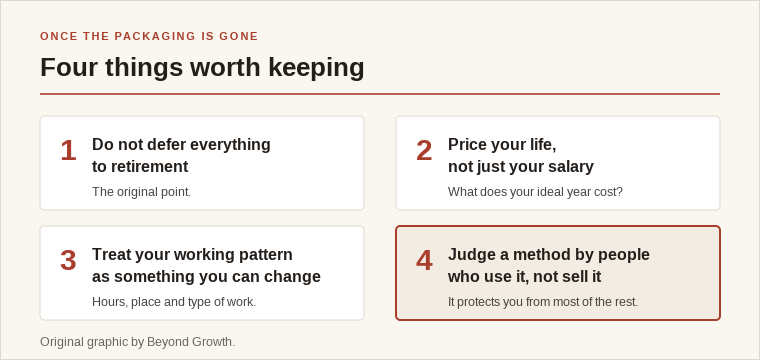
What is worth keeping from lifestyle design?
Quite a lot, once the packaging is gone.
- Do not defer everything to retirement. Ferriss's original point. Some of what you are saving the good life for can happen now, in smaller pieces.
- Price your life, not just your salary. Working out what your ideal year actually costs often shows that you need less than you assumed, or that the number you chase is not the one that matters.
- Treat your working pattern as something you can change. Hours, location and the type of work you do are more negotiable than most people try.
- Judge any method by people who use it, not people who sell it. That rule protects you from most of what is wrong with this corner of self-help.
The essays below go further into where lifestyle design went wrong, and what a more honest version would look like.
Essays on lifestyle design
What Is a Lifestyle Business? A Plain Answer
A lifestyle business is run to fund a life you chose, not to grow or sell. How it differs from a startup, how common it is, and whether it can do good.
14 November 2026 · Read →
The Lifestyle Design Unmanifesto: Six Honest Rules
Six plain rules for designing a life around what you want, without the beach photos, the 5 a.m. alarm or the course: keep the job, build first, price your life.
14 November 2026 · Read →
Why Every Lifestyle Designer Looks the Same
Lifestyle design sells escaping the herd, yet its followers share one template: beach laptop, 5 a.m. alarm, quit-my-job story. A maths model explains why.
14 November 2026 · Read →
The 4-Hour Body Review: Which Promises Hold Up?
Tim Ferriss promised 2-hour sleep, 300% more fat loss from cold and 34 lb of muscle in 28 days. We checked three headline claims against the research.
14 November 2026 · Read →
Lifestyle Design and Changing the World
Lifestyle design promises free time. The data shows where free time goes, how little of it is given away, and what small, regular giving looks like.
14 November 2026 · Read →
Ethical Lifestyle Design: Three Tensions
Is lifestyle design ethical? Three honest tensions, geoarbitrage, cheap outsourcing and visas, each with a practical answer and a short checklist.
14 November 2026 · Read →
Lifestyle Design Sucks? The Missing Failures
Most lifestyle design failures are never posted. What survivorship bias and US business survival data say about quitting for freedom, and what to do instead.
14 November 2026 · Read →
The Lifestyle Guru Playbook: 17 Steps to Instant Success
A deadpan, satirical field guide to the lifestyle-design genre — the 4 a.m. alarm, the beach laptop, the manufactured origin story, and the course about selling courses.
13 July 2026 · Read →