Lifestyle Design
The 4-Hour Body Review: Which Promises Hold Up?
By Beyond Growth · 14 November 2026
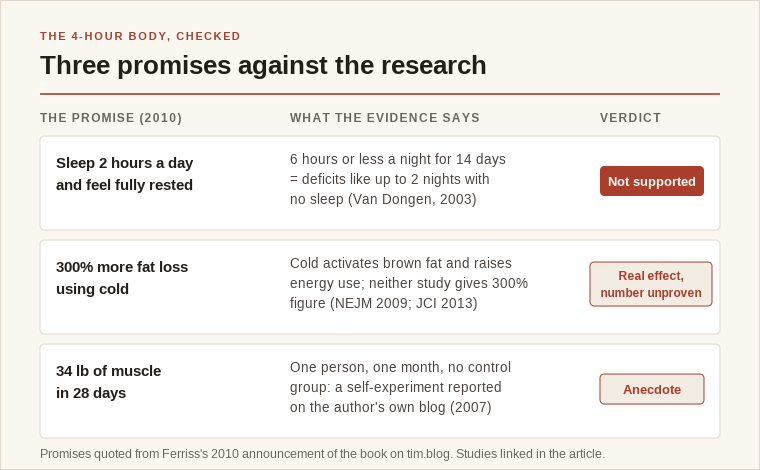
Does The 4-Hour Body work? Some of it points at real effects; much of it promises far more than the evidence supports. We checked three headline claims. Sleeping 2 hours a day runs against a controlled study of sleep restriction. Using cold to boost fat loss rests on a real effect, but neither study we cite supports the "300%" figure. Gaining 34 lb of muscle in 28 days is one man's self-experiment. The book's real lesson is about marketing: a precise number sells better than an honest range.
Tim Ferriss announced The 4-Hour Body in 2010, three years after The 4-Hour Workweek made him the face of lifestyle design. The workweek book promised freedom from the office. The body book promised freedom from the gym, the scales and, in one chapter, most of your sleep.
The promises were specific, and that is what makes them checkable. In the post announcing the book, Ferriss listed what readers would learn "in less than 30 minutes each", including "How to sleep 2 hours per day and feel fully rested", "How to increase fat-loss 300% using temperature manipulation" and "How Tim gained 34 pounds of muscle in 28 days, without steroids, and in four hours of total gym time". The same post says of the whole book: "it's all here, and it all works" (tim.blog, 2010).
We took those three claims and checked each against the research.
Can you sleep 2 hours a day and feel rested?
This is the boldest promise, and the one where the evidence is clearest.
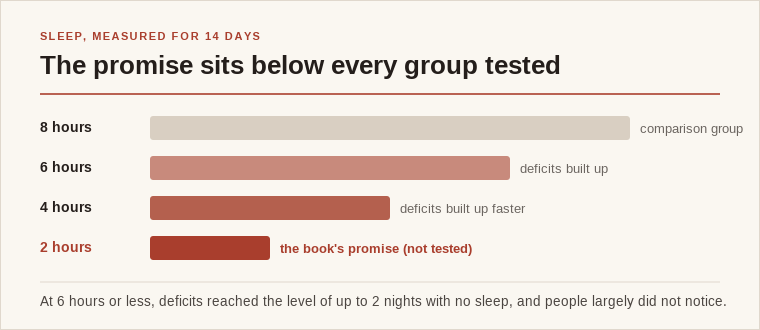
In 2003, researchers at the University of Pennsylvania ran two experiments with 48 healthy adults in all: 35 were randomly assigned to 4 hours (13 people), 6 hours (13) or 8 hours (9) in bed a night for 14 days, and the other 13 went 3 nights without sleep (Van Dongen et al., Sleep, 2003). Restricting sleep to 4 or 6 hours produced "cumulative, dose-dependent deficits in cognitive performance on all tasks". The authors concluded that 6 hours or less a night "produced cognitive performance deficits equivalent to up to 2 nights of total sleep deprivation".
The finding that matters most for the 4-Hour Body promise is the next one. The participants' own sleepiness ratings "suggest that subjects were largely unaware of these increasing cognitive deficits". The promise was not only that you could sleep 2 hours, but that you would feel fully rested. On this evidence, feeling rested is exactly the measure you cannot trust when you are short of sleep.
Two hours a day is well below any group in that study. The study also banned all other sleep, so it did not test schedules that split sleep into short naps across the day. We found no controlled study showing that such a schedule leaves people fully rested, and the closest controlled evidence points the other way.
Does cold really boost fat loss by 300%?
Here the book is pointing at something real, and then attaching a number to it.
Brown fat is a type of fat that burns energy to make heat. For a long time it was thought to matter only in babies. In 2009, a study in the New England Journal of Medicine exposed 24 men to mild cold (16°C) and found brown fat activity in 23 of them; it was lower in men who were overweight or obese (van Marken Lichtenbelt et al., 2009). In 2013, a Japanese study found that 2 hours a day of cold at 17°C for 6 weeks raised brown fat activity and produced "a concomitant decrease in body fat mass" (Yoneshiro et al., J Clin Invest, 2013).
So cold does make the body burn more energy, and repeated cold can reduce body fat. What neither study supports is a figure like "300%". A precise multiple implies a measured comparison: 300% more than what, in whom, over how long? The book's promise borrows the authority of a real mechanism to sell a size of effect that these studies do not show.

Did Ferriss really gain 34 lb of muscle in 28 days?
The claim comes from a 2007 blog post, "From Geek to Freak". Ferriss wrote that he "gained 34 lbs. of muscle, while losing 3 lbs. of fat, in 28 days", with two 30-minute workouts a week, and that measurements "including underwater hydrostatic weighings" were taken at a university human performance laboratory (tim.blog, 2007).
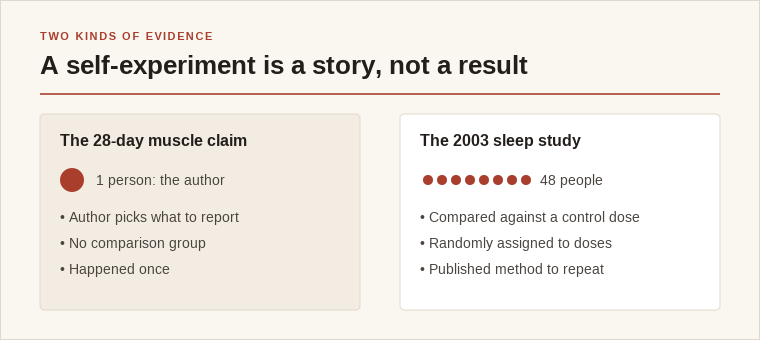
We are not in a position to say the numbers are wrong, and we do not need to. The problem is what kind of evidence it is. One person ran one experiment on himself, chose what to report, and had no comparison group. Even if every figure is exact, it cannot tell you whether the programme caused the change, whether something else did, or whether it would do anything similar for you. A self-experiment is a story. It can suggest what to test. It cannot settle what works.
So is The 4-Hour Body a scam?
That is the wrong frame. The book is better described as a marketing document wrapped around a set of self-experiments. Some chapters point at effects that are real. Some point at effects that are real but smaller and slower than promised. A few promise things that controlled research does not support, or not safe to judge from how you feel.
| What the book offers | What it amounts to |
|---|---|
| Precise numbers (300%, 34 lb, 28 days) | Figures that sell well and are rarely tested |
| "It all works" | Some of it points at real effects; the claim of all is the weakest part |
| One person's experiments | Ideas worth testing, not results |
| Results in "less than 30 minutes" of reading | Changes that, where they work at all, take weeks |
The same pattern runs through the wider genre. Lifestyle design sells the result first and the work underneath it second, and the body book did the same for health. If you take anything from it, take the habit it claims to model, testing things on yourself, and add the part it skips: be suspicious of how good you feel, and of any number too neat to be true.