Social Criticism
Do Rewards Kill Motivation? The Evidence
By Beyond Growth · 14 November 2026
Nine meta-analyses over four decades have fought over one question: does paying people to do something wear away their interest in doing it? (Cerasoli, Nicklin and Ford, 2014). Nine reviews is a sign that the answer is not simple, and that anyone selling you a one-line version is selling.
Do rewards destroy intrinsic motivation? Sometimes, and it depends on the reward and the task. A 1999 meta-analysis of 128 experiments found rewards significantly undermined free-choice motivation (d = -0.28 to -0.40). A 2001 meta-analysis concluded rewards are not harmful in general. Both report harm from tangible, expected rewards. A 2014 meta-analysis of work and school data found intrinsic motivation and incentives predict performance together, not as rivals. So the useful question is not "reward or no reward" but what kind, for what task, tied to what.
This is the social criticism take on a debate that gets quoted in management books, school policy and pay reviews. An earlier essay under this address, by a previous writer, is kept by the Internet Archive (2009 copy).
What is the undermining effect?
Intrinsic motivation means doing something for its own sake. The idea behind the "undermining effect" is that "performance-based extrinsic reward can actually undermine a person's intrinsic motivation to engage in a task" (Murayama et al., 2010, PNAS). It challenges economic and reinforcement-learning theories, which "tend to assume that monetary incentives monotonically increase motivation", which is why it matters beyond psychology.
Two clarifications from Ryan and Deci, who argue that intrinsic motivation reflects "the natural human propensity to learn and assimilate", and that extrinsic motivation "varies considerably in its relative autonomy", so it can reflect "external control or true self-regulation" (Ryan and Deci, 2000). In other words, not every external reason feels like a leash. A person who studies for a qualification they chose is extrinsically motivated and may still feel in charge.
What did the biggest 1999 meta-analysis find?
Deci, Koestner and Ryan pooled 128 studies. Rewards for engaging in a task, finishing it, or performing to a level all "significantly undermined free-choice intrinsic motivation" (d = -0.40, -0.36 and -0.28). Engagement- and completion-contingent rewards also reduced self-reported interest (d = -0.15 and -0.17). Positive feedback did the opposite (d = 0.33 on free choice, 0.31 on interest). Tangible rewards tended to be more harmful for children than for college students (Deci, Koestner and Ryan, 1999).
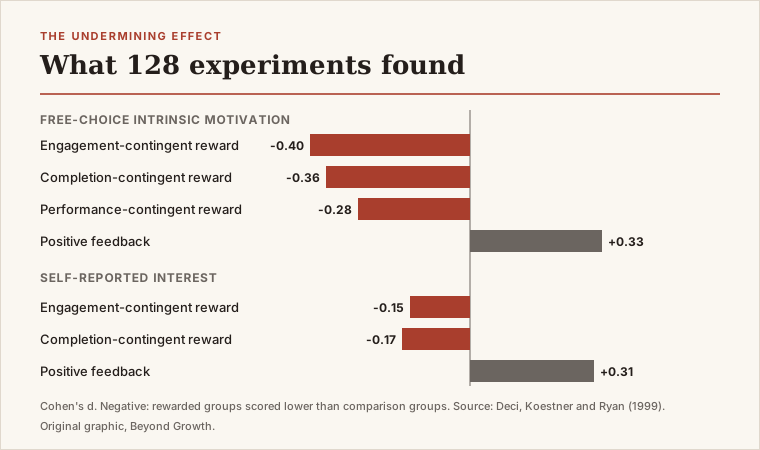
Those are modest effects, and they are not the same as "rewards ruin everything". They are also not nothing: statistically significant across many studies, and on the free-choice measure largest where the reward is paid just for taking part.
How do researchers measure "motivation" here?
Two ways, and they give different sizes. "Free-choice" motivation looks at what people do when they are left to choose, and Murayama's version counts "the number of voluntary engagements in the task". "Self-reported interest" asks people how much they liked it. In the 1999 meta-analysis the free-choice effects were larger than the self-report effects for the same rewards (d = -0.40 against -0.15 for engagement-contingent rewards). So a headline that says rewards "reduce motivation" is already choosing a measure. Neither is the same as day-to-day motivation across years of a job, which the lab studies above did not follow.
Who disagrees, and why?
In 1994, Cameron and Pierce had concluded that negative effects were "limited and could be easily prevented in applied settings". Deci and colleagues' 1999 review reached the opposite conclusion, and in 2001 Cameron, Banko and Pierce replied with a new meta-analysis whose result was: "in general, rewards are not harmful to motivation to perform a task". They reported that rewards on low-interest tasks enhanced free-choice motivation, and that harm appeared on high-interest tasks when rewards were "tangible, expected (offered beforehand), and loosely tied to level of performance" (Cameron, Banko and Pierce, 2001).
A published comment by Lepper, Henderlong and Gingras found the three meta-analytic reviews "dramatically opposed". They judged that the Deci review, and an earlier one by Tang and Hall, captured the literature "more accurately" than Cameron and Pierce's, and suggested there may be costs to "the unthinking or automatic use of meta-analysis" on a literature this varied (Lepper et al., 1999). The same issue carried a reply from the other side, by Eisenberger, Pierce and Cameron, arguing that reward effects can be "negative, neutral, and positive" (Eisenberger et al., 1999).
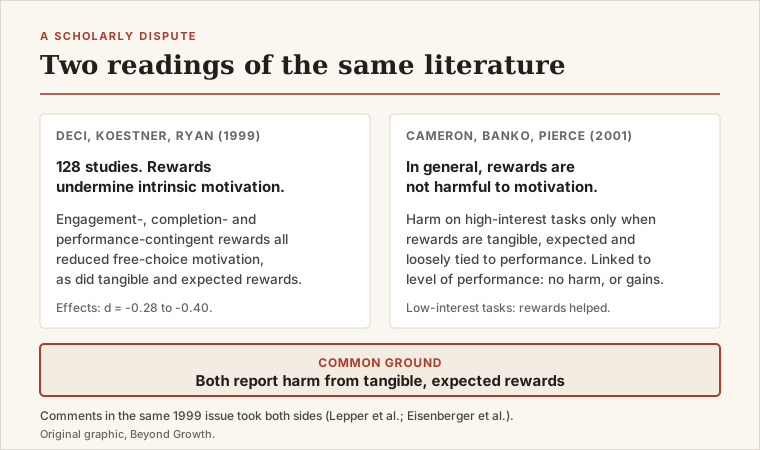
Read fairly, the camps disagree about breadth and prevention, not about whether any harm exists. Both report negative effects for tangible, expected rewards. The live argument is how often that situation arises in real life, and whether it can be designed around.
Does the brain tell a different story?
One well-known study tried. Murayama and colleagues induced the effect in a lab task and scanned participants: "performance-based monetary reward indeed undermines intrinsic motivation, as assessed by the number of voluntary engagements in the task", with reduced activity in the anterior striatum and prefrontal areas (Murayama et al., 2010). That supports the effect as real in one controlled setting. It does not show that a salary behaves the same way, and a brain scan cannot settle a dispute about meta-analytic breadth.
What about work?
A broad dataset on work, school and physical domains is Cerasoli's 2014 meta-analysis (183 samples, 212,468 people). Intrinsic motivation was a medium-to-strong predictor of performance (ρ = .21 to .45) "whether incentives were presented". When incentives were directly tied to performance, intrinsic motivation mattered less, a "crowding out" pattern. It predicted more of the quality of performance, while incentives predicted more of the quantity. The authors' conclusion: "incentives and intrinsic motivation are not necessarily antagonistic and are best considered simultaneously" (Cerasoli et al., 2014). Note that the abstract reports prediction, not experiments.
What about schools?
Fryer's school trials, across more than 250 urban schools, found that "student incentives increase achievement when the rewards are given for inputs to the educational production function, but incentives tied to output are not effective" (Fryer, NBER working paper 15898, 2010). The peer-reviewed version (Quarterly Journal of Economics, 2011), reporting three of the cities, was more cautious: it estimated the effect on achievement as "statistically 0, in each city", though it lacked the power to rule out worthwhile gains. Gneezy, Meier and Rey-Biel make the opposite worry vivid: an incentive for a child to learn to read "might achieve that goal in the short term, but then be counterproductive as an incentive for students to enjoy reading" (Gneezy et al., 2011). That is a stated risk, not a measured result, and Fryer's abstract reports achievement, not later enjoyment.
| Claim | What the research says | Source |
|---|---|---|
| Rewards always kill motivation | A 2001 meta-analysis found no pervasive harm; negative effects appeared in specific conditions | Cameron, 2001 |
| The undermining effect is a myth | The 1999 meta-analysis of 128 studies found significant undermining, d = -0.28 to -0.40 | Deci, 1999 |
| Pay and passion are opposites | Intrinsic motivation predicted performance with or without incentives; incentives predicted quantity | Cerasoli, 2014 |
| Pay kids for grades and they learn | Rewards for inputs looked better than rewards for test scores in a working paper; the published version found no clear effect either way | Fryer, 2010 and 2011 |
What does it imply for society?
Findings first, then our inference, kept apart on purpose.
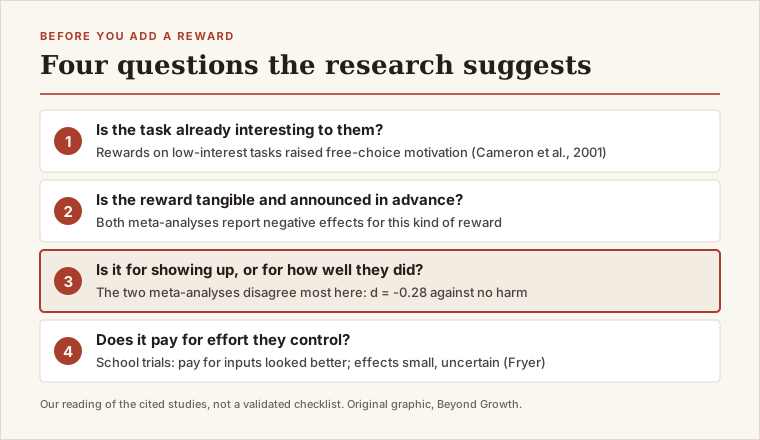
- For pay: The evidence supports design, not a slogan. Where quality matters and the task is one people already care about, a bonus tied directly to output sits in the area where Cerasoli found crowding out. Where quantity is the goal, incentives did better.
- For schools: Paying for things a child controls (reading a book, finishing homework) fared better in the working-paper results than paying for results they cannot yet produce; the published analysis found no clear effect on achievement. Whether either changes enjoyment of learning was not measured in what we read.
- For habit gadgets and gamified apps: Anything built on external consequences meets the same open question, whether it builds the habit or only the compliance. Our piece on the Pavlok wristband looks at one such device.
- For everyone: Positive feedback raised motivation in the 1999 meta-analysis, and verbal rewards did on high-interest tasks in the 2001 one. It costs nothing, so use it before reaching for a prize.
More in social criticism. For another popular idea that looks different under large studies, see Get a Growth Mindset (Or: What the Research Actually Shows).