Guru Criticism
The 4-Hour Body: Four More Claims
By Beyond Growth · 14 November 2026
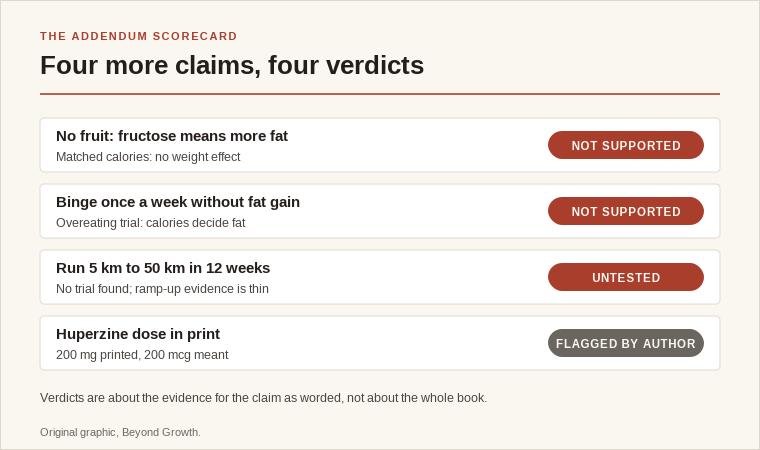
What else in The 4-Hour Body fails a check? Of four claims we tested, two lack support in controlled trials: the rule that fruit makes you fatter, and the idea that bingeing does not add fat (the closest trial overfed people for eight weeks, so a weekly binge itself is untested). One, running 5K to 50K in 12 weeks, has no trial behind it that we could find. And one is a dose typo the author flagged and asked his publisher to fix: a supplement dose off by a factor of a thousand. None of this makes the book worthless. It does mean any single number in it is worth checking before you act on it.
Our main review of The 4-Hour Body took three headline promises: two-hour sleep, a 300% fat-loss boost from cold, and 34 lb of muscle in 28 days. This is a companion piece for four other claims it did not cover. It sits in the guru-criticism section, but the target is the claims, not the man.
A 2011 post at this address, by a previous writer, was a short follow-up to his own review of the book (2011 original, via the Internet Archive). We check what the book says against what researchers measured.
Does skipping fruit burn fat?
The slow-carb diet's fourth rule, as Ferriss set it out on his blog in 2012, is "Don't eat fruit", with a one-line chemistry gloss ending in "more bodyfat, more or less". Avocado and tomatoes are excepted (tim.blog, 2012).
The test is whether fructose, the sugar in fruit, adds body fat by itself. A 2012 meta-analysis in the Annals of Internal Medicine pooled controlled feeding trials. In 31 trials (637 participants) where calories were matched, fructose compared with other carbohydrate made no overall difference to body weight: -0.14 kg, 95% interval -0.37 to +0.10. In 10 trials (119 participants) where fructose was added on top of the usual diet in large amounts, weight rose by 0.53 kg (0.26 to 0.79). The authors wrote that this "may have been attributable to excess energy rather than fructose itself" (Sievenpiper et al.).
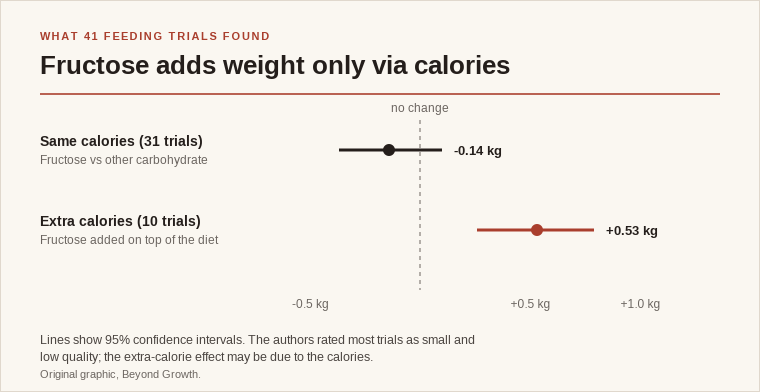
Fairness cuts both ways. Those trials were mostly small, short and of low quality, they studied free fructose rather than whole fruit, and they do not show fruit is harmless for everyone. A separate review of trials of eating more fruit and vegetables found that "studies to date do not support the proposition" that adding them causes weight loss unless other energy intake falls (Kaiser et al.). The pattern is consistent: calories are what move the scale. Dropping fruit may help someone eat less, and then it is a calorie rule. As a chemistry claim that fruit sugar turns into body fat, it is not what these trials found.

Can you binge weekly without gaining fat?
The same fifth rule of the diet reads: "Take one day off per week and go nuts." The book's back cover, quoted on Ferriss's blog, promises "How to prevent fat gain while bingeing" and asks whether you can "Lose more fat than a marathoner by bingeing" (tim.blog, 2010).
We found no trial of that exact pattern, so we looked at the closest ones. In a 2012 JAMA trial, 25 healthy adults lived in a metabolic unit and were overfed by about 40% (954 kcal a day) for eight weeks on diets with 5%, 15% or 25% protein. Weight gain differed, at 3.16, 6.05 and 6.51 kg, but "body fat increased similarly in all 3 protein diet groups". The authors concluded that "calories alone account for the increase in fat" (Bray et al.).
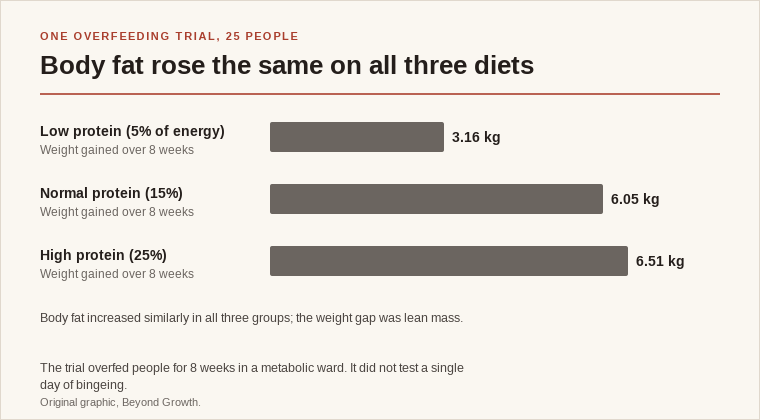
That trial ran for eight weeks, not one day, so it cannot say what happens after a single feast. A fair counter-example is the MATADOR trial: 51 men with obesity dieted in two-week blocks, alternating with two-week blocks at energy balance (eating enough to hold weight), and lost more than men who dieted continuously (14.1 against 9.1 kg, in those who completed the protocol) (Byrne et al.). But those breaks were at maintenance, with weight change "minimal" in the break blocks. They were not binges, and they were two weeks long.
So we land here. Planned breaks at maintenance improved weight loss in one trial, possibly by blunting the body's metabolic slowdown. "Go nuts" and "prevent fat gain" are not the same claim, and the controlled evidence says that a large calorie surplus is what adds fat. We found no study comparing a weekly binge with marathon training, so the marathon comparison is untested.
Can you go from running 5K to 50K in 12 weeks?
Another back-cover promise, again from Ferriss's own post, is "How to go from running 5 kilometers to 50 kilometers in 12 weeks" (tim.blog, 2010). We found no trial of that programme, so there is nothing to confirm or refute the headline.
What exists is a one-year study of 874 novice runners, which grouped them by how fast they raised weekly distance. Overall, "no statistically significant differences in injury rates" appeared across the three groups. Those who progressed by more than 30% over two weeks had a higher rate of distance-related injuries than those who progressed by less than 10%, a hazard ratio of 1.59 (95% interval 0.96 to 2.66, P = .07). The authors called it exploratory and suggested novices "may be well advised" to stay under 30% (Nielsen et al.).
That is thin evidence, and it is not a test of Ferriss's programme, whose details are in the book and not on the page we read. The useful lesson is about wording. "Possible" and "advisable" are not the same as "in 12 weeks, for anyone", and the headline carries no caveats.
What did the author correct?
On his blog in January 2011, Ferriss published a list of "4HB corrections and typos", noting that despite "more than six passes of the manuscript and a team of copyeditors, typos inevitably ended up". The first item is the huperzine dose on page 280. A reader pointed out that the book said 200 milligrams of the extract when it should be 200 micrograms. Ferriss replied in his notes to the publisher: "he's right. It should be 'micrograms (mcg)' NOT milligrams" (tim.blog, 2011).
Credit where due: he published the error and asked the publisher to fix it. The lesson is for readers. A thousandfold dose slip in print is how a self-experiment turns into a problem. The same post states the book's aim as to make readers "a self-sufficient self-experimenter within safe boundaries". Safe boundaries start with checking any supplement dose against the label, a pharmacist or a doctor, not a paperback.
Myth versus fact
| What the book or blog says | What the evidence says |
|---|---|
| "Don't eat fruit": fructose means more body fat | Matched-calorie trials show no weight effect; extra calories explain the gain |
| One day a week, "go nuts", with no fat gain | Overfeeding trial: calories alone account for fat; single-day bingeing untested |
| 5K to 50K in 12 weeks | No trial; faster mileage rises may raise injury rates, weakly shown |
| Launch post: "it all works" | It contains errors, such as a dose off by 1,000, that the author flagged on his blog |
How to test any chapter
Ask three things. What is the comparison, and what happened to the people who did not do it? Was it measured in a group, or reported by one person? And what number does it ask you to believe, and is it in a paper? Ferriss himself asks readers to track their own results, which is a sound instinct. The dose typo shows the other half of that habit: check every number against its source before you use it.
For the first three claims in this book, see the main review. For another case of a neat story and a thin evidence base, read the 4-minute mile and the myths of positive thinking, or browse more in guru criticism.