Identity
Is Small Talk Fake? Congruence Explained
By Beyond Growth · 14 November 2026

Is small talk fake? Not by itself. Congruence, the idea behind authenticity, asks whether what you say and do matches what you actually feel, not whether the subject is deep. The evidence points two ways: a 2010 study of 79 students found happier people had less small talk and more substantive conversation, and experiments with strangers found people expect deep talk to be more awkward than it turns out to be. Neither study shows that small talk is dishonest. The second suggests many of us stay shallower than we need to.
Small talk gets a bad press in the self-development world. It is "meaningless", "surface level", the thing real people skip. This essay, part of our identity section, asks a narrower question: does the psychology of authenticity say small talk is fake, and what does the research on conversation actually show?
What is congruence, and where does it come from?
Congruence is the match between three things: what you actually feel and think, what you are aware of, and what you say and do. The term comes from the person-centred psychology of Carl Rogers. Wood and colleagues, who built a peer-reviewed questionnaire for authenticity, describe their model as "based substantially on the theory of Rogers" (Wood et al., 2008). They cite a definition of authenticity as "consistency between the three levels of (a) a person's primary experience, (b) their symbolized awareness, and (c) their outward behavior and communication".
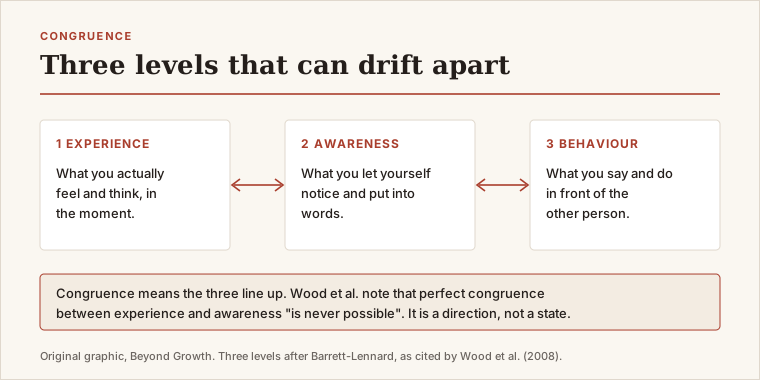
Two details matter for small talk. First, the test is consistency, not depth. Wood and colleagues describe authentic living as "behaving and expressing emotions in such a way that is consistent with the conscious awareness of physiological states, emotions, beliefs, and cognitions". Nothing in that says the topic must be profound. Second, they write that what you feel and what you are aware of can never match perfectly: "perfect congruence between these aspects of experience is never possible". Our reading: everyone edits themselves a little in company, and the useful question is how far apart the inside and the outside have drifted.
So is small talk incongruent?
It can be, and it often is not. Ask what is behind the sentence.
- Congruent small talk: you ask how someone's weekend was because you are mildly curious or want to be friendly, and you mean it. Inside and outside match; the content is light.
- Incongruent small talk: you say you love a restaurant you dislike, or laugh at a remark you find rude, because it keeps things smooth. Inside and outside have split.
- Incongruent depth: a confession you perform because the moment seems to call for it, with no real feeling behind it. That is a mismatch dressed as honesty.
The same is true in the other direction. A deep conversation can be a performance, and a chat about the weather can be an honest "I would like to be pleasant to you". So "is small talk fake?" is the wrong test. "Do I mean it?" is closer. That is our reading of the definition, not a finding from a study.
The practical upshot is a cheaper test than any questionnaire. Before you speak, there is usually a half-second in which you know whether you mean the sentence. Congruence is mostly the habit of noticing that half-second, and choosing the true version of the sentence over the smoothest one, even when the true version is only slightly different.
What does the research say about small talk and well-being?
A widely cited study is Mehl, Vazire, Holleran and Clark (2010), "Eavesdropping on happiness: well-being is related to having less small talk and more substantive conversations" (PubMed, author manuscript). Seventy-nine students wore a recorder for four days that captured 30 seconds of sound every 12.5 minutes, giving 23,689 recordings. Coders then labelled conversations. The authors defined small talk as "an uninvolved conversation of a banal nature", where "only trivial information is exchanged", and a substantive conversation as "an involved conversation of a substantive nature", where "meaningful information is exchanged".
Across participants, 17.9 per cent of conversations were small talk and 35.5 per cent were substantive. Higher well-being went with less small talk (r = -.33) and more substantive conversation (r = .28). Comparing the happiest participants (1.5 standard deviations above average) with the unhappiest (2.0 below), the authors report that the happiest had "roughly one third as much small talk", 10.2 per cent against 28.3 per cent, and "twice as many substantive conversations", 45.9 per cent against 21.8 per cent.
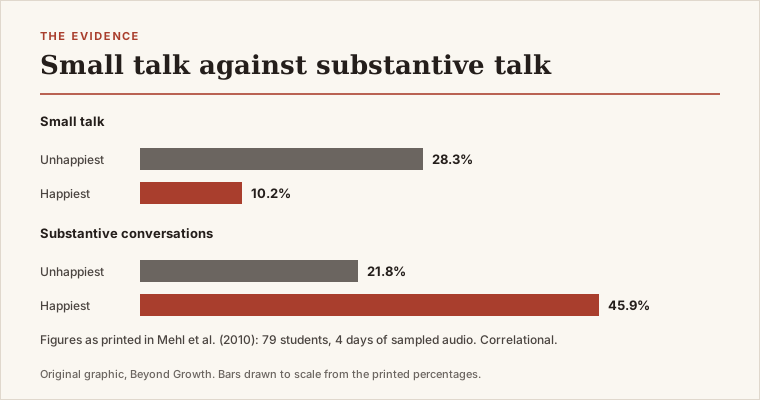
Three cautions, all from the paper or its method. The authors write that "our correlational findings are causally ambiguous": happy people may attract deeper talk, or deep talk may make people happier. After the authors adjusted for personality, "the effects for small talk were diminished". And the study measured depth of conversation, not authenticity: it never asked whether anyone meant what they said.
There is also evidence on the other side. Sandstrom and Dunn (2014) found that "weak ties", meaning acquaintances, are related to "social and emotional well-being", and conclude that "even social interactions with the more peripheral members of our social networks contribute to our well-being" (PubMed). Contact with acquaintances is not worthless. Taken together, the studies do not say small talk is bad or good. Our reading: the depth of a conversation and its honesty are different things, and these studies measured depth, not honesty.
Why do we stay shallow?
Kardas, Kumar and Epley (2022) tested a plausible reason: we misjudge how the other person will react. Their abstract reports that "conversations between strangers felt less awkward, and created more connectedness and happiness, than the participants themselves expected", and that participants "overestimate how awkward deep conversations would be compared with shallow conversations" (PubMed). The cause they identify is that people "expected others to care less about their disclosures in conversation than others actually did".
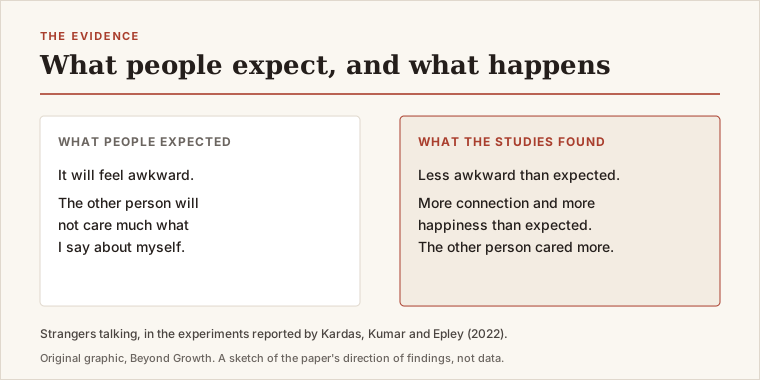
Note the scope: these were experiments with strangers, and the abstract adds that people predicted outcomes "more accurately" with close friends, family or partners. The finding is about a gap in our predictions. It is not an instruction to share your life story with the person next to you on the train.
Myth or fact?
| Common belief | What the evidence supports |
|---|---|
| Small talk is fake | Congruence is about matching feeling and expression, so small talk can be honest or not |
| Deep talk is always authentic | Depth can be performed; the match with what you feel is the test |
| Happy people avoid small talk | One correlational study links more substantive talk with well-being; it cannot show cause |
| Strangers do not want depth | In experiments, people overestimated how awkward deep talk would be |
| Talking to acquaintances does not count | Research on weak ties links it to belonging and mood |
How do you have more honest conversations?
None of this needs a technique. It needs a small habit.
- Mean the small bit. If you ask "how was your weekend?", wait for the answer. That alone makes small talk congruent.
- Add one deeper step. After the small talk, ask one question you are actually curious about, or give one real opinion. The Kardas studies suggest the reaction will be better than you predict.
- Follow the lead. If the other person stays light, stay light. Depth that is not wanted is another kind of mismatch.
- Notice the gap. If you say "great, thanks" when it was not, that is the sort of small split congruence is about. You do not have to confess; you can choose a true, lighter answer, such as "busy, but good to see you".
Small talk is not the enemy of authenticity; saying things you do not mean is. For the underlying idea, read what authenticity is and where "be yourself" goes wrong, or browse the identity section. For a related look at how individuality turns into conformity, see the herd mentality of lifestyle design.