Identity
What Is Authenticity? The Be-Yourself Paradox
By Beyond Growth · 14 November 2026

What is authenticity? It is acting in line with what you actually think, feel and value. A peer-reviewed psychology test of it is 12 statements long, and it measures three things: how out of touch you feel with yourself, whether you act on your own beliefs, and how far you bend to what others expect. The paradox is that "be yourself" is advice from someone else, so following it can be a way of doing what you are told. The research is real but limited: it is self-report, its samples were modest, and it shows a link with well-being, not a cause.
Few pieces of advice are given as often or explained as rarely as "just be yourself". This essay, part of our identity section, takes the phrase apart: what it can mean, what psychologists actually measure when they say authenticity, and where the idea runs out.
What does authenticity actually mean?
In everyday use it means being the same person inside and out: saying what you think, doing what you believe, not putting on a front. Psychology gives that a more careful shape. Alex Wood and colleagues, in a 2008 paper in the Journal of Counseling Psychology, cite a definition by the person-centred psychologist Godfrey Barrett-Lennard: authenticity involves "consistency between the three levels of (a) a person's primary experience, (b) their symbolized awareness, and (c) their outward behavior and communication" (Wood et al., 2008).
In plain words, three things can match or drift apart: what you actually feel and think, what you let yourself notice, and what you say and do. Authenticity is the match. The same paper says its model rests on the theory of Carl Rogers, and notes that what you feel and what you are aware of can never match perfectly ("perfect congruence between these aspects of experience is never possible"). So the target was never "be one hundred per cent yourself". It is "have fewer gaps".
Why is "be yourself" a paradox?
Because the instruction comes from outside. Someone tells you to be yourself; you try to behave the way a "real you" is supposed to behave; and you are now meeting an expectation, which is the thing authenticity is meant to be free of.
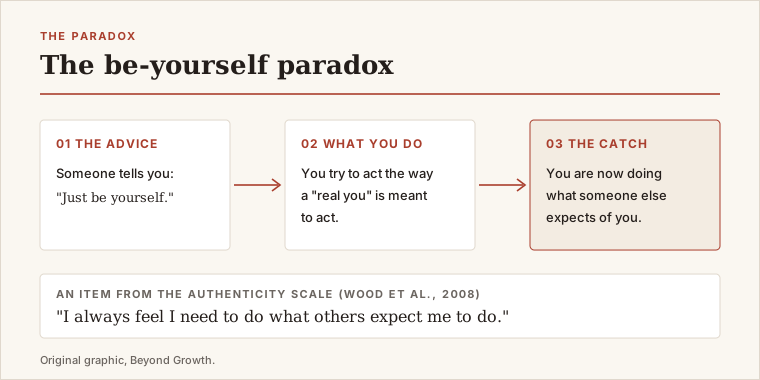
The research makes the tension visible. One of the statements that made it into the final scale is "I always feel I need to do what others expect me to do", which loaded on the factor they called accepting external influence. Another, "I think it is better to be yourself, than to be popular", loaded on authentic living. The scale therefore treats bending to others' expectations as one of the three things to measure, and "be yourself" as a stated preference to be weighed against popularity. It does not treat being told to be yourself as free of social pressure. That reading is ours, not the authors'.
In our view, "be yourself" works better as a question you ask yourself than as an order you receive. An order has a giver, and the giver's approval becomes the new target. A question (do I actually think this? do I actually want this?) has no audience, which is closer to what the measurement research is describing.
A version of this shows up in lifestyle design, a genre built around individuality that tends to produce a recognisable uniform; we look at it in the herd mentality of lifestyle design. Copying a template of "being yourself" is still copying.
How do psychologists measure authenticity?
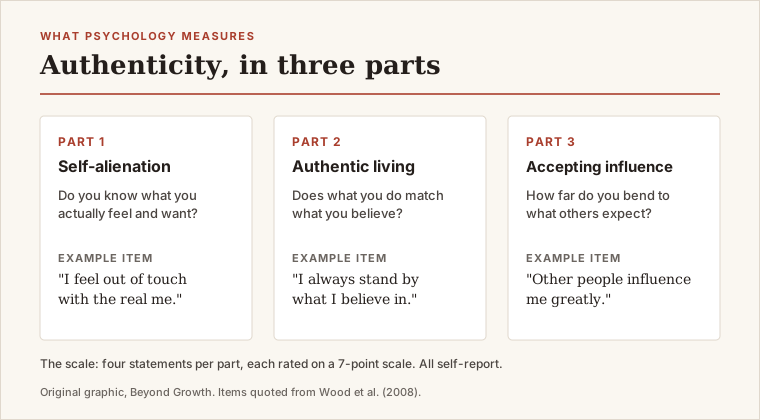
With a questionnaire. The paper's own abstract says the scales were "designed to measure a tripartite conception of authenticity, comprising self-alienation, authentic living, and accepting external influence". The authors started with 25 statements and cut the final Authenticity Scale to 12, four for each part, rated from 1 (does not describe me at all) to 7 (describes me very well).
The abstract also reports that the scale "showed substantial discriminant validity from the Big Five personality traits" and "nonsignificant correlations with social desirability", with test-retest correlations at 2 and 4 weeks ranging from .78 to .91. Put simply: the score is stable over a few weeks, it is not just a re-labelling of the standard personality traits, and people do not appear to answer it only to look good. That makes it a respectable measuring tool. It does not tell us whether authenticity is a good thing to chase.
Does being authentic make you happier?
The same abstract says: "Each subscale was strongly related to self-esteem and aspects of both subjective and psychological well-being." In the discussion the authors go further: "it appears that authenticity is one of the strongest predictors of well-being", noting that their authenticity and well-being measures share no items.
That is a real finding, and it is the main evidence behind the self-help claim. Read it with the limits in mind.
What are the limits of the research?
Three, and the authors name the last one themselves.
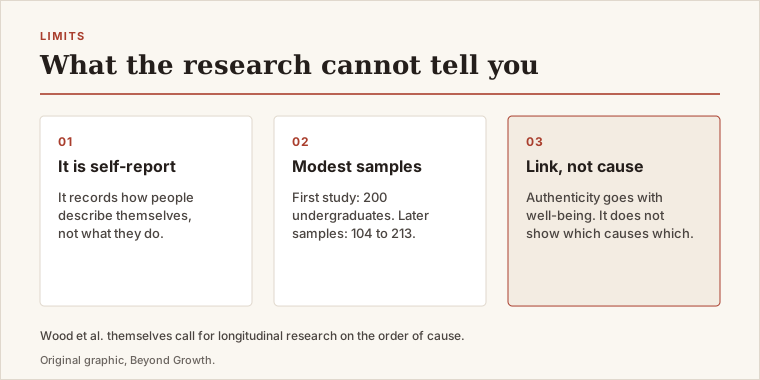
- It is self-report. The scale records how people describe themselves. Someone who feels authentic and behaves inconsistently would still score well.
- The samples were modest. The first study had 200 undergraduates, 90 per cent of them under 26. Later studies added community adults, in groups of 180 and 104, and the largest sample in the paper was 213 people. Whether the findings hold across ages, cultures and settings is a separate question.
- A link is not a cause. The authors say longitudinal research is needed on "the order of causality between authenticity and well-being". Happier people may find it easier to be themselves, not only the reverse.
There is a fourth issue we would add, labelled as our reading. The paper reports earlier work finding that people who see their personality vary more between roles tend to see themselves as less authentic. But behaving differently at a funeral and at a party is not obviously a failing. A role-variability measure that scores it as one may be catching tact and calling it falseness. We cover that boundary in our essay on small talk and congruence.
Myth or fact?
| Common belief | What the evidence supports |
|---|---|
| Being authentic means saying everything you think | The definition is about matching experience, awareness and behaviour, not total disclosure |
| You can reach a state of full authenticity | The authors say awareness can never perfectly match experience, so a complete match is not on offer |
| Authenticity causes happiness | Studies show a strong link; the authors say the order of cause is still open |
| "Be yourself" is the first step | It is an instruction with no method, and it can be one more expectation |
| Authenticity is the opposite of social influence | Social influence is one of the three parts the scale measures |
What can you do with this?
Four small moves, none of which need a course.
- Ask whose expectation it is. Before agreeing to something, notice whether you are doing it because you want to or because someone would expect it. That is the "accepting external influence" question, and you can ask it without scoring anything.
- Check for self-alienation. Can you say, in one sentence, what you actually feel or want about a decision? If not, you have found a gap worth closing before you act.
- Close one gap at a time. If you say yes when you mean no, change one instance this week. Do not redesign your personality.
- Test before you buy. Anyone selling the "real you" in a programme has a commercial reason to keep the question open. Prefer advice you can check against your own week. For another self-help claim held up against the research, see is manifestation real?
Authenticity is a useful word with a modest meaning: fewer gaps between what you feel, what you notice and what you do. More essays on identity will appear in the identity section, and for the growth-industry side of this theme, see what the growth-mindset research shows.