Personal Development
Ending Chronic Procrastination: What Works
By Beyond Growth · 14 November 2026
Twelve randomised trials, 718 people: psychological treatment for procrastination had a small average benefit (g = 0.34), and the three CBT-based studies a moderate one (g = 0.55) (Rozental et al., 2018, Frontiers in Psychology). That is the honest size of the evidence. It is real, it is modest, and it is more than most self-help advice on the subject can claim.
What does the research say about ending chronic procrastination? It is not described as laziness. A landmark 2007 review calls it a self-regulation failure, with the task's unpleasantness, self-efficacy and impulsiveness among the strongest predictors. A newer account says delay is a way of avoiding unpleasant feelings about a task. Trials favour CBT-based help, including online programmes and single sessions. A plain approach: name the feeling, make the first step small, write an if-then plan, drop the self-attack, and get structured help if it persists.
This is a piece about what the studies show, in the personal development section, and about what a reader can sensibly do with them. An earlier essay under this address, by a previous writer, is kept by the Internet Archive (2012 copy).
Is chronic procrastination just laziness?
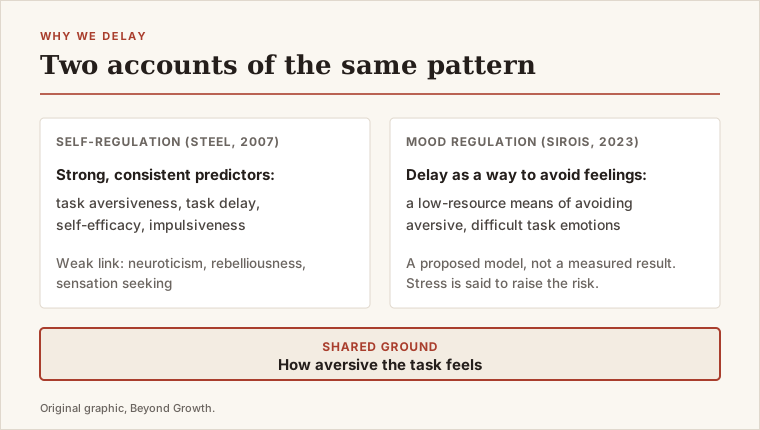
The research does not start there. Steel's 2007 meta-analysis, based on 691 correlations, calls procrastination "quintessential self-regulatory failure". It found that "task aversiveness, task delay, self-efficacy, and impulsiveness" were strong and consistent predictors, along with conscientiousness and its facets of self-control, distractibility, organisation and achievement motivation. Neuroticism, rebelliousness and sensation seeking "show only a weak connection" (Steel, 2007, Psychological Bulletin).
Read that list as a reader would. Some of it is about you (impulsiveness, belief in your own ability). A good deal of it is about the task: how unpleasant it is, and how long the delay before any payoff. The review ties the pattern to temporal motivation theory, a mix of expectancy theory and hyperbolic discounting, which in plain terms says a distant reward pulls less than a near one.
Is it an emotion-regulation problem?
Partly, and this is a live account rather than a settled finding. Sirois's 2023 review argues, from a mood-regulation view, that procrastination is "a low-resource means of avoiding aversive and difficult task-related emotions", and that stressful contexts raise the risk because they deplete coping resources (Sirois, 2023, International Journal of Environmental Research and Public Health). That is a proposed model, labelled by its author as one, not a measured result.
Three pieces of evidence lean its way, each with limits:
- Stress and health. Across 36 samples (8,603 people), trait procrastination correlated with poorer self-rated health (r = .21), and the link was explained in part by stress (Sirois and Monaghan, 2026). The samples were cross-sectional, so this shows association, not cause.
- Who gains from CBT. Pooling data from two trials (459 people), those with more emotion-regulation difficulty at the start benefited more, and gains ran through more positive and less negative task-related affect (Pietruch et al., 2026, Behaviour Research and Therapy). It is a secondary analysis, so it suggests a mechanism and does not prove one.
- A counterweight. Steel's meta-analysis found neuroticism only weakly linked. If procrastination were mainly about being emotionally reactive, you would expect more.
A fair summary: the two accounts overlap on the point that matters for action. How aversive the task feels sits in both.
Which treatments have trial evidence?
Here is the strongest evidence, side by side.
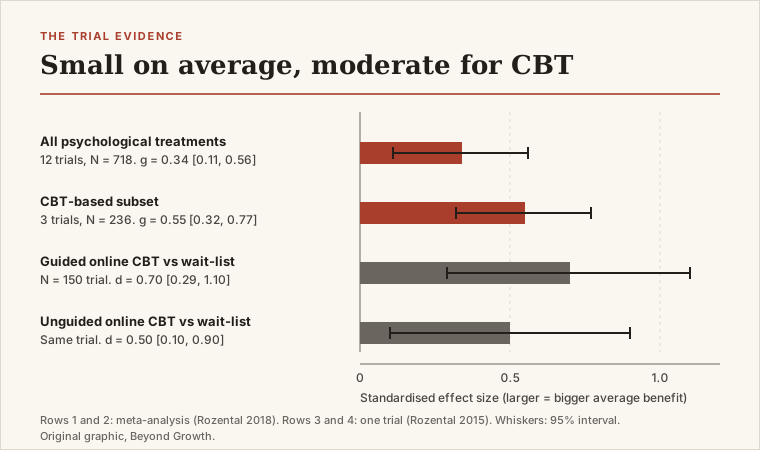
Cognitive behavioural therapy, including online. The 2018 meta-analysis found small benefits overall and a moderate one for CBT, but with "significant heterogeneity" and "some risk of bias", and the CBT subset was three studies. In a 150-person trial, guided and unguided internet CBT both beat a wait-list on the Pure Procrastination Scale (d = 0.70 and d = 0.50). Clinically significant change was reached by 31.3 to 40.0 per cent of the guided group and 24.0 to 36.0 per cent of the unguided group, so most participants did not reach that threshold (Rozental et al., 2015). A one-year follow-up found the gains held, with no difference between guided and unguided (Rozental et al., 2017).
Single sessions, for students. In a 2026 trial, 151 students with recurrent procrastination and a task they were currently putting off were randomised to one CBT session, one ACT session (about 60 minutes each) or nothing. Both sessions cut procrastination more than the control, with no significant difference between them. The follow-up was two weeks (Mousavi, Rief and Wilhelm, 2026).
Mental contrasting with if-then plans. A small 2026 trial (81 students) compared this method with a positive-thinking control. It reduced task aversiveness and raised willingness to start, with effects holding at one week (Zhou et al., 2026). It is small and short, so it is a promising signal, and it fits the pattern we found in our piece on whether vision boards work.
How much weight can these studies bear?
Less than the headlines around them. The meta-analysis included only trials with an inactive comparator and self-report outcomes, so it says nothing about whether treatment beats a friendly chat or a well-chosen book. The 150-person online trial compared treatment with a wait-list, which cannot show that the treatment beats any other kind of attention. The student trials are short. And none of the trials we read tested the things people actually buy for procrastination, such as planners, blockers or productivity apps. Absence from these trials is not evidence against them. It means these trials do not show that they work.
What do people get wrong about it?
| Myth | What the research says | Source |
|---|---|---|
| Procrastinators are lazy | The strongest predictors are task aversiveness, delay, self-efficacy and impulsiveness | Steel, 2007 |
| Positive thinking will fix it | A small trial found mental contrasting with if-then plans beat a positive-thinking control on task aversiveness | Zhou, 2026 |
| It needs months of therapy | A single session of about 60 minutes helped students in the short term | Mousavi, 2026 |
| It is a harmless habit | Trait procrastination links to poorer self-rated health (r = .21), partly through stress | Sirois and Monaghan, 2026 |
What can I try?
None of the trials tested the five steps below as a package. They are our reading of what the evidence points at, and each step names the finding behind it.
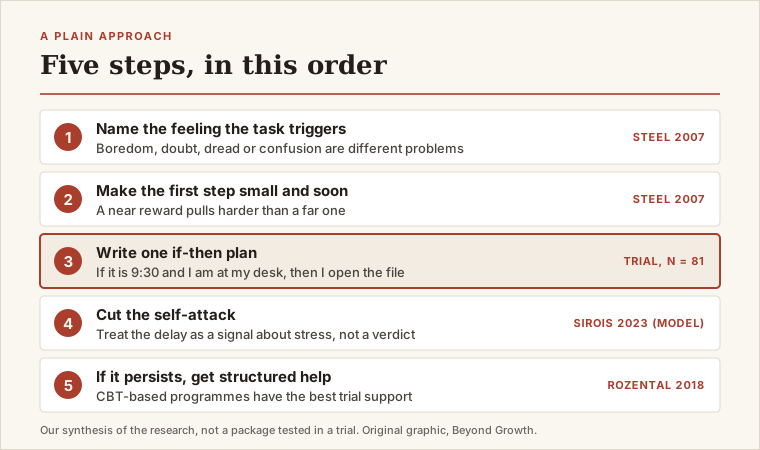
- Name the feeling. Boredom, doubt, dread or confusion are different problems. Task aversiveness is among the strongest predictors, and task-related feeling was part of how CBT worked in the Pietruch analysis. Writing "I am avoiding this because I do not know where to start" is already a step.
- Make the start small and soon. Delay and aversiveness both feature in Steel's findings, and temporal motivation theory says a near reward pulls harder than a far one. Pick a first action you can finish in minutes, today.
- Write one if-then plan. "If it is 9:30 and I am at my desk, I open the document and write one paragraph." The Zhou trial combined if-then plans with mental contrasting and compared the result with a positive-thinking control.
- Cut the self-attack. Sirois's model argues for "a more compassionate view" of why delay happens, because stress makes it more likely. That is a theory, so treat the compassion as a sensible working assumption, not a proven cure.
- Get structured help if it persists. Guided or unguided CBT programmes have the best trial support we found.
When is it more than procrastination?
The meta-analysis authors recommend a screening interview at intake in future research. If delay comes with persistent low mood, anxiety or attention difficulties, see a GP or a therapist. In the Pietruch analysis, baseline depression, anxiety and ADHD symptoms did not reduce how much people gained from CBT. That is an argument for asking, not for waiting.
More on this theme in personal development. If you want to see how a popular self-improvement idea fares against large studies, read Get a Growth Mindset (Or: What the Research Actually Shows), and for the if-then plan in a different setting, Do Vision Boards Work?.