Positive Thinking
Do Vision Boards Work? The Evidence, Plus a Fix
By Beyond Growth · 14 November 2026
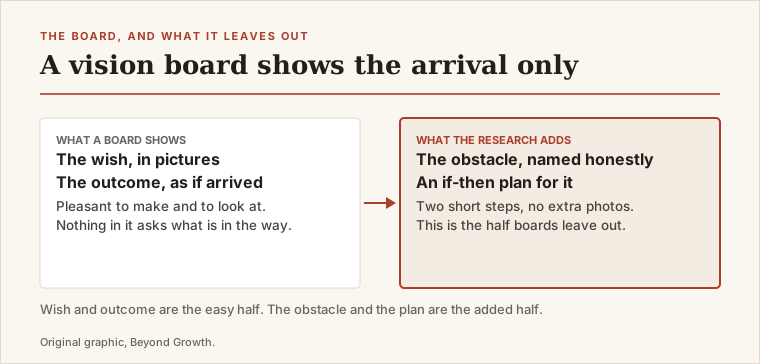
Do vision boards work? Not on their own, on the evidence we can find. We could not find a study testing a vision board on its own, so we cannot point to any evidence that a board by itself helps. The nearest research, on "positive fantasy", found that people who enjoyed picturing a desired future showed less effort and worse results later, in four different groups. The same researchers built a fix: keep the wish, then name the obstacle and write an if-then plan for it. A 2021 review of 21 studies found a small to medium benefit for that method.
A vision board is a collage of the life you want: the house, the body, the holiday, the job title. It feels productive, and making one is pleasant. The question is whether it moves you any closer. This piece is part of our positive thinking coverage and builds on our longer answer to whether manifestation is real. It also pairs with our look at what The Secret does and does not show.
Is there scientific evidence that vision boards work?
We could not find any. On 14 November 2026 we searched PubMed for "vision board" and "vision boards" in titles and abstracts and got zero records. That is a bounded search: it does not cover every database, book or conference paper, so read it as "we found no trial", not "none exists". It is still telling that a practice this widely taught has no trial we can point to.
The practice does have a stated source. The Secret's own site lists "visualization" among the principles for using the law of attraction, and its homepage promises "You can have, do, or be anything you want." That is a claim, not a result. The question becomes whether the thinking a board relies on has been tested. It has.
What does the nearest research say?
A board is a tool for dwelling on a desired future. Researchers call that positive fantasy: "experiencing one's thoughts and mental images about a desired future positively." In 2002 Gabriele Oettingen and Doris Mayer published four studies in the Journal of Personality and Social Psychology. The groups were graduates looking for a job, students with a crush on a peer, undergraduates anticipating an exam, and patients undergoing hip-replacement surgery. Effort and performance were measured "weeks or months (up to 2 years)" afterwards.
Their abstract reports: "Positive expectations (judging a desired future as likely) predicted high effort and successful performance, but the reverse was true for positive fantasies."
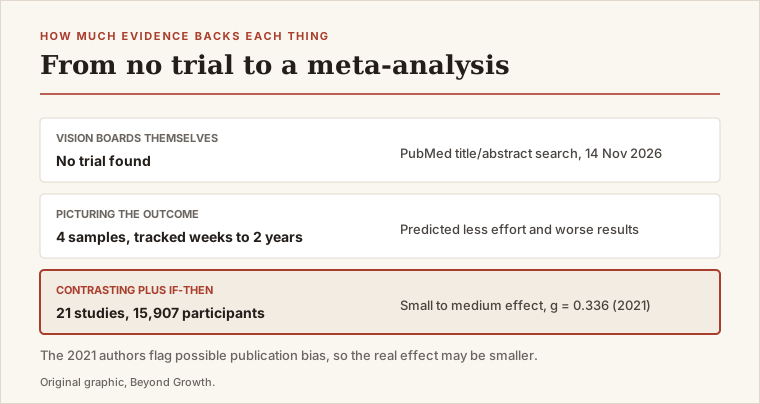
Two cautions keep this honest. First, "predicted" is not "caused": people reported their fantasies and were then followed, so it is an association. Second, none of those studies involved a board. The step from "enjoying a mental picture of success predicts less effort" to "a board of pictures of success is a poor bet on its own" is our inference. A board might behave differently, because it is something you make and look at over weeks. We found no study testing a board on its own; boards appear only as one part of wider programmes.
What actually helps instead?
The same research programme found a better pairing. In 2001 Oettingen, Pak and Schnetter showed what happens when people contrast the fantasy with present reality. Their abstract says: "Strong goal commitment arises in light of favorable expectations, and weak goal commitment arises in light of unfavorable expectations." People who only fantasised, or only dwelt on reality, ended up with "expectancy-independent moderate goal commitment".
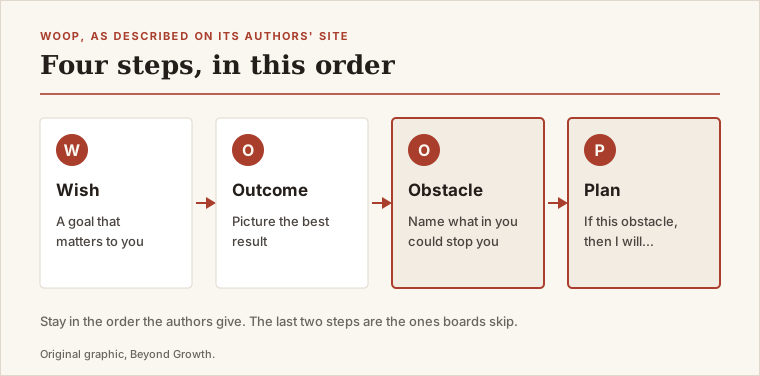
So the point is not to stop dreaming. The WOOP site puts it this way: "WOOP instructs us to dream our future dreams but then to imagine what obstacles inside ourselves prevent us from achieving these dreams." The method has four steps, Wish, Outcome, Obstacle, Plan, and the site says you "need to be focused and stick to the right order of the four steps."
A 2014 study by Sevincer, Busatta and Oettingen adds a physical measure. Mental contrasting a desired future of excelling in an intelligence test "triggered changes in energization", measured by systolic blood pressure, "that translated into physical effort in squeezing a handgrip." The idea is that facing the gap between where you are and where you want to be is what gets the body ready to act.
How much does the better method help?
Modestly, and it is worth saying so plainly.
- School. In a randomised trial, 77 fifth graders from an urban middle school learned either mental contrasting with implementation intentions (MCII) or a Positive Thinking control strategy. MCII "significantly improved their report card grades (η2 = .07), attendance (η2 = .05), and conduct (η2 = .07)" (Duckworth and colleagues, 2013).
- All goals. A meta-analysis of 21 studies and 15,907 participants found MCII "effective for goal attainment with a small to medium effect size (g = 0.336)". The authors warn that "because of some publication bias, the actual effect sizes may be smaller."
- Health. A separate review of mental contrasting for health behaviours (1,528 participants) found g = 0.28 at up to four weeks and g = 0.38 at up to three months (Cross and Sheffield, 2019). It found that adding if-then plans did not strengthen the effect further, based on a small subset of studies.
- Delivery. In the all-goals review, interventions with a person guiding you (g = 0.465) beat those delivered by documents (g = 0.277). A blog post is a document, so expect the weaker end.
A vision board plus two steps: the short version
Keep the board. Then, in this order:
- Wish. Pick one thing on the board you want in the next few months. Example, ours: run a 10k in spring.
- Outcome. Look at the board and imagine the best result: crossing the line.
- Obstacle. Name the thing inside you most likely to get in the way. Not "no time": the honest version. Example: "I skip evening runs when it is dark when I get home."
- Plan. Write one if-then plan. Example: "If it is dark when I get home, then I put my running kit on before I sit down."
Steps 3 and 4 are the part a board leaves out. The examples are ours, to show the shape; they are not from the studies.
Myth versus fact
| Common belief | What we can support |
|---|---|
| Vision boards are scientifically proven | We found no trial of vision boards (PubMed title and abstract search, 14 Nov 2026) |
| Picturing success makes it likelier | Positive fantasy predicted lower effort and performance in four samples (2002) |
| Dreaming is the problem | No: the research keeps the dream and adds the obstacle and a plan |
| Any visualisation helps | Mental contrasting, not fantasy alone, had trial and meta-analysis support |
| The fix is a big effect | Small to medium (g = 0.336), possibly smaller after publication bias |
So is a vision board worth making?
As a way to decide what you want, yes. It makes a vague wish concrete, and that is a fair first step. As a method for getting it, the evidence we found says it is incomplete at best. If you have a board on your wall, spend a few minutes on the two steps it lacks. The WOOP site says you "only need a few minutes". If you do not have one, you can skip the board and do the four steps on a sticky note.
More in positive thinking. Related: Is manifestation real?, Does The Secret work? and The 4-minute mile and the myths of positive thinking.
Sources: Oettingen and Mayer, PubMed 12416922, J Pers Soc Psychol 83(5), 2002; Oettingen, Pak and Schnetter, PubMed 11374746, 2001; Sevincer, Busatta and Oettingen, PubMed 24145296, Pers Soc Psychol Bull 40(2), 2014; Duckworth et al., PubMed 25068007, 2013; Wang, Wang and Gai, PubMed 34054628, Front Psychol 12, 2021; Cross and Sheffield, PubMed 30879403, Health Psychol Rev 13(2), 2019; A 2024 trial protocol pairing the MCII and WOOP names; WOOP my life, Science and Practice; The Secret homepage.