Personal Development
Deep Work by Cal Newport: What Holds Up
By Beyond Growth · 14 November 2026

Cal Newport's Deep Work gives you one big idea and a stack of confident advice, and the useful skill is telling which is which. It belongs in personal development because it is the rare self-help book whose central claim is checkable. This review checks the book's main claims, as Newport states them on his own pages, against the research behind them.
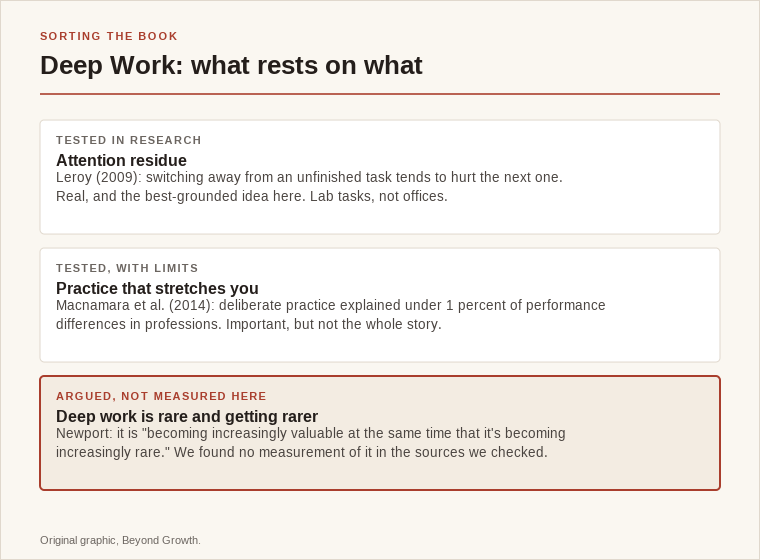
Which parts of Deep Work rest on research? Attention residue does: lab work found that switching away from an unfinished task is likely to hurt the next one. The claim that deep work is becoming rarer and more valuable is Newport's argument, and we found no measurement of it in the sources we checked. The neighbouring idea that focused practice explains top performance is weaker than popular books say. What you can apply: fewer task switches, protected blocks of time, and a two-week test on your own output.
What does the book claim?
Newport defines deep work on his own site as "the act of focusing without distraction on a cognitively demanding task", and states the thesis in one sentence: "Deep work is becoming increasingly valuable at the same time that it's becoming increasingly rare." (Cal Newport, announcement post, 20 November 2015). The post said the book would be published on 5 January, which puts it in January 2016. It names three practices the book develops: time blocking, fixed-schedule productivity and depth rituals.
That gives us three types of claim to separate. There is a research claim (switching tasks costs you). There is a trend claim (deep work is rarer and more valuable). And there is a practice claim (these habits will get you more deep work). Each needs a different kind of evidence.
Is attention residue real?
This is the strongest card in the book. Newport credits the idea to business professor Sophie Leroy, and describes it on his blog: "the original target leaves a 'residue' that reduces cognitive performance", adding "As I argued in Deep Work", the effect can have a "profoundly negative" impact on knowledge-worker productivity (Cal Newport, 6 September 2016).
The research is Leroy's 2009 paper, "Why is it so hard to do my work? The challenge of attention residue when switching between work tasks", in Organizational Behavior and Human Decision Processes. In a book excerpt published by Knowledge at Wharton, Newport describes one of the experiments: subjects began a set of word puzzles. In some trials Leroy interrupted them and gave them a new task, reading résumés and making hypothetical hiring decisions; in others they finished the puzzles first. A quick word-recognition game between tasks measured the leftover residue. The finding, as Newport reports it: "People experiencing attention residue after switching tasks are likely to demonstrate poor performance on that next task", and the more intense the residue, the worse the performance (Knowledge at Wharton).
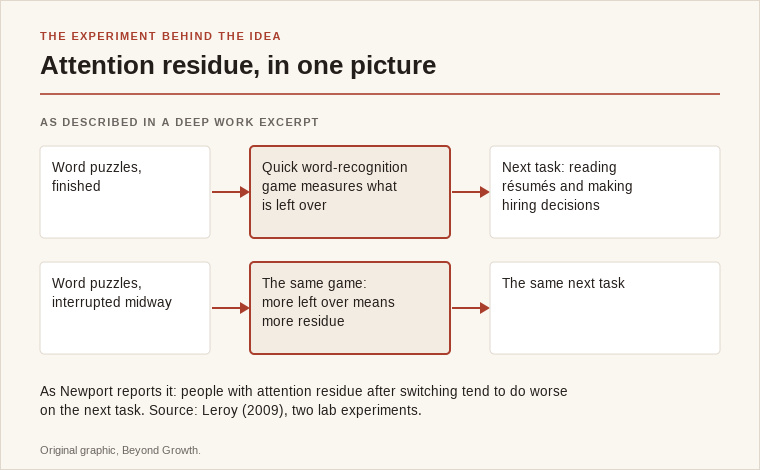
The paper's own abstract adds a twist the summary leaves out: across two experiments, finishing the first task was not enough on its own. People switched cleanly only when they had finished the first task under time pressure (Leroy, 2009). And these were short laboratory tasks. Whether a glance at your inbox leaves the same residue across a working morning is a reasonable inference, not something this study measured.
Even so, the direction is plausible and the design is a real experiment that varied whether the first task was finished and under how much time pressure. If you take one thing from the book, take this: a switch is not free.
Is deep work really getting rarer and more valuable?
This is the book's thesis. Newport calls it "The Deep Work Hypothesis" and says the book provides evidence that it is true (Cal Newport, 2015). The sources we checked contain an argument for it, not a measurement: nobody has shown us a count of how many hours of undisturbed work an average knowledge worker did in, say, 2005 and 2025, or a wage premium for people who do it. We are not saying the claim is false. It is intuitively reasonable, many people recognise it from their own days. We are saying that on the evidence we could verify, it is a claim about the world that is argued, not tested.
That matters because the advice builds on it. If deep work is both rare and valuable, then protecting it is an edge. If it is only valuable, protecting it is still sensible, but the competitive story weakens.
Does focused practice explain top performance?
A related idea often sits beside deep work in popular writing: that sustained, structured effort is what separates the best from the rest. Newport's book is not about this idea alone. But the best test of the neighbouring claim is worth knowing, because many readers carry it into the book.
A 2014 meta-analysis defined deliberate practice as "structured activities created specifically to improve performance in a domain", and found it explained 26% of the variance in performance for games, 21% for music, 18% for sports, 4% for education, and less than 1% for professions. Its conclusion: "deliberate practice is important, but not as important as has been argued" (Macnamara, Hambrick and Oswald, Psychological Science, 2014, via PubMed).
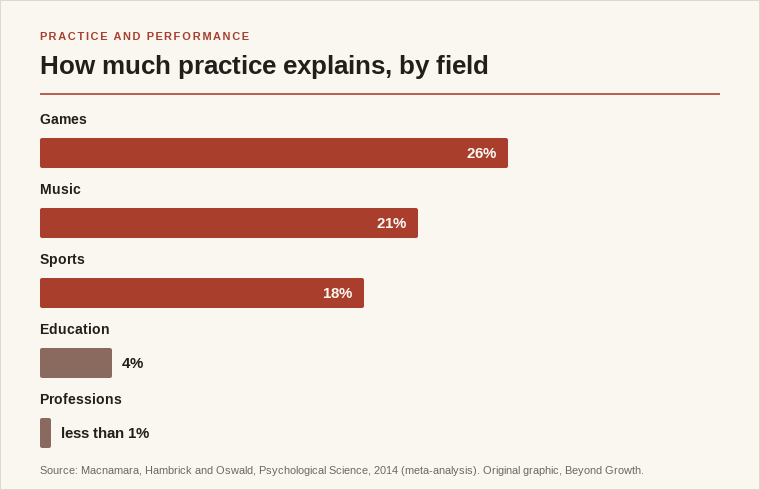
For a knowledge worker, the less-than-1% figure is the one to sit with. It does not say focus is useless. It says that in professions, other factors do most of the explaining, so concentration is a tool and not a master key.
Myth or fact: what holds up?
| Claim | Status |
|---|---|
| Switching tasks hurts the next task. | Supported by two lab experiments (Leroy, 2009), not tested in your office. |
| Deep work is rarer and more valuable than it was. | Argued by Newport. We found no measurement in the sources we checked. |
| Focused practice explains who excels. | Partly. Strong in games and music, under 1% in professions. |
| Time blocking and depth rituals work. | Plausible. We found no trial of them. Test them on yourself. |
What can a reader actually apply?
Three things, in descending order of confidence.
Cut the avoidable switches. This is the one the research speaks to. Close the tab you do not need, put the phone in another room for one task, and finish the sentence before you check the message. You are testing a cheap change against a plausible mechanism.
Protect a block, and name it. Time blocking is one of the practices Newport names. We found no trial of it, so treat it as a method to try, not a proven one. Pick one block of an hour or two, tell the people who need to know, and defend it.
Measure it for two weeks. This is the step that turns advice into evidence. Before you start, write down what you produce in a normal week: pages, tickets, lines of code, whatever your work yields. Run the protected blocks for two weeks. Compare. If nothing changed, the advice did not fit your job, and that is a legitimate result.
The book's strength is that it makes you notice something real about how work gets interrupted. Its weakness is the confidence that this explains and fixes more than the evidence we checked can show. If you want a second example of an idea with real research behind a bigger claim, read our growth mindset review. For a review of a book that mixes tested and untested advice in the same way, see The 4-Hour Body. More in personal development.