Positive Thinking
Is Manifestation Real? The Evidence Runs the Other Way
By Beyond Growth · 17 July 2026
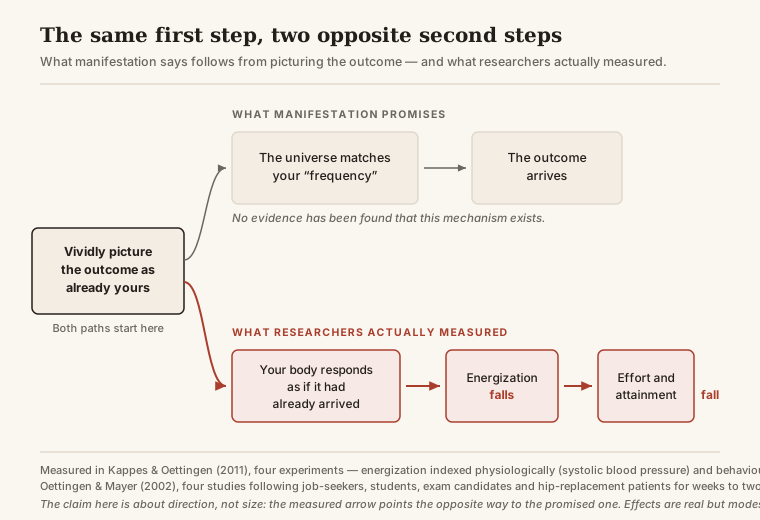
Is manifestation real? No — and the interesting part is not the missing evidence, it's the evidence that exists. Nobody has ever demonstrated that thoughts attract outcomes, and there is no mechanism by which they could. But researchers have measured what the central practice actually does to people, and the answer runs backwards: vividly picturing a desired future as already yours reliably lowered people's energy to pursue it, and predicted worse results months later, across job-seekers, students, and surgery patients. Manifestation isn't a harmless placebo that quietly does nothing. Its core technique is the one part of the process that has been measured, and it measured the wrong way.
Manifestation is the most successful idea in modern self-help, and it is worth being precise about what it claims. In the research literature, Lucas Dixon, Matthew Hornsey and Nicole Hartley define it as the belief in "the ability to cosmically attract success in life through positive self-talk, visualization, and symbolic actions." That is the whole engine: think it, picture it, act as if — and the world reorganises to deliver it.
The idea's commercial peak was The Secret, Rhonda Byrne's 2006 book and film, which has sold more than 30 million copies in 50 languages. Its modern form is smaller and more ambient: scripting, 369 journalling, vision boards, "acting as if," lucky-girl syndrome. The packaging changed. The claim didn't.
Most criticism of manifestation stops at the obvious objection — there's no evidence for it — and that objection is true but weak, because absence of evidence is the easiest thing in the world to shrug off. You can't measure everything. What's the harm in a bit of optimism? The better answer is that the harm has been measured, and the results are not what anyone selling a vision board would like.
| What manifestation implies | What the research found |
|---|---|
| Picturing the outcome pulls it toward you | Picturing the outcome as already yours lowered energization in four experiments, measured by blood pressure and by behaviour |
| Positive thinking about the future drives success | Positive expectations predicted success; positive fantasies predicted the opposite, across four populations tracked for up to two years |
| Believing harder improves your odds | Stronger manifestation believers were 1.42× more likely to have declared bankruptcy and 1.33× more likely to own crypto |
| It's harmless even if it doesn't work | If thoughts cause outcomes, illness and accident become the sufferer's fault — a flipside built into the logic, not an accident of it |
| It's grounded in quantum physics | Physicists featured in The Secret distanced themselves from its claims; the framework "has no basis in scientific reality" |
What manifestation actually claims — and why it can't be tested
The law of attraction says that like attracts like: your thoughts emit something the universe answers in kind. Byrne is explicit that the law is impersonal, that "it does not see good things or bad things." That sounds like physics. It isn't. Writing for the Committee for Skeptical Inquiry in March 2007, Benjamin Radford and Mary Carmichael put it flatly: "neither the film nor the book has any basis in scientific reality." The physicists who appear in The Secret subsequently distanced themselves from what the film did with their words.
The deeper problem is that the claim is built to survive any result. Got what you wanted? The law works. Didn't? You harboured doubt, your vibration was off, you weren't truly aligned. A claim that explains every outcome equally well forecloses the possibility of being wrong, which is another way of saying it predicts nothing at all.
That structure should be familiar if you've read our piece on the four-minute mile: the trick isn't a lie about the outcome, it's a story with the preconditions quietly deleted. So the useful question is not "can we prove the universe doesn't listen?" It's the one researchers can actually answer: what happens to a person who does this?
What happens when you measure it
In 2002, Gabriele Oettingen and Doris Mayer published a study in the Journal of Personality and Social Psychology that drew a distinction manifestation collapses. There are two different ways of thinking positively about your future, and they are not variations on a theme. They pull in opposite directions.
A positive expectation is a judgement: I think this will probably happen. A positive fantasy is an experience: I'm picturing it happening, right now, and it feels wonderful. Manifestation is entirely the second thing.
Oettingen and Mayer measured both, then waited — weeks, months, in one case two years — and checked what people had actually achieved. They did this across four unrelated populations: graduates looking for a job, students with a crush on a classmate, undergraduates facing an exam, and patients recovering from hip-replacement surgery. The pattern held every time. Positive expectations predicted high effort and successful performance. Positive fantasies predicted the reverse.
Graduates who fantasised more vividly about their ideal job sent out fewer applications and received fewer offers. Students who pictured the romance most happily were less likely to be in the relationship five months later. The relationship between fantasy and failure ran through effort: fewer applications submitted, fewer hours studied. Not cosmic punishment. Just less work done.
Note what this is not. It is not a study of manifestation believers versus sceptics, and it is not evidence that the universe punishes wishful thinkers. It is a measurement of what the fantasy itself does to the person having it.
The mechanism: your body can't tell the difference
If positive fantasy predicts worse outcomes, something has to be doing the work. In 2011, Heather Barry Kappes and Gabriele Oettingen went looking for it, in four experiments published in the Journal of Experimental Social Psychology. Their answer was energy — and they measured it in the body.
In the first experiment, 164 undergraduates were split into two groups. One was guided to fantasise positively about wearing high heels: how good they'd look, how admired they'd be. The other was directed to question whether wearing heels would really be so glamorous. The researchers took each participant's systolic blood pressure before and after — a standard physiological index of energization, because mobilising effort raises cardiovascular demand.
Blood pressure in the positive-fantasy group fell. In the questioning group, it didn't move.
Here is where the site's usual discipline applies, because this is exactly the kind of finding that gets oversold. The drop was small: about 1.7 mmHg, a modest effect by any standard, in one experiment on undergraduates thinking about shoes. If you've read our piece on what the growth-mindset research actually shows, you know the failure mode — a real but small effect inflated into a universal law. We're not making that trade in the other direction. One blood-pressure reading proves nothing on its own.
What makes it worth your attention is that it isn't on its own. The effect replicated across three further experiments using different measures: subjective feelings of energy, and, in the third study, real accomplishment. Participants who fantasised positively about their coming week reported feeling less energised immediately afterward — and, at the end of that week, reported getting less done. The drop in accomplishment was statistically traceable to the drop in energy. The fourth experiment found the effect bites hardest exactly where manifestation aims it: at a pressing, unmet need.
The authors' explanation is the most quietly devastating sentence in the literature on positive thinking. A vivid fantasy of a desired future lets you "mentally indulge" in that future now. In such fantasies, they write, people "hardly question whether a desired future can be achieved, nor do they imagine that the path to the desired future may contain obstacles, setbacks, pain, or effort." Your body responds to the imagined arrival roughly as it would to the real one: it stands down. The mind, having tasted the destination, sees no reason to fund the journey.
That is not manifestation failing to work. That is manifestation working — on you, in the wrong direction.
Who believes it, and what it costs them
The most direct evidence about manifestation as such is recent. Dixon, Hornsey and Hartley surveyed 1,023 people across three studies, published in Personality and Social Psychology Bulletin, and built the first validated instrument for measuring the belief — the Manifestation Scale. More than a third of participants endorsed manifestation beliefs.
Believers, they found, felt more successful, aspired to more, and rated their future success as more likely. They were also 1.42 times more likely to have declared bankruptcy, 1.33 times more likely to own cryptocurrency, and significantly more likely to agree that "you can get rich quick with the right advice." As lead author Lucas Dixon put it: "Although manifesters felt more confident and optimistic about achieving success, we didn't find objective proof to support the effectiveness of manifestation."
Read that carefully, because it is easy to overclaim. This is a cross-sectional survey. It cannot tell you whether manifestation belief caused the bankruptcies, or whether people who've been through financial catastrophe reach for a belief system that promises a way back. Both stories fit the data. What the study does establish is that the belief travels with a specific, expensive profile of financial risk-taking — and that the confidence it produces is not tracking any measurable improvement in results.
Notably, believers were no more likely to own ordinary stocks. The pull isn't toward investing. It's toward the lottery ticket.
The flipside that never makes the vision board
Every claim that thoughts cause outcomes carries a second claim on its back, and it is not optional. If your thinking produced your success, your thinking produced your cancer. Radford and Carmichael named it in 2007: "There's also an ugly flipside: if you have an accident or disease, it's your fault."
Byrne has not really shied away from this. Asked about people who suffer, she told Newsweek: "If we are in fear, if we're feeling in our lives that we're victims and feeling powerless, then we are on a frequency of attracting those things to us." In the same period she made a claim precise enough to be plainly false: "Food is not responsible for putting on weight. It is your thought that food is responsible for putting on weight that actually has food put on weight." The psychologist John Norcross, who has spent a career assessing self-help books on evidence, called the framework "pseudoscientific, psychospiritual babble."
The victim-blaming isn't a distortion introduced by careless followers. It's the theory's own logic applied evenly. You cannot claim the mechanism for the good outcomes and disown it for the bad ones.
What The Secret's most famous teacher went on to do
There's a reason this site treats manifestation as more than a silly idea. Among the teachers whose profile The Secret launched was James Arthur Ray, who rode the film onto Oprah and Larry King. In October 2009, at his Spiritual Warrior retreat near Sedona, three people died in a sweat lodge he was leading: Kirby Brown, 38; James Shore, 40; and Liz Neuman, 49, who died in a coma nine days later. Ray was convicted of three counts of negligent homicide.
We've written about what happened at Spiritual Warrior in detail, and the connection is worth stating carefully rather than dramatically. Nobody died because of the law of attraction. But a doctrine in which physical reality yields to sufficiently determined belief, sold by a man teaching people to push past their limits as proof of their power, is not a neutral backdrop to what happened in that lodge. The belief that mind overrides matter is not always confined to a journal.
What actually works, and why it's a smaller promise
The most useful thing about this literature is that the researcher who documented the problem also built the alternative — and it starts from the same raw material manifestation uses.
Oettingen's method is called mental contrasting with implementation intentions, popularised as WOOP: Wish, Outcome, Obstacle, Plan. You name the wish. You picture the best outcome — the same vivid image manifestation stops at. Then you do the thing manifestation never does: you turn and face the obstacle in your way, honestly. And you write an if-then plan for it. If it's 7pm and I'm tired, then I run anyway.
The contrast is the active ingredient. Holding the wished-for future against the real obstacle is what converts a pleasant daydream into a plan your body will actually fund.
In a randomised trial, Angela Duckworth, Teri Kirby, Anton Gollwitzer and Oettingen taught 77 fifth-graders — 85% of them from low-income families — either MCII or, as the control, a positive-thinking exercise in which they visualised desired outcomes and the good feelings attached. The MCII group came out ahead on report-card grades, attendance and conduct.
Be honest about the size of that: 77 children, one school, one trial, and a GPA difference of roughly two points. This is a promising result, not a law of nature, and we'd be committing the exact sin we've spent this piece describing if we sold it as one. But notice what the control condition was. In the only head-to-head here, visualising the outcome and the lovely feelings around it — manifestation's entire method, minus the metaphysics — was the thing that got beaten.
What to take from this
Manifestation is not real, but "not real" undersells the problem. A rain dance is not real, and a rain dance is harmless. Manifestation's core practice — vividly inhabiting the outcome as though it had already arrived — is the one component anyone has bothered to measure, and it measured as a mild sedative for exactly the drive you'd need to get there. The evidence isn't missing. It's pointing the other way.
The practical upshot is small, unglamorous, and free. Keep the wish; you'll need it, and the expectation that you can get there genuinely does predict success. Then stop where manifestation tells you to linger. Don't dwell in the arrival. Go and find the obstacle, name it out loud, and decide in advance what you'll do when it shows up. That is the whole difference between a fantasy and a plan, and it is the difference the research keeps finding.
If you take one thing from this: the universe was never listening, and that's the good news. Nothing is being withheld from you for having the wrong vibration. The obstacle you've been told not to look at is just an obstacle, and obstacles can be worked on.
Frequently asked questions
Is manifestation real?
There is no evidence that thoughts attract outcomes, and no known mechanism by which they could. The stronger finding is more uncomfortable than a simple absence of proof: when researchers measured what vivid positive fantasy actually does, it reduced the energy and effort people put into pursuing the goal, and predicted worse outcomes. Oettingen and Mayer (2002) followed job-seeking graduates, students with a crush, undergraduates facing an exam, and hip-replacement patients for weeks to two years, and found that the more positively people fantasised about the future, the less well they did.
Is there any scientific evidence for the law of attraction?
No. The law of attraction is not a scientific law and has never been demonstrated experimentally. Writing for the Committee for Skeptical Inquiry in 2007, Benjamin Radford and Mary Carmichael concluded that neither The Secret's film nor its book "has any basis in scientific reality." The quantum-physics language used to dress it up does not describe anything the physics actually says.
Does visualization help you achieve your goals?
It depends entirely on what you visualise. Picturing the outcome — the trophy, the offer, the finished body — is the version the research finds counterproductive. Kappes and Oettingen (2011) ran four experiments and found that inducing positive fantasies lowered energization, measured both physiologically and behaviourally. Picturing the process and the obstacles is a different act with different results.
Does believing in manifestation cause any harm?
The evidence here is correlational, not causal, so it cannot show that manifestation belief causes harm. But Dixon, Hornsey and Hartley surveyed 1,023 people and found that stronger manifestation believers were 1.42 times more likely to have declared bankruptcy, 1.33 times more likely to own cryptocurrency, and more likely to agree that you can get rich quick with the right advice. There is also a well-documented flipside: if thoughts cause outcomes, then bad outcomes are the sufferer's fault.
What actually works instead of manifestation?
The best-evidenced alternative comes from the same researcher who documented the problem. Gabriele Oettingen's mental contrasting with implementation intentions — popularised as WOOP: Wish, Outcome, Obstacle, Plan — pairs the desired outcome with the real obstacle and a specific if-then plan. In one randomised trial of 77 fifth-graders, it beat a positive-thinking control on grades, attendance and conduct. The effects are modest and the trials are small, which is precisely the point: it is a smaller, testable promise.
Sources: The motivating function of thinking about the future: expectations versus fantasies, Oettingen & Mayer, Journal of Personality and Social Psychology 83(5), 1198–1212 (2002); Positive fantasies about idealized futures sap energy, Kappes & Oettingen, Journal of Experimental Social Psychology 47(4), 719–729 (2011); "The Secret" to Success? The Psychology of Belief in Manifestation, Dixon, Hornsey & Hartley, Personality and Social Psychology Bulletin (published online 2023); Manifesting your way to bankruptcy, University of Queensland, for the Dixon quote; Secrets and Lies, Radford & Carmichael, Committee for Skeptical Inquiry (2007); 'The Secret': Does Self-Help Book Really Help?, Jerry Adler, Newsweek (2007), for the Byrne and Norcross quotes; From Fantasy to Action: Mental Contrasting with Implementation Intentions (MCII) Improves Academic Performance in Children, Duckworth, Kirby, Gollwitzer & Oettingen, Social Psychological and Personality Science 4(6), 745–753 (2013).