Positive Thinking
The 369 Method: Does It Work?
By Beyond Growth · 14 November 2026
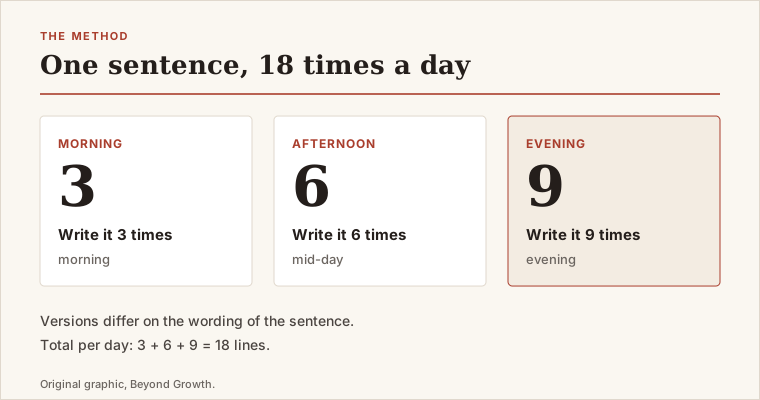
Does the 369 method work? We found no study testing the counting, so there is no evidence for the 3-6-9 pattern itself, and none for the idea that the universe responds to it. The Tesla quote that gives the method its authority has no source we could find. What is left is two ordinary activities: deciding on a specific goal, and writing. Those have some research behind them, mostly small effects, none of it about 3, 6 and 9. If the routine gets you to name what you want and act on it, that is a fair use of ten minutes. If you expect it to move the world, nothing we found supports that.
The 369 method is one of the most common forms of manifestation on social media, and it is easy to describe: you choose a sentence about something you want, write it three times in the morning, six in the afternoon and nine in the evening. Mental Floss, describing the version most often suggested, says you write down or repeat your desires "three times in the morning, six times in the afternoon, and nine times at night", and that advocates say it will "reprogram" your mind "to align with your intentions, thus drawing them towards you" (Mental Floss, May 2026).
This piece takes the three questions people actually search: what is it, did Tesla really say it, and does any of it hold up.
| The claim | What we found |
|---|---|
| Tesla said 3, 6 and 9 are the key to the universe | No primary source; historians "have not found a definitive source" |
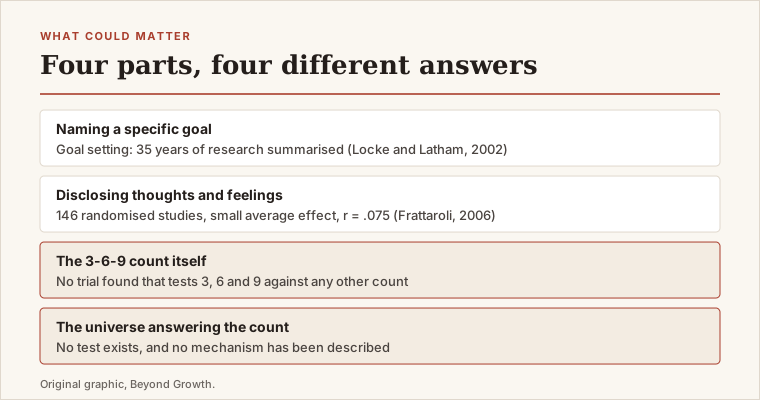
| Repeating the sentence 3, 6 and 9 times reprograms the mind | We found no study testing the count against any other |
| Written intentions draw outcomes towards you | No test and no described mechanism; what has been measured is the reverse for vivid fantasy |
| Writing things down does nothing | Not true: disclosing thoughts and feelings has a small measured effect, and goal-setting is a studied field |
Did Tesla really say 3, 6 and 9 are the key to the universe?
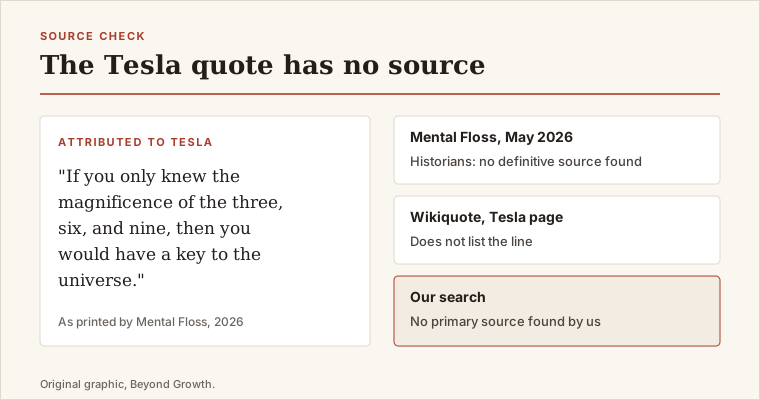
The line attributed to him reads: "If you only knew the magnificence of the three, six, and nine, then you would have a key to the universe." That is the wording Mental Floss prints, introduced with "Allegedly, he once said". The same article states plainly: "Historians have not found a definitive source for this quote."
We looked for one as well. Wikiquote's page for Tesla, which collects sourced and disputed quotations, does not contain the line (we checked the page on 14 November 2026 for the phrases "magnificence" and "key to the universe" and found neither). We found no primary source for it.
What is documented is smaller. Mental Floss reports that Tesla "would often walk around blocks three times before entering buildings", insisted on hotel rooms with numbers divisible by three, and died in room 3327 at the New Yorker Hotel. It adds that he "reportedly cited 'energy, frequency, and vibration'" as the three elements holding the key to the universe, though Wikiquote lists that line as disputed too, and notes that some writers have linked his habits to possible OCD. A man who liked threes is not a man who endorsed a writing exercise. That jump was made by internet users decades after he died, and the same article describes the method as something "co-opted by Internet users".
So the honest label on the quote is "unsourced". It might have been said. We found nothing showing that it was, and a method built on an unverifiable quotation starts without its main credential.
What is the method actually asking you to do?
Strip the Tesla and the mysticism and you have a short daily writing task with a fixed count. Three features are doing the work, if anything is:
- A specific sentence about a goal. You have to decide what you want, in words.
- Repetition across the day. You come back to it three times, with a rising number of lines.
- Handwriting or typing the words. You produce text rather than only thinking.
The count (3, 6, 9) and the story about the universe are decoration on those three. The useful question is whether the three working parts have evidence, and whether the decoration adds anything. Here is where each stands.
Does writing down a goal help?
There is a real research tradition on goals. Edwin Locke and Gary Latham's 2002 paper in American Psychologist summarises "35 years of empirical research on goal-setting theory", including "the core findings of the theory, the mechanisms by which goals operate, moderators of goal effects" and "the theory's limitations" (PubMed abstract). We are using that abstract only to show that the field exists, and that it studies goals as a tool for directing effort at work and tasks. We are not claiming from it that any particular wording or number of repetitions improves outcomes. It does not say that.
The practical reading: deciding what you are aiming at, in a sentence you can check, is a normal part of getting things done. The 369 routine happens to force that step. Whether you need 18 repetitions to do it is a separate question with no study behind it.
Does writing about your thoughts help?
The closest research to "writing every day about something that matters" is expressive writing. Joanne Frattaroli's 2006 meta-analysis in Psychological Bulletin pooled "one hundred forty-six randomized studies of experimental disclosure", where people write about personal topics. Her abstract says the results "indicate that experimental disclosure is effective, with a positive and significant average r-effect size of .075" (PubMed abstract).
Two cautions. First, .075 is a small effect, and the abstract notes "a number of moderators were identified", meaning it varies by who writes and how. Second, the research covers disclosing thoughts and feelings about personal and meaningful topics, in writing or out loud. That is not writing "I am a millionaire" eighteen times a day. The method borrows the idea of writing without being the kind of writing those studies tested.
Is there a problem with picturing the result?
This is where the method can work against itself. If your sentence is written as if the goal has already happened, "I am now earning a salary of..." The research on that style of thinking points the other way. Gabriele Oettingen and Doris Mayer's 2002 paper separated two kinds of thinking about the future. In their words, "Positive expectations (judging a desired future as likely) predicted high effort and successful performance, but the reverse was true for positive fantasies (experiencing one's thoughts and mental images about a desired future positively)". They followed graduates looking for jobs, students with a crush, undergraduates facing an exam and hip-replacement patients, with results measured "weeks or months (up to 2 years)" later (PubMed abstract).
That study did not test the 369 method, and we are not saying 369 writers do worse. We are saying the plausible reason to expect harm comes from the "already mine" framing, not the counting. Our longer piece, Is Manifestation Real?, covers this work and the alternative the same researcher proposes, which pairs the wish with the obstacle and a plan.
Should you try it anyway?
There is no harm in ten minutes of writing, and the method may suit people who like a ritual. The risks are quiet ones: spending time every day on a count that has no test behind it, treating missed repetitions as a reason the goal "did not manifest", or substituting the writing for the phone call, application or conversation that actually moves things.
If you want to keep what could be useful and drop what cannot, three changes make the routine honest:
- Write one sentence about a goal you can act on this week, not about a result you hope arrives.
- Add one line naming the likeliest obstacle and what you will do about it.
- Cut the count. One careful sentence, written once, does the same job as eighteen.
The method's own claim, that the universe answers a count, can stay where it began: an unsourced quote and a good story. For more on how this family of ideas is tested, see the positive thinking section, and our piece on the four-minute mile and the myths of positive thinking.