Social Criticism
Breakthrough with Tony Robbins: A TV Review
By Beyond Growth · 14 November 2026

One episode of television, one lasting breakthrough: that was the pitch. In July 2010 NBC put it on at 8pm on a Tuesday. This is a review of that promise, filed under social criticism because the question is about the format as much as the man. This review draws on press coverage from the time and on research about follow-up.
Did Breakthrough with Tony Robbins show that intensive coaching changes lives? No, and it could not have. A television hour records a few days of filming and a hopeful ending. It cannot show whether the change lasted, what would have happened anyway, or whether anyone without a film crew and a budget could get the same help. The research on short, intense interventions says the same thing: measure them months and years later, because a powerful experience is not a lasting result.
What did the show promise?
Breakthrough with Tony Robbins ran on NBC as a six-episode series, premiering on Tuesday 27 July 2010 (Associated Press review, via The Hollywood Reporter). HuffPost described the premiere the next morning as the first of six primetime specials (HuffPost, 28 July 2010). The series set out to apply Robbins's advice to people facing big obstacles.
The premiere followed Frank and Kristen Alioto. Their destination wedding in Puerto Vallarta in December 2008 ended hours later when Frank jumped into the pool, broke his neck and became a quadriplegic, according to the AP review. Robbins promised them, in the reviewer's quotation, "greater joy and freedom than you ever knew before". The same review lists Robbins among the show's executive producers.
None of that is a criticism of the people on screen, who agreed to be filmed at a hard moment. The question is what the format can honestly claim.
What can a TV hour show, and what can it not?
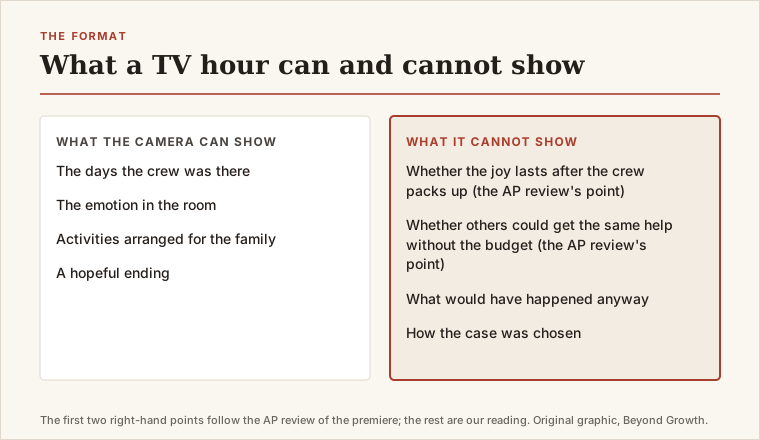
The AP's reviewer was not unkind about the television. He wrote that Robbins "delivers on his promise in one feel-good scene after another". Robbins flew the couple to his home island of Fiji for skydiving, sent Kristen to a spa, and outfitted Frank for the wheelchair sport of murderball. With help from friends, Frank also converted an old truck into a hand-controlled desert racer. The reviewer called it heartwarming to watch Frank do things he never thought he could.
Then he asked the questions the hour could not answer. His verdict on durability: "there's little here to indicate that the joy and freedom will remain after the production crew packs up". He also noted that the help would not be available to someone "who lacked a seven-figure bank account", and that practical issues, "from having children to changing catheters", were never adequately addressed. He asked whether this was "a life-altering breakthrough or a one-time Dream Factory-type experience".
Those are fair questions, and they are the whole review in miniature. A show can capture the high. It cannot film the following March.
There is a fourth limit, which is ours rather than the AP's: we are shown cases chosen to make television. A story that films well is not a typical story, and without knowing how cases were selected we cannot tell what the sample represents.
What does the evidence say about intense one-off interventions?
We found no published follow-up of the people on this show. So the fair way to judge the format is to look at what happens when other intense, emotionally powerful interventions are measured later. Two examples, neither of them about coaching, both useful as warnings.
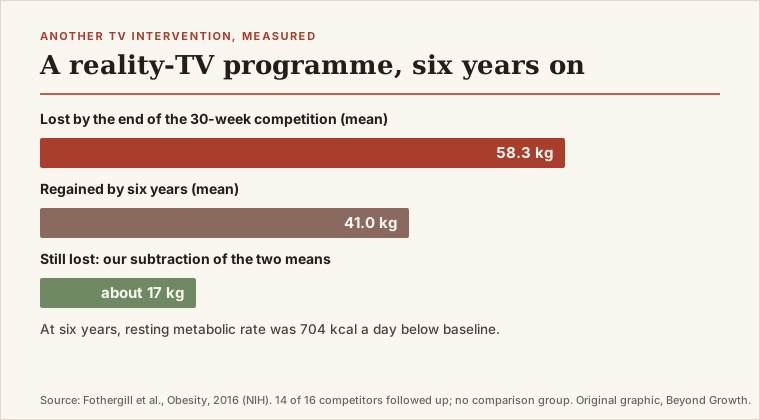
A television weight-loss contest, six years on. US government researchers followed up contestants from The Biggest Loser. Of 16 originally studied, 14 took part. They lost an average of 58.3 kg by the end of the 30-week competition, and 41.0 kg of it had come back six years later (Fothergill et al., Obesity, 2016, via PubMed). By our subtraction of the two averages, about 17 kg stayed off. Their resting metabolic rate was 704 kcal a day below baseline. There was no comparison group, and the authors describe the metabolic slowing as likely "proportional, but incomplete". The point for viewers is the shape of the result: the finale looked like a triumph, and the follow-up told a more complicated story.
A single intense session after trauma. For years, a one-session emotional "debriefing" was widely used after traumatic events on the assumption that talking it through straight away would prevent PTSD. A Cochrane systematic review of 11 randomised trials, which it described as generally of poor quality, concluded that single-session debriefing "did not reduce psychological distress nor prevent the onset of post traumatic stress disorder". One trial reported a significantly higher risk of PTSD at one year in the debriefed group (odds ratio 2.88, 95% CI 1.11 to 7.53), and the authors wrote that compulsory debriefing "should cease" (Rose et al., Cochrane Database of Systematic Reviews, via PubMed). This is a different intervention in a different population, and it says nothing direct about Robbins. What it shows is that an intervention can feel powerful, be offered with confidence, and still fail when it is finally tested.
Neither study says intensive experiences never help. They say that how it feels in the room is a weak guide to what happens afterwards.
Myth or fact: what does a transformation show tell you?
| What the format implies | What it can actually support |
|---|---|
| "This changed their life." | It shows the days of filming. Durability needs a follow-up the show does not provide. |
| "It works." | One chosen case is a story, not a result. There is no comparison with what would have happened anyway. |
| "Anyone could do this." | The AP review noted the help depended on resources most viewers lack. |
| "The emotion proves it." | Emotion is a measurement of the moment. Biggest Loser and the debriefing trials show it can precede a poor outcome. |
What should you ask of any transformation show?
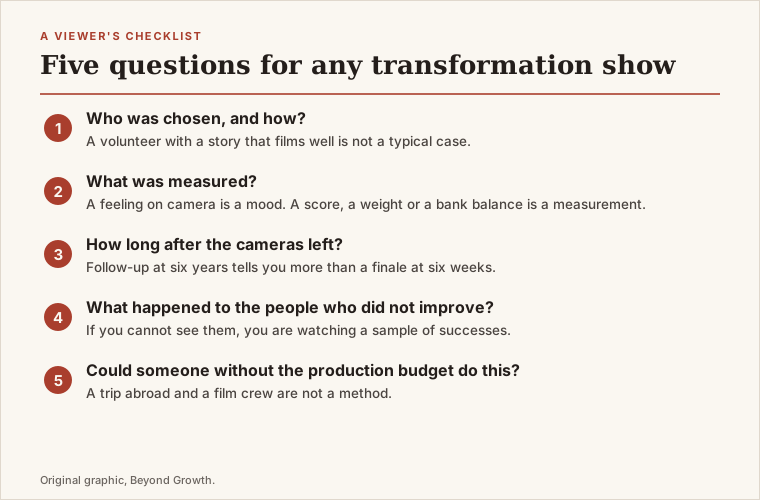
Five questions, in the order they tend to matter: who was chosen and how; what was measured, and by whom; how long after the cameras left; what happened to those who did not improve; and whether someone without the budget could do the same. A programme that can answer all five is making a claim you can weigh. One that cannot is entertainment, which is fine, as long as nobody mistakes it for a method.
The fair thing to say about Robbins's show is that it was a feel-good film about people who got a memorable stretch of attention and experiences they would not otherwise have had. The harder claim, a permanent breakthrough, was never tested on screen, and the review we have from the time said so.
Is it fair to judge a 2010 show this way?
It is, with one caution. A broadcaster is entitled to make a feel-good hour, and the people in it may well have been glad of the experience. Nothing here says they were not. What we are judging is the framing: a promise of permanence made in an hour that could only record the beginning. The same test applies to any programme, book or weekend event that sells change by showing the day it started, and it is why the first question to ask of any of them is always "and then what happened?"
Where to go next
If you want the argument about the methods rather than the format, our two-part series covers them: what Robbins teaches and whether it holds up, and how forced positivity can backfire. For another device that promises fast change and is better tested than trusted, read The Pavlok: a shockingly bad idea. More in social criticism.