Positive Thinking
Tony Robbins and the Cult of Aggressive Positivity, Part 2: How Positive Thinking Can Make You Depressed
By Beyond Growth · 24 July 2026
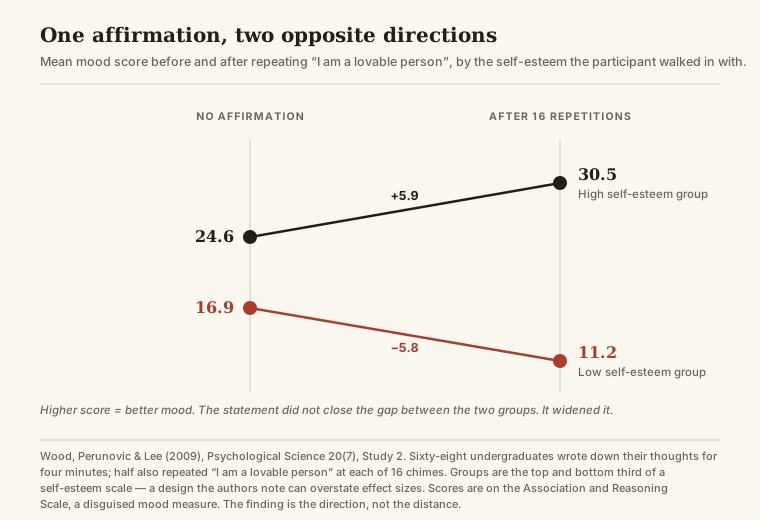
Can being told to think positively actually make you feel worse? Yes, and it has been measured. When researchers had people repeat "I am a lovable person," participants with low self-esteem came out in a worse mood than those who said nothing — while people who already felt fine got a small lift. The mechanism is unkind and specific: an instruction to feel great sets a standard, and if your actual feeling falls short of it, you now have two problems instead of one. Part one argued that aggressive positivity relocates every failure into your own head. This part is about what the research says that relocation does to you.
There is a moment nobody puts in the testimonial reel. It is about four days after the event. The room is gone, the chanting is gone, the certainty is gone, and you are back at the kitchen table with the same job, the same overdraft and the same phone call you have been avoiding. You do the thing you were taught. You change your posture, you change your focus, you say the words. And nothing happens. Worse than nothing, actually — you feel a small, cold drop, because the words are now evidence.
Part one of this series looked at what Tony Robbins teaches and whether the evidence supports it: the firewalk that is really thermodynamics, the "neuro" branding built on a discredited technique tradition, and the structural cost of a philosophy in which your state is the decisive variable. That last point was offered there as reasoned opinion. The question this piece asks is narrower and more answerable: is there actual evidence that being pushed to think positively can leave a person feeling worse?
There is. Not as much as anyone would like, and none of it is a study of Robbins events specifically. But what exists points consistently in one direction, and it has been sitting in the literature since 2009.
| What the room is told | What the research found |
|---|---|
| Say it until you believe it | Repeating "I am a lovable person" left low-self-esteem participants in a worse mood than saying nothing at all |
| Affirmations help the people who need them most | The measured harm landed on exactly that group; the benefit went to people who already felt good, and it was small |
| Negative thoughts are the enemy | Participants allowed to consider how the statement was and wasn't true came off better than those told to focus only on how it was true |
| Pressure to feel good is harmless encouragement | Across 30 days, people with elevated depression scores had more symptoms after days of feeling pressure not to feel negative |
| Optimism is the right setting for everyone | People who manage anxiety by imagining what could go wrong perform worse when made to relax or think positively instead |
| Feeling flat afterwards means you didn't commit | The gap between the promised feeling and the actual one is itself a documented mechanism of distress |
Can an affirmation actually make you feel worse?
In 2009, Joanne Wood, Elaine Perunovic and John Lee published a paper in Psychological Science with a title that gives away the ending: "Positive Self-Statements: Power for Some, Peril for Others." They began with a fair observation. Positive self-statements are everywhere, they have been since Norman Vincent Peale's The Power of Positive Thinking in 1952, and almost nobody has checked whether they work.
Their first study was a survey of 249 undergraduates, and it confirmed the practice is genuinely widespread: 52% said they used positive self-statements often, 8% said almost daily, and only 3% said never. People reported using them before exams (85%), before presentations (78%) and to cope with bad events (74%). They also, on average, believed the statements helped.
But one result in that survey is the whole essay in miniature. The higher a person's self-esteem, the more they used affirmations and the more helpful they said they were. The lower a person's self-esteem, the more likely they were to agree that affirmations "sometimes make me feel worse, rather than better." The people the technique is aimed at were quietly reporting that it misfires on them. Nobody had followed that up.
So the researchers ran the experiment. Sixty-eight undergraduates were asked to write down their thoughts and feelings for four minutes. Half of them were also told that every time they heard a doorbell sound they should repeat to themselves: I am a lovable person. The chime went every 15 seconds — 16 repetitions in all. The experimenter did not know which participants had high or low self-esteem. Afterwards, everyone completed three measures, two of them disguised so that people's beliefs about affirmations couldn't contaminate the answers.
The results are in the chart at the top of this page. On the disguised mood measure, participants with high self-esteem who repeated the phrase scored better than those who didn't — 30.5 against 24.6. Participants with low self-esteem who repeated the phrase scored worse than those who didn't: 11.2 against 16.9. The same instruction, given to two groups in the same room, moved them in opposite directions. The gap between them did not close. It roughly doubled.
The pattern held on a second measure too. Asked how much they fancied doing pleasant things — going to a party, that sort of thing, a standard proxy because low mood flattens appetite for enjoyment — the low-self-esteem group dropped after repeating the affirmation, from 39.5 to 33.2. On the third measure, how good they felt about themselves right then, the low-self-esteem group also dropped, 28.8 to 25.5.
How solid is this, really?
Here is where the site's usual discipline applies, because a piece attacking overclaiming has no business overclaiming.
This is 68 undergraduates. The authors compared the top and bottom thirds of the self-esteem distribution, and they say in their own footnote that this approach "can overestimate effect sizes." They excluded participants of East Asian descent, on the grounds that the practice is culturally Western, which means the finding is about Westerners. On that third measure — how participants felt about themselves — the overall statistical interaction missed the conventional significance threshold, landing at a p-value of about .10, and the drop in the low-self-esteem group was only marginal. The effect sizes throughout are modest, in the range you would call small-to-moderate.
So: not a law of nature. A real, replicated-within-paper, modest-sized finding, in a good journal, on a specific population.
What lifts it above a one-off is the third study in the same paper, which did something cleverer, and which is the part that matters most for anyone who has sat in a large motivational room.
The second failure
Wood and her colleagues suspected that the problem was not simply that negative thoughts creep in while you are affirming. They suspected that the real damage comes from what you conclude about yourself when you fail to keep them out.
So in Study 3 they took 116 undergraduates and gave them all the same statement — "I am a lovable person" — with two different instructions. Half were told to focus only on ways the statement was true. The other half were told to focus on ways it might be true of them and ways it might not be.
Among participants with lower self-esteem, the group given permission to consider how the statement wasn't true reported better mood and more happiness with themselves than the group told to stay positive — clearly on both of those, and marginally on a third measure of how they felt about themselves in the moment. Being allowed to think the negative thought was better than being required not to.
The authors' explanation is the sentence to take away from all of this. Repeating a positive self-statement carries an implicit standard: you are supposed to be thinking only favourable things about yourself right now. If you cannot meet that standard — if the contrary thoughts keep arriving anyway — you draw an inference from your own failure to suppress them. As the paper puts it, the person may conclude: "If I'm supposed to think about how I'm lovable and I keep thinking about how I'm not lovable, the ways in which I'm not lovable must be important. I must not be very lovable."
That is the mechanism, and it is why aggressive positivity is a specifically bad delivery system for it. The stronger and more absolute the demand to feel good, the higher the standard you are failing when you don't. A quiet suggestion to look on the bright side sets a low bar. Four days, a stadium PA, an arena of people visibly transformed and a man telling you that your state is entirely within your control sets a very high one. You are not just sad afterwards. You are sad and you have failed at the one thing you were told was completely up to you.
Wood's own summary of the whole paper is worth quoting exactly, because it is more restrained than anything a critic would write: positive self-statements "may benefit certain people, but backfire for the very people who 'need' them the most."
Does the pressure to feel happy actually predict depression?
The affirmation research is about one technique. The broader claim in this essay's title needs broader evidence, and there is a body of it now, built around a simple idea: it is not only what you feel that matters, but what you believe you are supposed to feel.
In 2012, Brock Bastian and colleagues published four studies in Emotion under the title "Feeling bad about being sad." Their finding: when people think others expect them not to feel negative emotions, they experience more negative emotion and report lower well-being. The perceived expectations of other people predicted this more consistently than a person's own standards did, and the route was specific — the pressure promoted negative self-evaluation about having the feeling in the first place. Studies 3 and 4 were experimental, which lets them speak to causation rather than just correlation. The authors' own compressed version: "when people perceive that others think they should feel happy, and not sad, this leads them to feel sad more frequently and intensely."
Five years later, Egon Dejonckheere, Bastian and colleagues took that to the population the title of this piece is about. They recruited 112 people with elevated depression scores — everyone above the clinical cut-off on the PHQ-9 screening questionnaire — and had them report, every day for 30 days, both their depressive symptoms and how much social pressure they felt not to be sad or anxious. The design lets you ask which came first. Their answer was that felt pressure predicted increases in depressive symptoms the following day, and not the reverse.
Be careful with that, because the authors are. They say plainly that "direct causal claims about this relationship cannot be made," that the design is correlational, and that something unmeasured — social isolation, lack of support — could be driving both. The sample was recruited online rather than in a clinic, which probably under-represents the most severely affected people. What the study establishes is temporal order in a group who already had symptoms, which is a necessary step towards a causal claim rather than the claim itself.
The pattern turns up at scale, too. A 2022 study in Scientific Reports surveyed 7,443 people across 40 countries and found that feeling societal pressure to be happy predicted stronger symptoms of depression, anxiety and general distress — and, strikingly, that the effect was concentrated in the happiest countries. In nations lower on the World Happiness Index the association was close to nothing. The authors are equally clear that the cross-sectional design "prohibits causal conclusions" and that the sample was largely university students. Read it as a consistency check on the others, not as proof.
And there is a neat laboratory demonstration of the same idea. In 2011, Iris Mauss and colleagues had one group of participants read a fabricated newspaper article extolling happiness — copy that could have been lifted from a seminar brochure, telling them that "the happier people can make themselves feel from moment to moment, the more likely they are to be successful, healthy, and popular." The control group read the same paragraph with "making accurate judgments" swapped in for happiness. Everyone then watched a film clip. The people primed to value happiness reacted less positively to the happy clip than the controls, and the difference ran through their disappointment at their own feelings. In a companion study of 59 women — community volunteers rather than students, average age 37 — valuing happiness more went with lower well-being and more depressive symptoms, but only among those at the lower end of the stress range. Among the most stressed, the association essentially disappeared. Which is the point: the shortfall only stings when you have every reason to feel good and don't.
The caveats are substantial and the authors list them: 59 and 69 participants, all women, all in the United States, and a mediation analysis they describe as only hinting at mechanism. This is suggestive, not settled.
Put the four together and the shape is consistent even though no single study is decisive. Being told, loudly, that you should feel great is not a neutral input. It creates a standard, and standards can be missed.
Isn't this just an argument against optimism?
No — and the cleanest way to show that is to look at who the aggressive version actually harms.
Julie Norem has spent a career on a strategy she calls defensive pessimism: setting low expectations and then thinking through, in vivid detail, everything that might go wrong. It sounds like a recipe for misery. In practice, for anxious people, it is a way of converting anxiety into a to-do list. Norem's traveller imagines the lost suitcase, and therefore packs a spare shirt in her carry-on. The catastrophising is not the end state, it is the input to a plan.
The relevant finding, in her own review of the literature, is what happens when you take that strategy away. Experiments designed to make defensive pessimists more optimistic produced worse performance. Distracting them before a task left them scoring lower, feeling less in control and more anxious, with the anxiety statistically accounting for the drop. In a study comparing three approaches — negative reflection, relaxation and distraction, and focusing only on positive outcomes — both relaxing and thinking positively produced worse results for defensive pessimists than working through what could go wrong. Even successfully cheering them up backfired: two studies found you can put defensive pessimists in a better mood, and that doing so makes their performance worse.
Norem is scrupulous about not overselling this, and the honesty is worth borrowing. Defensive pessimists report more negative emotion and more stress than optimists. She writes that on a simple tally of measured outcomes, the optimists would "win." Her argument is not that pessimism is superior. It is that these two groups are not running the same race, because one of them starts with anxiety to manage and the other doesn't.
The most interesting result in her work compares defensive pessimists not to optimists but to people who are equally anxious and don't use the strategy. Followed from their first year of university through the year after graduation, the defensive pessimists' self-esteem climbed steadily until it nearly matched the optimists'. The equally anxious group who lacked the strategy went the other way: their self-esteem fell.
So the objection to aggressive positivity is not that optimism is bad. Optimism is fine, and a genuine positive expectation — the belief that you can probably get there — predicts effort and success. The objection is to the universal prescription: one mood, sold as correct for everybody, delivered at volume, with the strong implication that anyone it doesn't work for is failing to commit.
What the seminar gets wrong that a good coach gets right
There is a version of all this that works, and it is quieter.
The distinction the research keeps landing on is between a positive expectation and a positive fantasy. Expecting that you can succeed predicts effort. Vividly inhabiting the success as though it had already arrived does the opposite — we go through that evidence in detail in our piece on whether manifestation is real, where researchers measured positive fantasy sapping the physical energy to pursue the goal. A big event is optimised for the fantasy. It is very good at making the finish line feel present in the room, and the finish line feeling present is precisely the thing that reduces the drive to go and get it.
The second thing a good coach does is refuse to delete the preconditions. That is the move we take apart in the four-minute mile piece — take a real achievement, quietly remove the years, the money, the training, the luck and the people who helped, and present what's left as a triumph of mindset. Robbins tells that exact story, with an inflated number attached to it. A method built on deleted preconditions has no choice but to explain your shortfall as a deficiency of belief, because it has removed every other candidate from the room.
And the third — the one the affirmation research points at most directly — is permission. The single most useful finding in Wood's paper is that people did better when they were allowed to hold the positive statement and its contradiction at the same time. Not "I am a lovable person." Something closer to: some people love me, I have made a mess of some of it, and I can work on the part that's mine. That is a duller sentence. It is also one you can say without lying to yourself, which is the entire reason it doesn't backfire.
If you're going anyway
Plenty of people get real value from a big motivational event, and this piece is not an argument against going. It is an argument for going with your eyes open, so here is the practical version.
Expect the drop. The come-down after a peak state is a feature of the format, not a verdict on you. Nothing in the research suggests that a person who feels flat on Tuesday committed less than the person still glowing.
Be suspicious of the second failure. If you find yourself concluding that you must be beyond help because you couldn't keep the negative thoughts out, notice what has happened: an instruction has manufactured a new failure that did not exist before you were given the instruction. That inference is the documented mechanism, not a fact about you.
Keep the parts that survive contact with reality — the decision you finally made, the habit of moving your body when you're stuck, the willingness to act before you feel ready. Those are real, they are cheap, and you did not need the metaphysics to get them.
And if the room told you that your state is the one thing standing between you and the life you want, hold that up against the evidence. For a good number of people, on the best measurements anyone has taken, being told to feel wonderful is not the cure. It is one more standard to fall short of.
Frequently asked questions
Can positive thinking make you depressed?
It can make some people feel worse, and there is measured evidence for it. In Wood, Perunovic and Lee's 2009 experiment, participants with low self-esteem who repeated "I am a lovable person" ended up in a worse mood than those who said nothing at all, while people who already had high self-esteem felt slightly better. Separately, a 30-day diary study of 112 people with elevated depression scores found that days on which they felt social pressure not to feel negative were followed by more depressive symptoms, not fewer. Neither study is about clinical depression being caused by a seminar, and both have real limits, but the direction of the evidence is consistent.
Do positive affirmations actually work?
Not reliably, and not for everyone. The best-known experiment on the practice found that repeating a global positive statement about yourself helped people who already felt good about themselves, by a small amount, and made people with low self-esteem feel measurably worse on mood, on their appetite for pleasant activities, and on how they felt about themselves in the moment. The authors' summary is that positive self-statements "may benefit certain people, but backfire for the very people who 'need' them the most."
What is toxic positivity?
It is the informal name for a social norm that treats negative feelings as unacceptable, so that having them becomes a second problem on top of whatever caused them. Research on that norm is more solid than the phrase suggests. Across four studies, Bastian and colleagues found that when people believe others expect them not to feel sad, they feel more negative emotion and report lower well-being, and the effect ran through negative self-evaluation about having the feeling at all.
Is pessimism ever better than optimism?
For some people, in some situations, yes. Julie Norem's research describes "defensive pessimism", a strategy in which anxious people set low expectations and think through in detail what could go wrong, which lets them plan around it. Experiments that pushed defensive pessimists to relax, cheer up, or think positively instead made their performance worse. Norem is careful to add that on a simple tally of outcomes, optimists still come out ahead. The point is not that pessimism is superior, it is that one prescribed mood does not fit everyone.
Is it wrong to feel bad after a motivational seminar?
No, and it is worth knowing that the design of the event makes it more likely, not less. A room engineered to produce a peak emotional state sets a very high standard for what you are supposed to feel. If your feeling falls short of it, you are left with a visible gap between how you feel and how you were told you would feel, and that gap is exactly the mechanism the research on self-discrepancy identifies as distressing. Feeling flat afterwards is a predictable response to the format, not evidence that something is wrong with you.
This is part two of a series. Part one examines the method itself — state management, the firewalk, and the science underneath the branding.
Sources: Positive self-statements: power for some, peril for others, Wood, Perunovic & Lee, Psychological Science 20(7), 860–866 (2009), read in full text; Feeling bad about being sad: the role of social expectancies in amplifying negative mood, Bastian, Kuppens, Hornsey, Park, Koval & Uchida, Emotion 12(1), 69–80 (2012); Perceiving social pressure not to feel negative predicts depressive symptoms in daily life, Dejonckheere, Bastian, Fried, Murphy & Kuppens, Depression and Anxiety 34, 836–844 (2017), full text; Perceiving societal pressure to be happy is linked to poor well-being, especially in happy nations, Dejonckheere et al., Scientific Reports 12, 1514 (2022); Can seeking happiness make people unhappy? Paradoxical effects of valuing happiness, Mauss, Tamir, Anderson & Savino, Emotion 11(4), 807–815 (2011), full text; Defensive Pessimism, Anxiety, and the Complexity of Evaluating Self-Regulation, Julie K. Norem, Social and Personality Psychology Compass 2(1), 121–134 (2008), full text, which reviews Norem & Cantor (1986), Norem & Illingworth (1993), Spencer & Norem (1996) and the longitudinal study with Andreas Burdzovic (2007).