Lifestyle Design
Lifestyle Design Sucks? The Missing Failures
By Beyond Growth · 14 November 2026
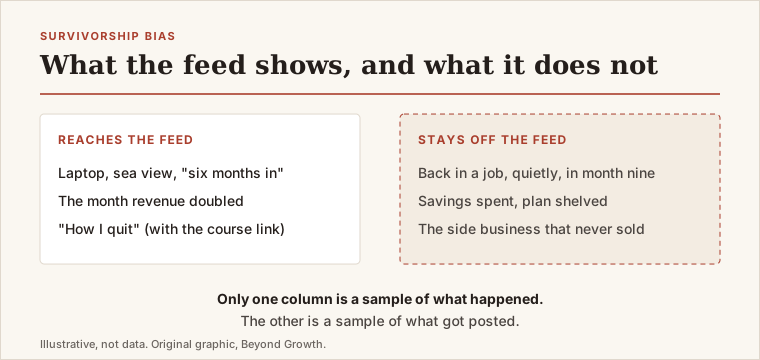
Does lifestyle design suck? The idea does not; the evidence you see for it does. The feed shows people who made it work and hides people who did not, which is survivorship bias. The honest base rate is less cheerful: in US Bureau of Labor Statistics data, 34.9% of private sector establishments opened in the year to March 2014 were still open ten years later. So test the income before you quit, keep a runway of savings, and write your exit point down in advance.
In October 2010 Eric Schiller, then writing on this site, shared an excerpt of "Lifestyle Design Sucks", a satirical reply by his friend Carlon Haas, first posted on Haas's own blog, to Schiller's "17 Steps to Instant Success as a Lifestyle Designer" and written in the voice of a failed lifestyle designer (archived copy). It was a joke. The question under the joke is a fair one, and this is our own, separate answer to it: when people try lifestyle design and it does not work, where do they go, and what does that tell you before you try?
Why does lifestyle design look easier than it is?
Because you meet it through a filter. Someone who quits, builds a business and travels has a story, an audience and a reason to post. Someone who quits, runs through their savings and takes a job in month nine has none of those. Nobody writes "How I went back to work" with a course link underneath.
None of this makes the people who succeeded fakes. Many of them did real work. The trouble is what the filter does to you, the reader. You see a sample made only of survivors and mistake it for the whole group, so the odds in your head drift upwards. That is not a flaw in the individuals. It is a flaw in the sample.
What is survivorship bias, and where did the idea come from?
The standard example is the statistician Abraham Wald, who worked in the Statistical Research Group at Columbia University during the Second World War. The popular telling goes like this: bombers came back with bullet holes in some places and not others, and Wald saw that the holes you can inspect are only on the planes that made it home. The planes that were hit elsewhere never came back to be counted.
The retellings are tidier than the record. The mathematician Bill Casselman, writing for the American Mathematical Society, says that "most of the rest of the story is--to use a charitable phrase--'plausible reconstruction'", and that for Wald's work on aircraft damage there are only two short mentions in a memoir and the memoranda Wald wrote (AMS Feature Column, "The Legend of Abraham Wald"). What the memoranda do show is the core problem. Casselman puts it plainly: "All we know about the planes that didn't return is ... that they didn't return."
That is the point for us. If you only study what came back, you will learn about the survivors and conclude something false about the odds.
What does failure in a location-independent business look like?
Rarely dramatic. A few common shapes, described here as patterns and not as statistics, because nobody keeps a count of them:
- The runway ends. Savings run out before the income arrives, and the person takes a job, often in the same field they left.
- The idea never sold. The product works and nobody pays. Friends said they loved it, which was not the same as buying it.
- The income is real but small. It covers a cheap country and nothing else. It stops being freedom the first time a visa, a flight or a health bill lands.
- The life itself does not fit. The business works, and the constant moving is exhausting or lonely. This one gets no airtime because it looks like success.

None of these are shameful. They are what happens when a reasonable bet does not pay. The shame belongs to a feed that makes them invisible.
What are the real odds for a new business?
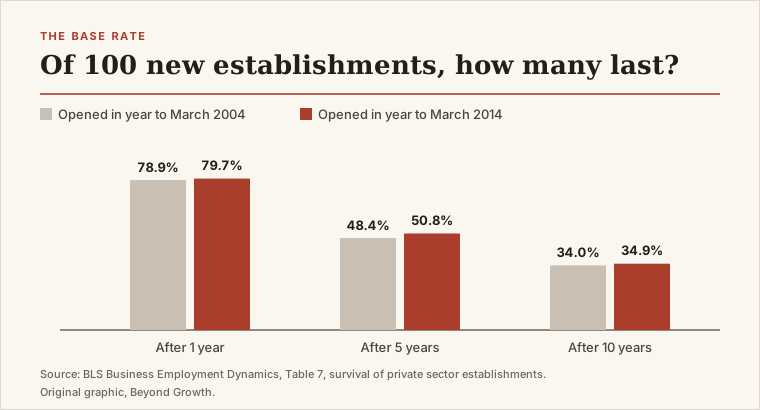
The US Bureau of Labor Statistics tracks this in its Business Employment Dynamics data. Its Table 7, "Survival of private sector establishments by opening year", follows each year's new establishments forward (BLS Table 7). Of the establishments opened in the year to March 2014, 79.7% were still open in March 2015, 50.8% in March 2019 and 34.9% in March 2024. For those opened in the year to March 2004, the figures were 78.9% after one year, 48.4% after five and 34.0% after ten.
Read that carefully, because three cautions apply.
- It is a base rate, not a verdict. It describes thousands of very different businesses. A well-run business in a good niche may do much better, and a poorly funded one much worse.
- A closing is not always a failure. BLS defines a closed establishment by employment reporting: one with positive third-month employment in the previous quarter and none in the current one. So a founder who chooses to stop and lets the staff go counts the same as a business that failed. BLS does try to link records across "a change in ownership, a firm restructuring", so most sales are not meant to show up as closings (BLS Business Employment Dynamics FAQ).
- It does not describe a solo freelancer. The data comes from employers' unemployment insurance records and, in BLS's words, excludes "establishments with zero employment" (BLS FAQ). A one-person business with nobody on the payroll is not in these tables, so the odds for a lone remote worker are unknown, not better.
What the table does give you is a sober anchor. Before you quit, assume your business has roughly even odds of lasting five years, not the near-certainty the feed implies.
Myth or fact: what the feed says against what the data says
| What the feed implies | What the evidence shows |
|---|---|
| Everyone who tries it ends up free | You see survivors; the exits are not posted |
| If it worked for them, it will work for you | A visible success is one case, not the odds |
| Quitting is the brave first step | Quitting first is when you know least and have least cover |
| Closing a business means you failed | BLS counts a closing when payroll employment drops to zero, which is not the same as failing |
| New businesses mostly last | In the BLS cohorts, about half were open at year five and about a third at year ten |
What should you do differently?
Three habits make the quiet endings above less likely, or at least cheaper. None of them is exciting.
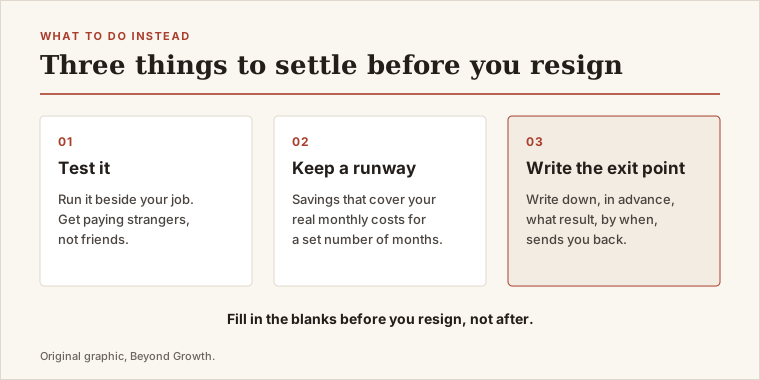
Test it before you quit. Run the idea beside your job and look for paying strangers, not supportive friends. A few real sales tell you more than months of planning, and they cost you evenings, not your income. This is the same order we argue for in the Unmanifesto: keep the job until the numbers say otherwise.
Keep a runway. Work out what your actual monthly costs are, including the boring ones, and hold savings that cover them for a number of months you choose in advance. Choose it while you are calm. The runway decides whether a slow start is a setback or a disaster.
Write the exit point down. Before you resign, put on paper what result, by what date, would send you back to employment. It sounds defeatist. It is the opposite: a written line stops you drifting, month after month, through a plan that has already told you the answer. Without one, the exit point tends to arrive on its own, at the bottom of your savings.
Is it fair to say lifestyle design sucks?
Half fair. The core idea, arranging work around the life you want and not deferring everything to retirement, is sound, and the people who try it and stop are not fools. They placed a bet that many reasonable people would place. What sucks is the way the evidence is presented: a procession of winners, a course at the end, and no denominator.
If you want to keep reading, the lifestyle design hub is the place to start. Why every lifestyle designer looks the same looks at the other half of the filter: the template that everyone who survives ends up copying. And our own take on the 17 steps is the satire version of the same point.