Technology Of The Self
Reality-Based Goal Setting, Step by Step
By Beyond Growth · 14 November 2026


How do you set a goal that fits reality? Do three things in order. First, estimate the time from how long similar attempts took, not from a best-case plan. People underestimate their own task times, and the bias shrank in one study when people linked their predictions to past experience. Second, write an if-then trigger for the first step: across 94 independent tests, implementation intentions had a medium-to-large effect on goal attainment (d = .65). Third, name the obstacle most likely to stop you. The sequence is our assembly of separate findings.
Most goal advice is about wanting harder. This is the other half: making the goal match the world you will actually be working in. It sits in our technology of the self coverage, and it is a how-to. If you want the argument about whether goals help or hurt at all, read do goals help or hurt first.
An earlier post on this site, by Duff McDuffee, also used the title "Reality-Based Goal Setting"; here is the archived copy. This is a new essay with its own method and sources.
Why do goals fail at the planning stage?
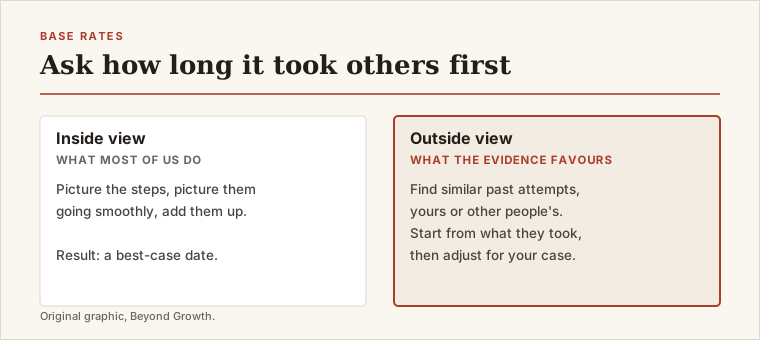
Because we plan from the best case. Buehler, Griffin and Ross tested this in 1994 and reported three results. People "underestimate their own but not others' completion times." They "focus on plan-based scenarios rather than on relevant past experiences while generating their predictions." And, in their words, "predictions of their completion times were too optimistic for a variety of academic and nonacademic tasks."
The same paper holds the fix. "In Study 4, the optimistic bias was eliminated for Ss instructed to connect relevant past experiences with their predictions." And when observers judged other people's tasks, they "overestimated others' completion times and made greater use of relevant past experiences." Watching someone else, people made the opposite error. The gap is about whose task it is.
How do you start from base rates?
Ask "how long did this take people like me?" before you ask "how long will it take me?" Bent Flyvbjerg's 2006 paper describes the method for large projects, called "reference class forecasting", which "achieves accuracy by basing forecasts on actual performance in a reference class of comparable projects and thereby bypassing both optimism bias and strategic misrepresentation."
You do not need a database for a personal goal. Three cheap versions work in the same spirit. We are applying the idea to personal goals ourselves; the studies above were on tasks and projects.
- Your own record. How long did the last three similar things take? Write the real figures down, not what you remember.
- Other people. Ask two people who have done it how long the first attempt took, and how many tries.
- A multiplier. If your own record shows you finish in about 1.5 times your estimate, plan on 1.5. That number is yours; we offer no general figure.
How big should a goal be?
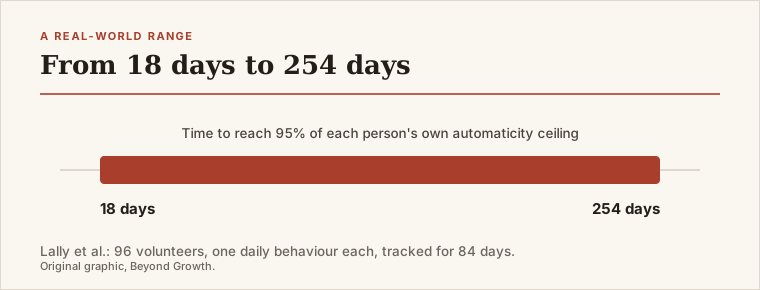
Small enough to repeat, because repetition is what builds a routine, and routines vary far more than people assume. In a study by Lally and colleagues, 96 volunteers chose an eating, drinking or activity behaviour to carry out daily in the same context, such as "after breakfast", for 12 weeks. The time to reach 95% of each person's own ceiling of automaticity "ranged from 18 to 254 days; indicating considerable variation in how long it takes people to reach their limit of automaticity and highlighting that it can take a very long time."
Two readings follow, and both are cautions. A plan that says "this will feel natural in 21 days" has no support in this study. And since the study lasted 84 days, the figures come from fitted curves, and the model fitted for only 62 of the 82 people with enough data, and fitted well for 39. There was one encouraging finding: "Missing one opportunity to perform the behaviour did not materially affect the habit formation process." A single missed day is not a reset.
What is an if-then plan, and does it work?
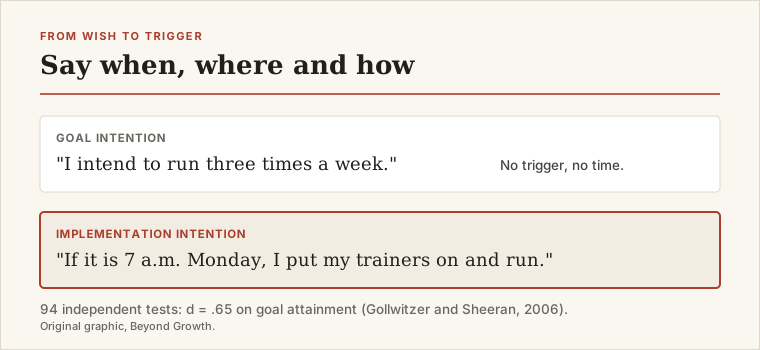
It is the single best-supported tool in this essay. Peter Gollwitzer and Paschal Sheeran's 2006 meta-analysis begins from a plain problem: "Holding a strong goal intention ('I intend to reach Z!') does not guarantee goal achievement, because people may fail to deal effectively with self-regulatory problems during goal striving."
Their remedy is an implementation intention that "spells out the when, where, and how of goal striving in advance ('If situation Y is encountered, then I will initiate goal-directed behavior X!')." The result: "Findings from 94 independent tests showed that implementation intentions had a positive effect of medium-to-large magnitude (d = .65) on goal attainment." The abstract says the plans helped with "the initiation of goal striving, the shielding of ongoing goal pursuit from unwanted influences, disengagement from failing courses of action, and conservation of capability for future goal striving."
There is a neat link with the planning fallacy. Koole and van't Spijker (2000) asked participants to complete an assignment in a set period; half added where-and-when plans. The plans led to "more optimistic completion predictions" and "an even greater increase in actual rates of goal completion", so that the "optimistic bias in completion predictions" shrank. The authors tie the effect to "a smaller number of interruptions while working on the assignment." In plain terms, the plans narrowed the gap between forecast and result.
One limit applies. This was a single study with an assignment task, so it does not show the same size of effect for life goals.
What does the method look like in practice?
Here it is as five steps. The sequence is ours; each step cites its own evidence above.
- Write the goal as an outcome you could check. "Run three times a week for 12 weeks."
- Estimate from base rates. Use your record or other people's, then add your multiplier. If it will take 1.5 times as long as your hunch, put that date on the calendar.
- Shrink the first repeat. Choose a size you could do on a bad day, such as ten minutes in your trainers. Treat any extra as a bonus.
- Write one if-then trigger. "If it is 7 a.m. Monday, I put my trainers on and run." Pick a cue you already meet daily, and say where and when.
- Name the obstacle and add a second if-then. "If it is raining, then I run the stairs in the car park." Obstacle planning is the second half of the method in our piece on whether vision boards work, which covers the research on mental contrasting combined with if-then plans (a 2021 meta-analysis of 21 studies found a small to medium effect on goal attainment, g = 0.336, and said publication bias may make the true effect smaller).
Then review on a fixed date. If you missed it by a wide margin, update your multiplier and keep the goal; the base rate has just become more accurate. That adjustment is our suggestion, not a studied step.
Myth versus fact
| Common belief | What we can support |
|---|---|
| A strong enough intention gets it done | A goal intention "does not guarantee goal achievement" (Gollwitzer and Sheeran, 2006) |
| I know how long my own tasks take | People underestimate their own times but not others' (Buehler et al., 1994) |
| Habits take 21 days | In one study the range was 18 to 254 days (Lally et al.) |
| A missed day ruins the habit | One missed opportunity did not materially affect formation (Lally et al.) |
| If-then plans are a small trick | 94 tests, d = .65, medium-to-large, on goal attainment (Gollwitzer and Sheeran, 2006) |
So how do you set a goal that fits reality?
Estimate from what has happened to people like you, make the first repeat small, and decide in advance when and where you will start. Then expect the date to move and plan for the obstacle. None of this makes the goal less ambitious. It stops the plan from depending on a best case that the research suggests most of us overrate.
More in technology of the self. Related: Do goals help or hurt?, Do vision boards work? and The 4-minute mile and the myths of positive thinking.
Sources: Gollwitzer and Sheeran, doi:10.1016/S0065-2601(06)38002-1, Advances in Experimental Social Psychology 38, 2006; Buehler, Griffin and Ross, doi:10.1037/0022-3514.67.3.366, J Pers Soc Psychol 67(3), 1994; Koole and van't Spijker, European Journal of Social Psychology, 2000, Eur J Soc Psychol 30, 2000; Flyvbjerg, doi:10.1177/875697280603700302, Project Management Journal 37, 2006; Lally, van Jaarsveld, Potts and Wardle, doi:10.1002/ejsp.674, Eur J Soc Psychol 40, 2010; Wang, Wang and Gai, PubMed 34054628, Front Psychol 12, 2021.