Personal Development
Do Goals Help or Hurt? The Evidence
By Beyond Growth · 14 November 2026


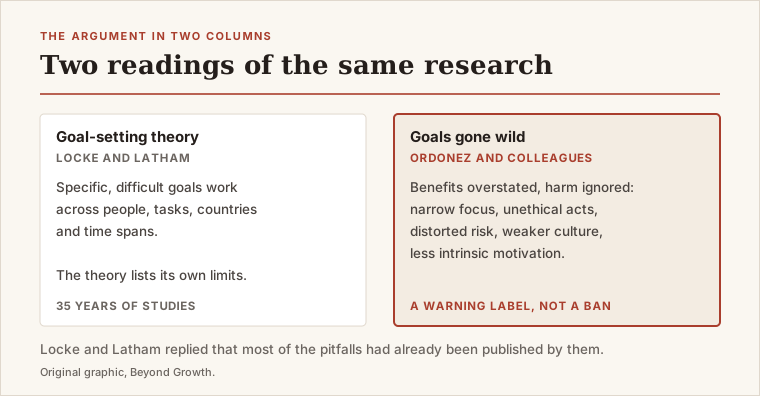
Do goals help or hurt? Both, depending on the goal and the task. Two research camps argued this in print in 2009. Goal-setting theory, summarised by Edwin Locke and Gary Latham, finds that specific, difficult goals are effective across people, tasks, countries and time spans. The "Goals Gone Wild" critique by Lisa Ordóñez and colleagues argues the benefits are overstated and the side effects ignored. Studies on both sides agree on the practical point: a goal is a strong tool, so choose it for the job. Learn on new tasks, guard what a single number can corrupt, and expect a near miss to tempt you.
Most advice in personal development says to set a big goal and write it down. A smaller set of critics says goals are a trap. Both are quoting real research. This essay reads each side's own words and sets out where they meet. It does not tell you to drop goals, and it does not tell you to chase every number you can think of. For the method that follows from the evidence, see our companion piece on reality-based goal setting.
An earlier post on this site, by Duff McDuffee, also asked whether goals help or hinder; here is the archived copy. This is a new essay with a different angle, not a rewrite of it.
What does the case for goals say?
It rests on a long programme of experiments. In 2002 Locke and Latham published a review in American Psychologist titled "Building a practically useful theory of goal setting and task motivation. A 35-year odyssey." Its abstract says the authors "summarize 35 years of empirical research", describe "moderators of goal effects" and explain "the theory's limitations."
A shorter 2006 summary in Current Directions in Psychological Science is more specific. It reviews "the effectiveness of specific, difficult goals" and "the generality of goal effects across people, tasks, countries, time spans, experimental designs, goal sources (i.e., self-set, set jointly with others, or assigned), and dependent variables."
One study shows the core idea at small scale. Winters and Latham (1996) gave 114 business students a scheduling task. On a simple version, "an outcome goal led to significantly more correct schedules being produced than urging people to do their best." That is the textbook result: a clear number beats "try your best".
Two cautions belong here. First, these are mostly work and lab tasks with a measurable output. Second, even the theory's own authors flag moderators and limits, so "goals work" is a claim with conditions attached.
What does the "goals gone wild" critique say?
In 2009 Lisa Ordóñez, Maurice Schweitzer, Adam Galinsky and Max Bazerman published "Goals Gone Wild: The Systematic Side Effects of Overprescribing Goal Setting" in Academy of Management Perspectives. The authors' own abstract (the version posted on SSRN) opens by granting the other side's case: "setting specific, challenging goals can powerfully drive behavior and boost performance."
Then it turns. "In this article, we argue that the beneficial effects of goal setting have been overstated and that systematic harm caused by goal setting has been largely ignored." The side effects it lists are "a narrow focus that neglects non-goal areas, a rise in unethical behavior, distorted risk preferences, corrosion of organizational culture, and reduced intrinsic motivation."
Their proposal is a dosage rule, not a ban: managers should treat goal setting as "a prescription-strength medication that requires careful dosing, consideration of harmful side effects, and close supervision." They add "a warning label."
When do goals actually backfire?
Three findings, from three kinds of evidence, are worth knowing.
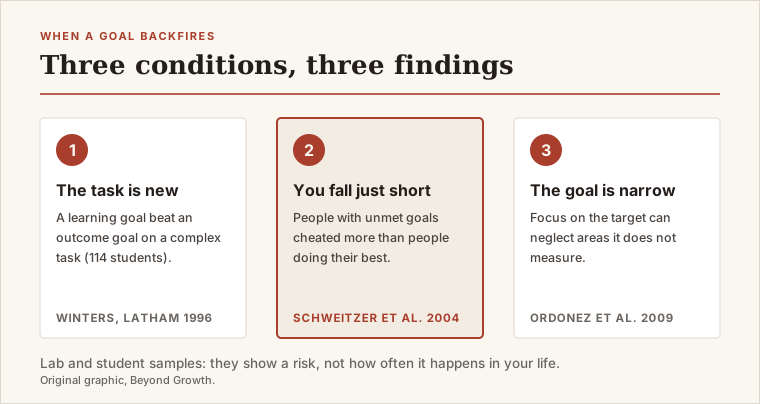
When the task is new and complex. In the same 1996 study, a second scheduling task was complex. There, "assigning a learning goal led to performance that was significantly higher than either an assigned outcome goal or being urged to do one's best." The authors' advice: "when attempting new complex processes, such as acquiring new businesses, organizations should set specific difficult learning as opposed to performance outcome goals." A learning goal is a goal about finding out how, such as "test three approaches", rather than hitting a result.
When you fall just short. Schweitzer, Ordóñez and Douma (2004) ran a laboratory experiment. They "found that people with unmet goals were more likely to engage in unethical behavior than people attempting to do their best", both with and without economic incentives, and "the relationship between goal setting and unethical behavior was particularly strong when people fell just short of reaching their goals." In plain terms, a near miss was when the temptation was strongest.
When the goal is narrow. The 2009 paper's list includes "a narrow focus that neglects non-goal areas." The authors' abstract does not say how large that effect is, so treat it as a flagged risk and not a measured size.
Did the critics get it right?
Locke and Latham answered in the same journal. Their rejoinder, "Has Goal Setting Gone Wild, or Have Its Attackers Abandoned Good Scholarship?", says the critics "chose to draw their central theme from anecdotal evidence" and used "unrepresentative citations from the literature." It adds that almost all the pitfalls the critics cite "have already been published", by Locke and Latham themselves.
Ordóñez and colleagues replied in turn. Their abstract reiterates "our original claim that goal setting, like a potent medication, can produce both beneficial effects and systematic, negative outcomes", and says it "should be carefully prescribed and closely monitored."
Read side by side, the two camps disagree about emphasis and about the quality of evidence, not about whether goals can ever backfire. Locke and Latham accept that the pitfalls exist. The critics accept that goals can raise performance. The live question is how often the downsides bite outside the settings studied. We found no study that answers that for everyday life goals.
What should you do with this?
Treat it as a decision, not a creed. Three questions follow from the findings above. They are our reading of the studies, not a tested method.
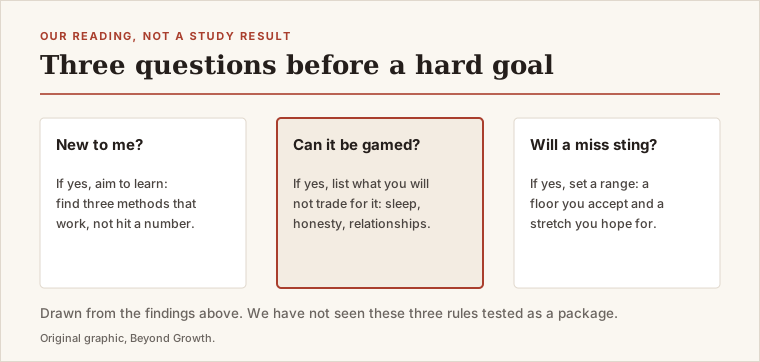
- Is the task new to you? Then a learning goal fits the 1996 result better than a target number.
- Can one number be gamed? Then write down what you will not trade for it. This answers the "narrow focus" and unethical-behaviour risks.
- Would a near miss tempt you to cut a corner? Then set a floor you accept and a stretch you hope for, so that "just short" does not feel like failure.
If your goal is a familiar, measurable task, a specific hard target is what the strongest evidence supports. If you want a way to turn a goal into action, the research on "if-then" plans is next; our piece on reality-based goal setting covers it. For the narrower claim that picturing success is enough, see does a vision board work.
Myth versus fact
| Common belief | What we can support |
|---|---|
| Goals always raise performance | Specific, difficult goals are effective across many settings, with stated limits (Locke and Latham, 2002 and 2006) |
| Goals are a trap | Critics list real side effects, but argue for careful dosing, not abandonment (Ordóñez et al., 2009) |
| Hard targets help on any task | On a complex new task a learning goal beat an outcome goal (Winters and Latham, 1996, 114 students) |
| Missing a goal just motivates you | Falling just short was linked to more unethical behaviour in one lab study (Schweitzer et al., 2004) |
| The experts settled it | The two camps still disagree on emphasis and evidence quality (2009 papers) |
So should you set goals?
Yes, with a purpose. A goal tells you what to do next, and the evidence says that is useful. The question is which goal, for which task, and what you refuse to sacrifice on the way. Pick a learning goal for something new, guard the things a single number cannot see, and plan for the near miss before it arrives.
More in personal development. Related: Reality-based goal setting, Do vision boards work?, Is manifestation real? and Get a growth mindset.
Sources: Locke and Latham, PubMed 12237980, Am Psychol 57(9), 2002; Locke and Latham, doi:10.1111/j.1467-8721.2006.00449.x, Curr Dir Psychol Sci, 2006; Winters and Latham, doi:10.1177/1059601196212007, Group and Organization Management, 1996; Schweitzer, Ordóñez and Douma, doi:10.2307/20159591, Academy of Management Journal, 2004; Ordóñez, Schweitzer, Galinsky and Bazerman, abstract on SSRN and doi:10.5465/amp.2009.37007999, Academy of Management Perspectives, 2009; Locke and Latham, doi:10.5465/amp.2009.37008000, 2009; Ordóñez et al. reply, doi:10.2139/ssrn.1382000, 2009.