Guru Criticism
James Arthur Ray After Prison: Buyer Checks
By Beyond Growth · 14 November 2026
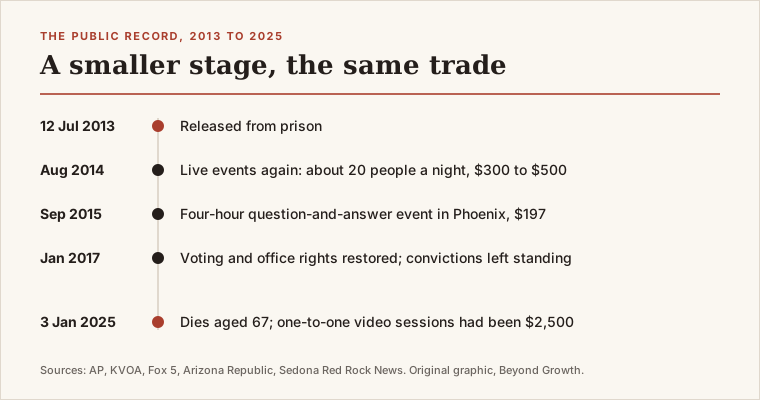
Where is James Arthur Ray now? He died on 3 January 2025, aged 67. After his release on 12 July 2013 from a two-year sentence for three counts of negligent homicide, he went back to running paid events and, later, online coaching. In 2017 a judge restored his voting rights but refused to set his convictions aside. His story leaves a question that outlasts him: should a teacher's past follow them, and what can a buyer check before paying for something intense?
People searching for "James Arthur Ray now" often expect a comeback story. The record is more modest than that, and it ends sooner than they think. This page covers what is documented, then turns to the useful question for anyone who might attend an event like his. It belongs to our guru criticism section. The courtroom story is in the Ray trial explained, and the event itself is in our account of the sweat lodge deaths.
Where is James Arthur Ray now?
He died on 3 January 2025. The Associated Press reported that his family announced on X that he died "suddenly and unexpectedly" and did not give a cause. The Sedona Red Rock News gives 3 January as the date. He was 67.
Until then, the AP said, he was active in the self-help industry: he posted advice videos with his wife, Bersabeh Ray, co-hosted a podcast called Modern Alchemy, and kept a website where he offered one-on-one video sessions of up to 90 minutes for $2,500. The AP quoted his brother, Jon Ray, saying that Ray's passion in life was always to make others' lives better and more fulfilled. The same report carried a statement from Kirby Brown's sister, Jean, that Ray was one of many operators in an industry "built on the exploitation of those who would improve their lives and find fulfillment."
How did James Arthur Ray come back after prison?
Slowly, and on a much smaller stage.
Release, July 2013. NBC reported that he was paroled after serving 85 percent of his two-year sentence, and that nothing in his conditions of release would prevent him from holding self-help seminars. His brother said at the time that Ray had no intention of moving back into public seminars.
August 2014. KVOA in Tucson reported that, 13 months after his release, Ray was holding live presentations again, including in Scottsdale. About 20 people attended each night at a private residence, with tickets of $300 to $500, in a format he called "The Conversation". Asked whether he would hold sweat lodge ceremonies again, he answered: "Absolutely not." He said all civil suits against him and his company had been settled. At his peak, the same report noted, he had sold out arenas of 17,000 seats.
September 2015. Fox 5 in San Diego reported a four-hour question-and-answer event in a Phoenix ballroom at $197. A former member of his inner circle told the station she did not trust him.
January 2017. At a hearing in Camp Verde, Judge Michael Bluff restored Ray's right to vote, hold public office and serve on a jury but refused to set the convictions aside. The Arizona Republic reported him saying, "My work was never on trial," and arguing that the convictions had prevented him from international travel. The judge said he was "just not comfortable that enough time has passed." Relatives of the three who died asked him to leave the convictions in place; Kirby Brown's father said that "the elephant is money." Ray said afterwards: "The conviction is negligence."

| The common claim | What the record says |
|---|---|
| He did his time and vanished | He ran paid live events from 2014 and was coaching online until his death |
| His convictions were wiped | In 2017 a judge restored his civil rights but refused to set them aside |
| He went back to sweat lodges | In 2014 he said "Absolutely not"; the reports we read mention no later ceremony |
| He is still teaching | He died on 3 January 2025 |
Should a guru's past follow them?
There are two honest answers, and both have evidence behind them.
The case for letting it go is real. Ray served his sentence. A judge restored his civil rights. He took, in the words reported at sentencing, full responsibility for the pain to the families, and he said he would not run a sweat lodge again. The reports we read mention no injuries at his later events, which were talks and conversations rather than endurance rituals.
The case for keeping it in view is real too. The families told the court in 2017 that Ray had never fully accepted responsibility, and worried a set-aside would let him portray himself as an innocent bystander, according to the Republic. Ray, for his part, stressed that his conviction was for negligence.
Our view is a narrow one. A served sentence settles what a person owes the law. It does not answer the question a buyer is asking, which is whether this event is safe for them. The most useful rule is to weigh each kind of past for what it can actually tell you.
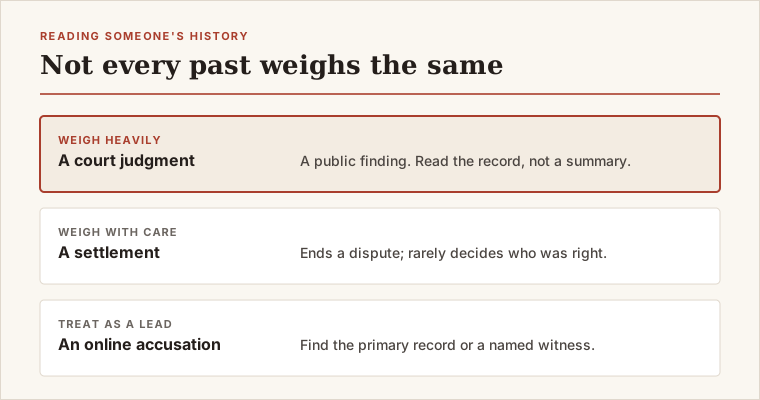
A conviction is a public finding and deserves the most weight. A settlement ends an argument and rarely settles who was right. An accusation online is a reason to look, not a verdict. Fairness runs both ways: a past is information about risk, not a sentence that never ends.
What can a buyer check before a high-intensity event?
You do not need to be a lawyer. Most of this is free and takes an evening. SEEK Safely, the non-profit founded by Kirby Brown's family, publishes a list of red flags that supplies much of what follows.
- Search the organiser's name with "court", "lawsuit", "convicted" and "arrested". Ray's case was widely reported; a record like that is findable in minutes.
- Ask for the medical and safety plan in writing. SEEK's list flags a physical challenge with no information about medical support in case of an accident.
- Read the waiver before you pay. The same list flags being asked to sign one without time to read it, being told it is standard, and being discouraged from asking questions.
- Ask who can stop the event, and whether you may leave at any point. SEEK flags a locked door or strong discouragement from leaving the room. Ray's recorded pitch was about pushing through.
- Ask in writing about the physical demands: fasting, lost sleep, heat, cold, breathing work. At Ray's retreat participants had been encouraged to fast for 36 hours before the ceremony. SEEK also flags very short breaks that leave no time to eat, drink or use the toilet.
- Check the refund and cancellation terms. SEEK flags a no-refund or very limited policy on purchases made at the event.
- Notice the sales pressure. SEEK flags constant reminders about further products, and "scarcity" claims such as only a few places left.
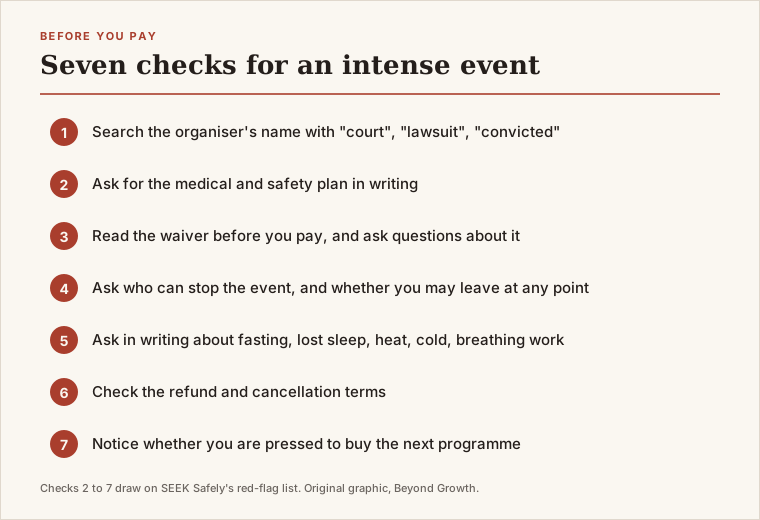
No checklist makes a dangerous event safe. What it does is slow you down at the point where a persuasive person is speeding you up, and a good organiser will answer every question above without irritation. If a question gets you a sneer, a "trust the process", or talk of your resistance, that is useful information too.
For more in the same spirit, see is manifestation real?, the Tony Robbins and aggressive positivity essay, and the rest of our guru criticism writing.