Guru Criticism
James Arthur Ray on Trial: Verdict Explained
By Beyond Growth · 14 November 2026
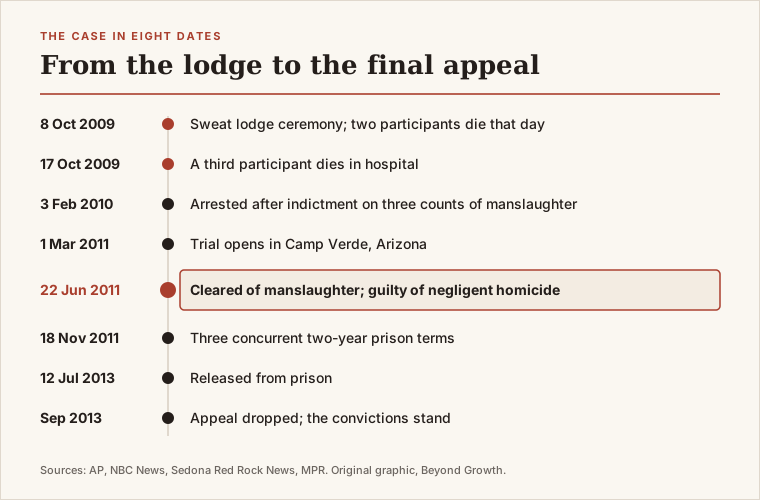
What happened at the James Arthur Ray trial? An Arizona jury found him guilty of three counts of negligent homicide on 22 June 2011, after a four-month trial, and cleared him of the three manslaughter charges he was indicted on. On 18 November 2011 a judge gave him three concurrent two-year prison terms. He was released on 12 July 2013, and his appeal was dropped that September. The trial is a rare public test of what an organiser owes people who pay to be pushed.
Three people died after a sweat lodge ceremony that closed Ray's "Spiritual Warrior" retreat near Sedona, Arizona, in October 2009. That page tells the story of the ceremony. This one is about the courtroom: what he was charged with, what the jury decided, what the judge said, and what any of it means if you ever pay to be put through something hard. It sits in our guru criticism section.
What was James Arthur Ray charged with?
Manslaughter, three counts. Ray was arrested on 3 February 2010 after an indictment, according to the Sedona Red Rock News, one count for each of Kirby Brown, 38, James Shore, 40, and Liz Neuman, 49. Brown and Shore died on 8 October 2009. Neuman died on 17 October, after more than a week in hospital. The Associated Press reported that more than 50 people took part in the ceremony and 18 were hospitalised.
The trial was meant to start in August 2010. Pretrial motions pushed it to 1 March 2011, in Camp Verde, Yavapai County, and it ran for about four months.
How did the trial unfold?
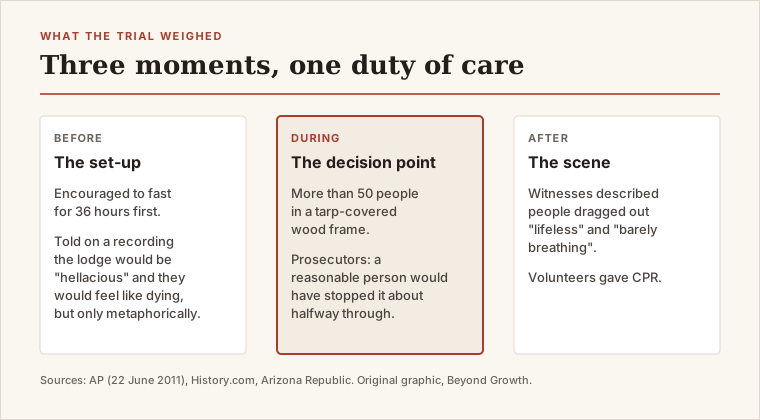
The state's case was that Ray knew the risks and ignored them. Sedona Red Rock News reports that prosecutors called 34 witnesses to show that he failed to provide adequate safety measures and ignored participants who were clearly in distress. The AP reported that they relied heavily on Ray's own words. A recording played in court had him telling participants the lodge would be "hellacious" and that they were guaranteed to feel like they were dying, but only metaphorically. On the recording he also said: "You will have to get a point to where you surrender and it's OK to die." Prosecutors argued that a reasonable person would have stopped the "abomination of a sweat lodge" when people began showing signs of distress about halfway through.
Ray's lawyers said it was a tragic accident. They argued he took the necessary precautions, that investigators botched the inquiry, and that toxins may have played a part, and they called two witnesses to support that. History.com's account adds that the defence said participants were free to leave at any time.
What was the verdict, and why not manslaughter?
The jury's verdict came on Wednesday 22 June 2011. Jurors had started deliberating the day before. They found Ray guilty of three counts of negligent homicide, and the manslaughter charges did not stick.
The gap between the two charges is a single idea: awareness. In the Arizona statutes, manslaughter includes "recklessly causing the death of another person". The definitions section says recklessly means a person "is aware of and consciously disregards a substantial and unjustifiable risk". Negligent homicide is causing a death "with criminal negligence", which the definitions section describes as failing "to perceive a substantial and unjustifiable risk", where that failure is "a gross deviation from the standard of care that a reasonable person would observe in the situation". (We quote the current text of the statutes.)
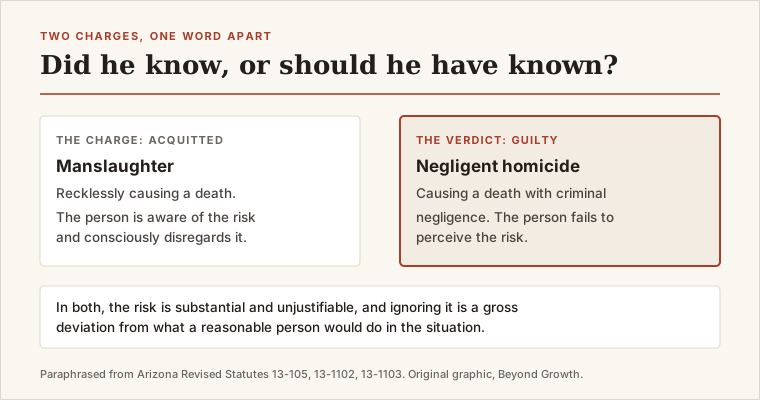
So the jury did not find that Ray knowingly ignored a risk to life. It did find, on all three counts, that he caused the deaths and that his failure to see the risk was far below what a reasonable person would have done. Juries return verdicts, not reasons, so nobody outside the room can say how each juror got there.
| The common claim | What the record says |
|---|---|
| Ray was convicted of manslaughter or murder | He was cleared of manslaughter and convicted of negligent homicide |
| Two people died | Three did: Neuman died on 17 October 2009 |
| The jury accepted it was a freak accident | The defence said accident; the jury convicted on all three counts |
| He walked free | He was sentenced to two years in prison |
What sentence did James Arthur Ray get?
On Friday 18 November 2011 Judge Warren R. Darrow sentenced Ray to three two-year terms, running concurrently, so two years in all. He ordered $57,514.12 in restitution to the families and a $20,000 fine, plus a surcharge.
The judge's reasoning is worth reading. Darrow said "there is a factor of deterrence that is very prominent in this case" and that "when a person has your incredible abilities to gain peoples' trust there is a lot of responsibilities that go along with it." He found probation was not warranted: "A prison sentence is just mandated."
Ray began serving on 22 November 2011 and was placed on parole on 12 July 2013, according to Arizona Department of Corrections records quoted by the Arizona Republic. A relative of one of the victims, quoted by CBS, put the time behind bars at about 600 days. At sentencing, CBS reported, Ray said he would have stopped the ceremony had he known people were dying or in distress, and took full responsibility for the pain to the families.
What did the trial show about duty of care?
A verdict is not a seminar on ethics, but four points follow from what was said in court. The first and last are our reading, not a legal finding.
1. The pitch became the evidence. Prosecutors leaned on Ray's own recorded words. What an organiser tells people in advance shows what they expected to happen. "It will feel like you are dying" is a harder sentence to defend afterwards than it is to say on a stage.
2. "You were free to leave" is not a safety plan. The defence made that argument and the jury still convicted on all three counts. In an event built so that quitting feels like failure, a theoretical right to leave is not protection. Participants had been encouraged to fast for 36 hours first, and had paid up to $10,000.
3. The standard is the reasonable person, not the believer. The statute asks what a reasonable person would have done in the situation. Sincere belief in the method is not the test. The judge's remark about trust says the same thing from the other side: the more trust you ask people to place in you, the more you owe them.
4. Safety is planned before the event. The state's case included that Ray did not provide adequate safety measures. Medical cover, the ability to stop, and a named person with authority to halt things are decisions made before anyone walks in, not mid-ceremony.
What happened after the verdict?
Ray appealed, then stopped. In September 2013 the Arizona Court of Appeals granted his request to drop the challenge and dismissed a cross-appeal. He said he wanted to avoid the possibility of a retrial and resentencing, and he maintained the convictions were flawed; the Attorney General's Office disputed that. The convictions therefore stand.
Kirby Brown's family went on to found SEEK Safely, a non-profit that campaigns for accountability in the self-help industry. What Ray did next is its own story, which we cover in what happened to James Arthur Ray after prison.
If you are weighing a high-intensity event yourself, read that piece for the practical checklist. For more on this kind of teacher, see the rest of our guru criticism writing, the Tony Robbins and aggressive positivity essay, and is manifestation real?